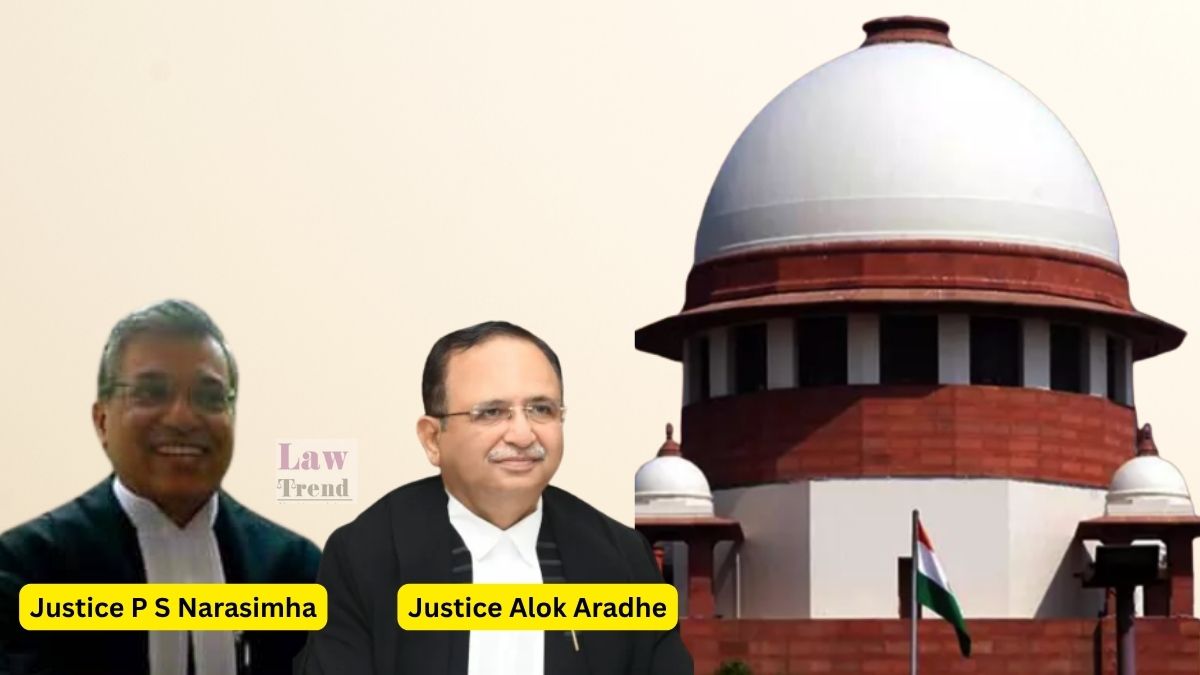
The Supreme Court of India, comprising a bench of Justice Pamidighantam Sri Narasimha and Justice Alok Aradhe, has ruled that the regulatory power of the Reserve Bank of India (RBI) to supersede the Board of Directors of a multi-State co-operative bank under Section 36AAA of the Banking Regulation Act, 1949 is neither restricted by the six-month ceiling under Article 243ZL(1) of the Constitution nor constrained by the expiration of the directors’ original elected tenure. Delivering the judgment, the Court dismissed the appeals filed by former directors of Abhyudaya Co-operative Bank Limited, upholding the High Court of Judicature at Bombay’s decision that confirmed the RBI’s supersession orders and the appointment of an Administrator.
Background of the Case
Abhyudaya Co-operative Bank Limited, originally established in 1960 under the Maharashtra Co-operative Societies Act, was converted into a bank in 1965 and subsequently declared a Scheduled Bank under Section 42(6)(a) of the Reserve Bank of India Act, 1934 in 1988. Following amalgamations under Section 45 of the Banking Regulation Act with banks in Gujarat and Karnataka, it attained the status of a multi-State co-operative bank.
In May 2019, the appellants were elected to the Bank’s Board of Directors for a statutory five-year term. On November 24, 2023, the RBI exercised its powers under Section 36AAA(1) and (2) read with Section 56 of the Banking Regulation Act to supersede the Board for one year and appointed Mr. Satya Prakash Pathak as Administrator. The RBI’s order cited three grounds:
- The financial health of the Bank had deteriorated to a dangerous level;
- Supersession was necessary to protect the interest of depositors and save the Bank from collapse; and
- The affairs of the Bank required professional management to restore financial stability.
The ousted directors challenged the action before the Bombay High Court. During the pendency of the writ petitions, their original five-year elected term expired on May 24, 2024. Subsequently, on November 18, 2024, the RBI extended the supersession for an additional year. On the same day, the High Court dismissed the petitions, holding that Section 36AAA of the Banking Regulation Act is not rendered otiose by Articles 243ZL and 243ZT of the Constitution, that prior consultation with the State Government does not apply to multi-State co-operative banks, and that principles of natural justice cannot be read into Section 36AAA.
The appellants approached the Supreme Court against this dismissal. During the pendency of the civil appeals, the RBI issued a third order on November 7, 2025, extending the supersession for yet another year with effect from November 24, 2025.
Submissions of the Parties
Appearing for the appellants, Senior Counsel Devadatt Kamat contended that supersession under Section 36AAA(1) cannot extend beyond the elected tenure of the Board. He argued that once the appellants’ term expired on May 24, 2024, no Board remained in existence to be superseded, rendering subsequent extension orders legally unsustainable. Relying on decisions including Union of India v. Rajendra N. Shah, the appellants argued that successive supersessions violate the constitutional mandate under Part IXB (Articles 243ZL and 243ZT) and that elections ought to have been conducted immediately under Article 243ZL(2). They added that the proviso to Section 36AAA(1) required mandatory consultation, which was omitted, and argued that the Constitution Bench ruling in Pandurang Ganapati Chaugule v. Vishwasrao Patil Murgud Sahakari Bank Ltd. was distinguishable as it dealt with the SARFAESI Act.
Opposing the plea, Senior Counsel Jaideep Gupta, appearing for the RBI, submitted that Section 36AAA(7) mandates the Administrator to convene a general meeting to elect new directors only on or before the expiration of the supersession period specified by the RBI, demonstrating that the Board’s original tenure has no bearing on regulatory supersession. He maintained that the RBI is authorized to extend supersession up to an aggregate period of five years. He further argued that the third proviso to Article 243ZL(1) explicitly carves out co-operative societies carrying on banking business by making the Banking Regulation Act applicable, while Article 243ZT applies exclusively to State legislation and not Central banking laws enacted under Entry 45 of List I.
Counsel Ninad Laud, appearing for respondent no. 5, supported the RBI’s position, arguing that the Constitution (Ninety-Seventh Amendment) Act, 2011 explicitly preserved the application of the Banking Regulation Act to banking societies through the third proviso to Article 243ZL(1). He submitted that the interpretation of this proviso stood settled by the Constitution Bench in Pandurang Ganapati Chaugule.
The Court’s Analysis
The Supreme Court formulated two primary questions: whether the RBI’s supersession power under Section 36AAA(1) is circumscribed by the six-month limit in Article 243ZL(1), and whether supersession can be extended beyond the Board’s original term of office.
Examining the architecture of Article 243ZL, the Court observed that while the substantive clause prescribes a general six-month cap on supersession, the third proviso specifies that the provisions of the Banking Regulation Act “shall also apply” to societies carrying on banking business. Applying the doctrine of incorporation by reference, Justice Aradhe noted that the phrase “shall also apply” operates in an additive sense, incorporating the provisions of the Banking Regulation Act—including Section 36AAA—into Part IXB for multi-State co-operative banks as an independent substantive provision.
The bench highlighted the textual design of the fourth proviso to Article 243ZL(1), which extends supersession up to one year for banking co-operative societies while expressly excluding multi-State co-operative societies from that specific clause. Analyzing this structural carve-out, the Court observed:
“An exclusion, by its very nature, presupposes a prior inclusion; Parliament does not exclude from a proviso what could never have fallen within it in the first place.”
Emphasizing the vital public interest underlying banking regulation, the Court stated:
“Banking, unlike ordinary commercial or co-operative activity, is impressed with a public interest of a distinct order: it is the medium through which the savings of depositors, frequently persons of modest means, who repose in the banking system both their trust and their life earnings, are held and deployed.”
The bench warned against adopting an interpretation that would hinder banking oversight:
“To read the third proviso to Article 243ZL(1) as excluding multi-State co-operative banks from the reach of the BR Act and thereby confining the RBI’s regulatory hand to a rigid six-month period, ill-suited to the time genuinely required to nurse a distressed bank back to health, would be to subordinate the protection of depositors and the discipline of the banking system to a truncated and overly technical reading of a constitutional proviso.”
The Court further held:
“We are, therefore, of the considered view that the construction which subserves the object of protecting depositors and preserving financial discipline in the banking system must be preferred over one which would fragment regulatory authority and expose multi-State co-operative banks to a supervisory vacuum upon the expiry of an artificially truncated period.”
Addressing the second issue, the bench ruled that under Section 36AAA(1), the RBI may extend supersession from time to time up to a total aggregate period of five years. Relying on Section 36AAA(7), the Court held that the Administrator is required to call a general meeting for elections only upon the expiration of the supersession period determined by the RBI. Consequently, the expiry of the erstwhile directors’ statutory five-year term does not impede or invalidate the extension of supersession, provided it remains within the five-year aggregate statutory ceiling.
Finally, the Court rejected the appellants’ argument regarding lack of prior consultation under the proviso to Section 36AAA(1), clarifying that statutory consultation is strictly confined to banks registered with the Registrar of Co-operative Societies of a State and does not apply to multi-State co-operative banks.
The Decision
Finding no legal infirmity in the Bombay High Court’s judgment, the Supreme Court affirmed the RBI’s orders and dismissed both appeals with no order as to costs.
Case Title: Sandeep S. Ghandat & Ors. v. Reserve Bank of India & Ors.
Case No.: Civil Appeal Nos. 5351-5352 of 2025
Bench: Justice Pamidighantam Sri Narasimha and Justice Alok Aradhe
Date: September 03, 2026