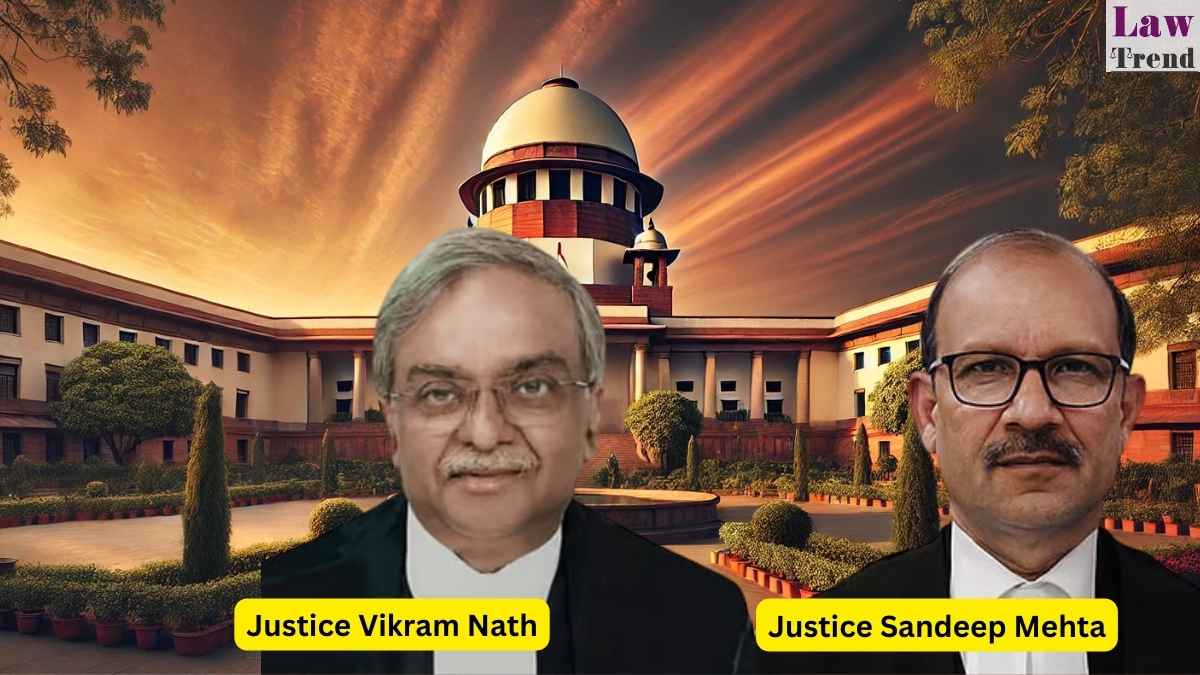
The Supreme Court of India has set aside the concurrent convictions of three individuals in a 1977 murder case, ruling that the unexplained delay in transmitting the First Information Report (FIR) to the jurisdictional Magistrate, combined with serious doubts over the presence of the alleged eyewitnesses, entitles the accused to the benefit of doubt. A division bench comprising Justice Vikram Nath and Justice Sandeep Mehta observed that these critical gaps, along with investigative lapses such as leaving the dead body unattended overnight, eroded the very foundation of the prosecution’s case.
Background of the Case
The case dates back to the intervening night of June 27 and 28, 1977, when an attempted theft was reported at the house of the complainant, Raghav Ram (PW-1), in village Lalemau Pure Pundit, Uttar Pradesh. After handing over the apprehended suspect to the Colonelganj Police Station on the morning of June 28, Raghav Ram and Ram Nath (PW-2) visited a nearby cattle fair. There, they met Nand Lal Singh (PW-4), Babu Ram, and the deceased-victim, Harihar Saran.
According to the prosecution, while the group was returning on foot at around 4:30 p.m., six accused individuals—armed with weapons including a ‘kanta’ (a sharp-edged weapon), a ‘ballam’ (spear), and ‘lathis’ (wooden staffs)—emerged from an ambush under a bael tree near Kanchanpur village. The assailants allegedly shouted slogans to attack and chased the victims. While others managed to flee, Harihar Saran, who was slowed down by his bicycle, was cornered and brutally assaulted. The attackers then fled, leaving behind two bicycles.
Raghav Ram dictated a written complaint at the crime scene, which was scribed by Ram Nath and presented at the Colonelganj Police Station around 7:00 p.m. that evening. Based on this, an FIR was registered under Sections 147, 148, 149, and 302 of the Indian Penal Code, 1860 (IPC).
The trial court (III Additional Sessions Judge, Gonda) convicted the accused-appellants in June 1981, sentencing them to rigorous imprisonment and life imprisonment. The High Court of Judicature at Allahabad, Lucknow Bench, subsequently dismissed their appeal in November 2011, affirming the convictions. Three of the original co-accused (Ram Dhani, Raj Kishore, and Deo Prasad) passed away during the pendency of the legal proceedings, leading to the abatement of their respective appeals. The surviving appellants—Hira Lal, Raj Bux, and Subedar—challenged the High Court’s ruling before the Supreme Court.
Arguments of the Parties
The counsel representing the accused-appellants challenged the convictions on several grounds. It was argued that the incident did not occur in broad daylight as alleged, but rather late at night, and that the FIR was registered ex-post facto after the police investigation had already concluded. The defense pointed out that the deceased’s body remained exposed at the spot throughout the night, which was unnatural conduct for close relatives and inconsistent with standard police procedures, given that the police station was located just three and a half miles away.
Furthermore, the defense pointed to deep-rooted political and electoral rivalries between the families of the accused and the deceased as a strong motive for false implication. They also argued that the medical evidence contradicted the eye-witness testimonies, noting that the post-mortem conducted on June 30 indicated the death could have occurred up to two and a half days prior. Lastly, they raised a plea of juvenility for one of the appellants, Subedar, who was a minor at the time of the incident.
The counsel for the State of Uttar Pradesh, Mr. Namit Saxena, defended the concurrent findings of the lower courts. He argued that the eye-witness accounts of Raghav Ram, Ram Nath, and Nand Lal Singh were consistent, natural, and directly implicated the appellants. The State contended that the medical evidence, which revealed 17 ante-mortem injuries on the victim, corroborated the use of blunt and sharp weapons as described by the witnesses. Additionally, the recovery of two bicycles from the spot was presented as a key circumstance establishing the presence of the accused at the crime scene.
The Court’s Analysis
In reviewing the evidence, the Supreme Court identified several glaring anomalies that undermined the prosecution’s narrative. First, the bench observed that the dead body was left unattended at the roadside throughout the night of June 28, 1977. The Court found it inexplicable that neither the family members nor the police took immediate steps to secure or transport the body, despite the proximity of the police station.
Second, the Court highlighted the unexplained 48-hour delay in conducting the post-mortem examination, which was delayed until the afternoon of June 30. Third, the Court identified a serious contradiction regarding the lodging of the FIR: the complainant claimed that only Ram Nath accompanied him to the police station, whereas the station’s General Diary recorded that he arrived with the deceased’s father-in-law and brother.
Most critically, the Supreme Court discovered that the FIR, despite its purported registration on June 28, 1977, was received by the jurisdictional Magistrate only on June 30, 1977.
To evaluate the impact of this delay, the Court examined key judicial precedents:
- Pala Singh v. State of Punjab (1972): The Court noted that under Section 157 of the Code of Criminal Procedure, 1973 (CrPC), sending the report “forthwith” to the Magistrate is designed to keep the judiciary informed and prevent investigative taint.
- Jafarudheen v. State of Kerala (2022): The Court reiterated that the prompt transmission of the FIR is a vital safeguard to prevent the introduction of a colored, exaggerated, or concocted story resulting from deliberation and consultation.
Applying these principles, the Supreme Court observed that the delayed transmission did not stand in isolation but was accompanied by other suspicious factors. The Court noted:
“These circumstances are, by themselves, sufficiently clinching to establish that the prosecution version of the occurrence having taken place on 28th June, 1977 was a subsequent fabrication devised to lend credibility to the prosecution case and to support the cooked-up story that Raghav Ram (PW-1), Ram Nath (PW-2) and Nand Lal Singh (PW-4) had actually witnessed the incident.”
The Court concluded that it was highly probable that the attack occurred during the darkness of the night when no witnesses were present, and that the body was discovered only the next morning, after which the prosecution tailored its story to implicate the appellants. The Court remarked:
“Once a reasonable doubt arises regarding the presence of the alleged eye-witnesses and the truthfulness of the prosecution version regarding the genesis and timing of the occurrence, the very substratum of the prosecution case stands eroded.”
Regarding the recovered bicycles, the Court dismissed the prosecution’s claims as “wholly flimsy,” noting a total lack of independent evidence linking the bicycles to any specific accused individual.
The Decision
As an upshot of its findings, the Supreme Court held that the prosecution had failed to establish the guilt of the accused-appellants beyond a reasonable doubt. The bench set aside the June 1981 judgment of the trial court and the November 2011 judgment of the High Court.
The surviving accused-appellants—Hira Lal, Raj Bux, and Subedar—were acquitted of all charges. The Court discharged the bail bonds of Raj Bux and Subedar, and noted that no further directions were required for Hira Lal, who had already been released under a remission scheme. Given the acquittal on merits, the Court declined to examine the plea of juvenility raised on behalf of Subedar.
Case Details
Case Title: Deo Prasad and Anr. v. State of Uttar Pradesh (with connected matters)
Case No.: Criminal Appeal No. 239 of 2013 (with Criminal Appeal Nos. 237, 238, and 236 of 2013)
Bench: Justice Vikram Nath, Justice Sandeep Mehta
Date: July 15, 2026