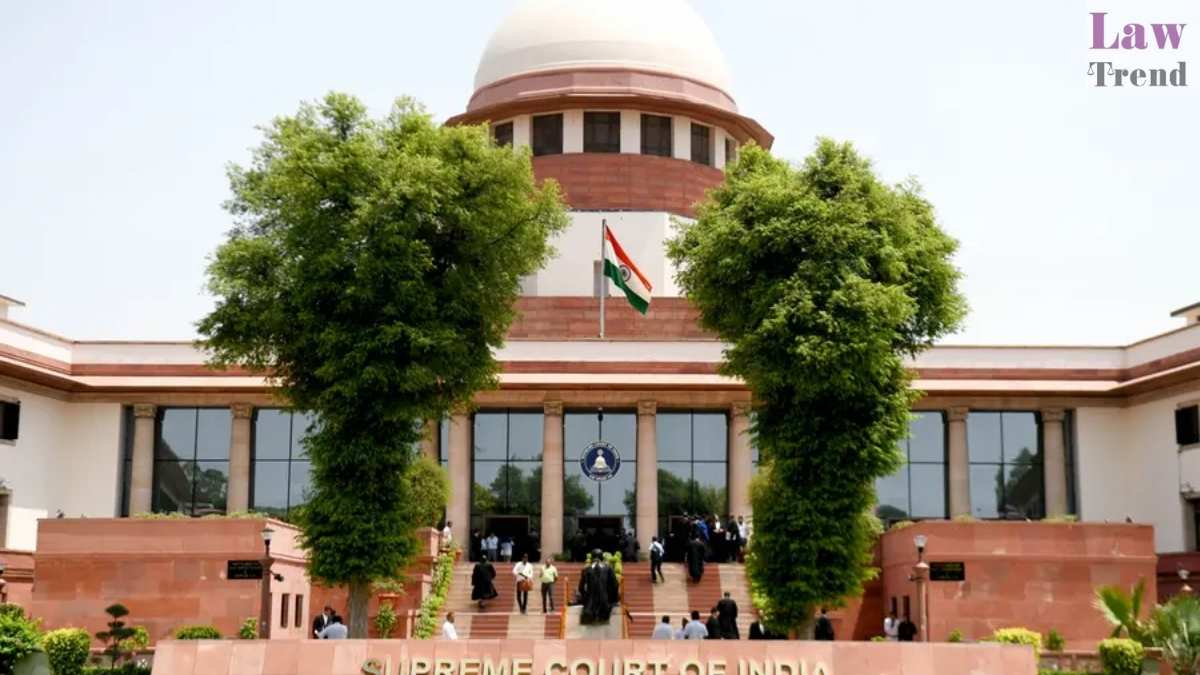
The Supreme Court of India has ruled that a First Appellate Court cannot overturn a trial court’s decision through a cryptic, unreasoned order. A bench comprising Justice Sanjay Karol and Justice Vipul M. Pancholi emphasized that recording clear and cogent reasons is fundamental to the administration of justice. With this observation, the Court set aside a Kerala High Court judgment that had summarily reversed a trial court’s decree in a partition dispute. The Supreme Court also strongly condemned and expunged the High Court’s disparaging remarks directing the trial court judge to undergo training, reiterating the necessity of judicial restraint and independence.
Background of the Case
The dispute arose over the estate of Thankam, who died on August 27, 2011. Following her death, one of her daughters (the plaintiff-appellant) filed a suit for partition. In response, the other siblings (the defendant-respondents) claimed that Thankam had executed a registered Will dated March 22, 1999, bequeathing the property exclusively to them.
The Principal Sub Court at Thrissur, in its judgment on February 18, 2019, held that the defendants failed to prove the execution of the Will in accordance with Section 63 of the Indian Succession Act, 1925. The trial court highlighted several suspicious circumstances: the sole examined attesting witness (DW2) did not sufficiently prove that the execution was witnessed by him and the other attesting witness; the testatrix was illiterate, and there was no evidence that the Will’s contents were read over to her; and no explanation was offered for why the second attesting witness was not examined. Consequently, the trial court passed a preliminary decree dividing the property into 10 shares, awarding the plaintiff a 2/10th share.
The defendants appealed to the High Court of Kerala. In a brief judgment of just two paragraphs, the High Court set aside the trial court’s decree and dismissed the partition suit. The High Court characterized the trial court’s reasoning as being based on “extraneous considerations” and concluded that the trial court did not understand the controversy. Furthermore, the High Court directed that the Principal Sub Judge be sent for training due to the “seriousness of the laches.” Aggrieved by this decision, the plaintiff approached the Supreme Court.
Arguments of the Parties
Before the Supreme Court, the scope of the appeal was narrowed down to two primary aspects:
- The manner in which the High Court of Kerala dealt with the first appeal.
- Whether the disparaging remarks and training directives issued against the Principal Sub Judge of Thrissur were legally justified.
The appellant contended that the High Court failed to exercise its statutory duty under Section 96 and Order 41 Rule 31 of the Code of Civil Procedure (CPC), 1908, which requires a detailed reappraisal of evidence and a reasoned determination. Conversely, the respondents maintained that the registration of the Will and the testimony of the attesting witness were sufficient to prove its validity, asserting that the High Court’s reversal of the trial court’s “erroneous” findings was correct.
The Court’s Analysis
The Supreme Court examined the legal framework governing the powers of a First Appellate Court. Under Section 96 of the CPC, the first appeal is a valuable right, and the court is the final court of fact and law. Referring to Order 41 Rule 31 of the CPC, the Supreme Court listed the essential requirements for an appellate judgment, which must state the points for determination, the decision, the reasons for the decision, and the relief.
The Court emphasized that while an appellate court agreeing with a trial court may express general agreement, a court reversing a judgment must rigorously analyze the trial court’s evidence and provide detailed, independent reasoning. The bench observed that the Kerala High Court’s judgment fell short of these established legal principles, as it failed to frame points for determination or provide reasoned findings to demonstrate how the trial court had erred in law.
The Necessity of Reasoned Judgments
The Supreme Court underscored that reasons are the lifeblood of judicial decision-making. Citing the case of Raj Kishore Jha v. State of Bihar, the Court noted that:
“non-reasoned conclusions by appellate courts are not appropriate, more so, when views of the lower court are differed from. In case of concurrence, the need to again repeat reasons may not be there. It is not so in case of reversal. Reason is the heartbeat of every conclusion. Without the same, it becomes lifeless.”
Similarly, referencing CCT v. Shukla & Bros., the Court observed:
“Reason is the very life of law. When the reason of a law once ceases, the law itself generally ceases (Wharton’s Law Lexicon). Such is the significance of reasoning in any rule of law.”
The Court also highlighted the principles formulated in Kranti Associates (P) Ltd. v. Masood Ahmed Khan, which establish that reasons are indispensable for judicial accountability, transparency, and sustaining a litigant’s faith in the justice system.
Legal Requirements for Proving a Will
Addressing the merits of the dispute, the Supreme Court outlined the strict legal requirements to establish the genuineness of a Will under Sections 59 and 63 of the Indian Succession Act, 1925, and Sections 67 and 68 of the Indian Evidence Act, 1872. The Court noted that since proving a Will occurs after the testator’s demise, a high level of sanctity is attached to the process.
The Court reiterated the foundational test established in landmark rulings like H. Venkatachala Iyengar v. B.N. Thimmajamma and Meena Pradhan v. Kamla Pradhan, which requires the propounder to satisfy the court on several counts: whether the testator signed the Will, whether they understood its nature and effect, and whether they signed it of their own volition. The bench ruled that the High Court was legally bound to discuss these aspects and explain how the trial court’s concerns regarding the testatrix’s illiteracy and the lack of communication of the Will’s contents were “extraneous.”
Condemnation of Disparaging Remarks Against Trial Judges
The Supreme Court expressed strong disapproval of the High Court’s direction to send the Principal Sub Judge for training. Reaffirming the landmark ruling in State of U.P. v. Mohd. Naim, the Court held that judicial pronouncements must maintain sobriety, moderation, and reserve. The bench quoted the cardinal principle from Mohd. Naim:
“the proper freedom and independence of Judges and Magistrates must be maintained and they must be allowed to perform their functions freely and fearlessly and without undue interference by anybody, even by this Court. At the same time it is equally necessary that in expressing their opinions Judges and Magistrates must be guided by considerations of justice, fair play and restraint.”
The Court also referred to State of Punjab v. Shikha Trading Co. and S.K. Viswambaran v. E. Koyakunju, cautioning that passing adverse remarks lightly can jeopardize the independence of judicial officers. It observed that the attitude of appellate courts toward lower courts should not be punitive:
“The attitude to be adopted by appellate Courts should be that of a friend, philosopher and a guide rather than wielding the heavy-handed baton of superior authority pointing out errors committed by its underlings.”
Decision of the Court
Concluding that the Kerala High Court’s judgment lacked proper judicial application of mind and failed to fulfill the statutory requirements of a first appeal, the Supreme Court allowed the appeal.
The Supreme Court set aside the High Court’s judgment and order dated November 30, 2022, in its entirety. The bench also expunged and set aside the directive concerning the training of the trial judge. The first appeal (RFA No. 298 of 2019) has been restored to the file of the High Court of Kerala to be heard afresh on all contentions. No order was made as to costs.
Case Details:
Case Title: Lakshmi Versus Gopi & Ors.
Case No.: Civil Appeal No. …. of 2026 (Arising out of Special Leave Petition (Civil) No. 9510 of 2023)
Bench: Justice Sanjay Karol and Justice Vipul M. Pancholi
Date: July 15, 2026