

Compliance With SEBI Regulations Is Non-Negotiable; Investor Profit No Defence to Regulatory Breach: Supreme Court
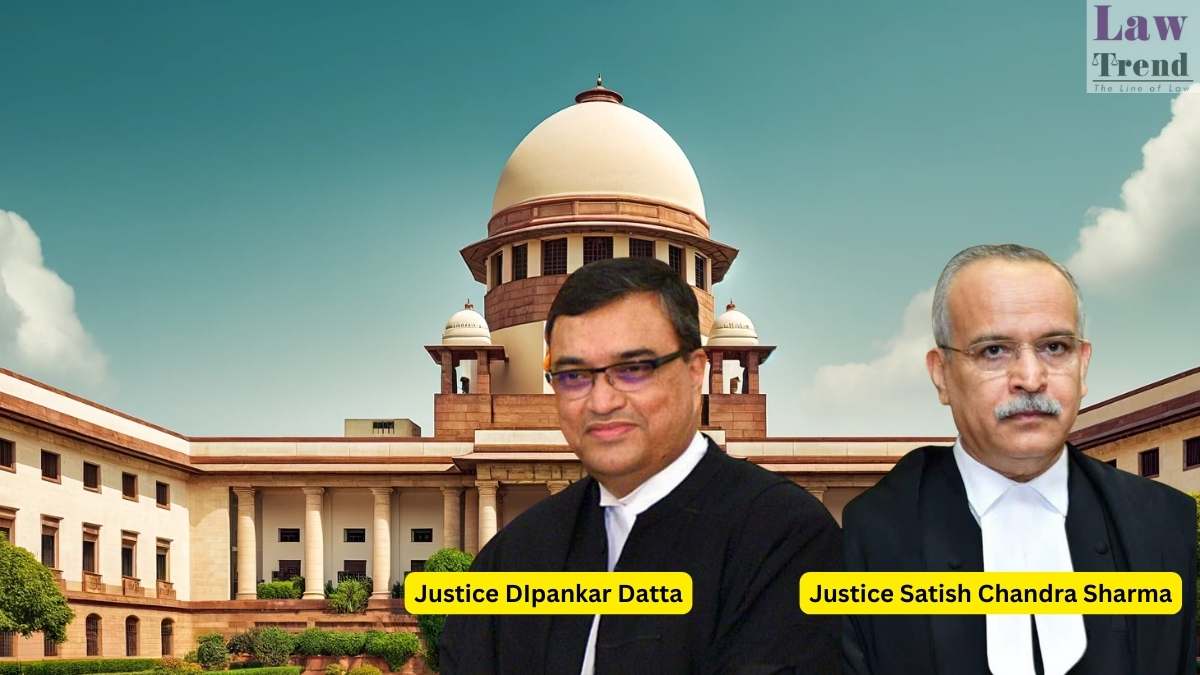

In a significant ruling reinforcing the absolute nature of financial regulations, the Supreme Court of India has dismissed the appeals filed by Kotak Mahindra Asset Management Company Limited (Kotak AMC), Kotak Mahindra Trustee Company Limited (Kotak Trustee), and their senior executives, declaring that the regulatory regime governing mutual funds is strictly consequence-neutral. The division bench comprising Justice Dipankar Datta and Justice Satish Chandra Sharma upheld the concurrent findings of the Securities and Exchange Board of India (SEBI) and the Securities Appellate Tribunal (SAT) regarding serious violations of the SEBI (Mutual Funds) Regulations, 1996. The central legal issue before the Apex Court was whether a mutual fund can be held in breach of statutory regulations for restructuring and extending maturity dates of close-ended schemes without a formal rollover, even if the decision was taken in good faith to protect unitholders and ultimately resulted in no financial loss.

Background of the Case

The dispute traces back to six close-ended Fixed Maturity Plan (FMP) schemes launched by Kotak Mahindra Mutual Fund (Kotak MF) between 2013 and 2016, which were scheduled to mature in or around April and May 2019. Under the 1996 Regulations, close-ended schemes must be wound up and fully redeemed at the end of their maturity period unless they are formally rolled over.

Kotak AMC had invested Rs. 266 crore out of the FMPs’ total pool of Rs. 1,625 crore in Zero Coupon Non-Convertible Debentures (ZCNCDs) issued by Konti Infrapower & Multiventures Private Limited and Edison Utility Works Private Limited, both of which were part of the Essel Group. These investments were secured by a pledge of shares in Zee Entertainment Enterprises Limited (ZEEL) held by Cyquator Media Services Private Limited, which was required to maintain a security cover of 1.5 times the exposure.

In late 2018, ZEEL announced plans to divest part of its holdings, triggering a sharp decline in its share price. Consequently, the collateral security cover dropped below the 1.5-times threshold. Despite notices sent on January 25, 2019, by the debenture trustee, the issuers failed to provide additional shares or cash to restore the collateral cover. During a meeting on January 26, 2019, the promoters of ZEEL refused to provide more security and requested a moratorium.

Faced with two choices—either to invoke the pledge and sell the ZEEL shares or to restructure the debt—Kotak AMC chose the latter, ostensibly to prevent a further crash in ZEEL’s share price. On January 28, 2019, Kotak Trustee concurred with this decision and advised Kotak AMC to secure a personal guarantee from the promoter. On April 6, 2019, Kotak AMC entered into multilateral restructuring agreements, effectively extending the maturity of the ZCNCDs beyond the FMPs’ scheduled maturity dates.

READ ALSO  Section 113B Evidence Act Presumption Mandatory When Death Occurs Within 7 Years of Marriage: SC Cancels Bail in Dowry Death Case

When the first two FMPs matured on April 8 and 10, 2019, Kotak AMC withheld a portion of the redemption proceeds (about 10% to 21%) representing the Essel exposure. Similar portions were withheld as the remaining four FMPs reached maturity. While all unitholders were eventually paid their full dues with interest by September 25, 2019, SEBI initiated regulatory proceedings.

Following show-cause notices, SEBI’s Whole Time Member (WTM) in August 2021 imposed a monetary penalty of Rs. 50 lakh on Kotak AMC, barred it from launching FMPs for six months, and ordered the refund of investment management fees with 15% interest. In June 2022, the SEBI Adjudicating Officer (AO) penalized Kotak Trustee Rs. 40 lakh and fined six senior executives—including Mr. Nilesh Shah, Ms. Lakshmi Iyer, and Mr. Deepak Agarwal—amounts ranging from Rs. 10 lakh to Rs. 30 lakh. While SAT later set aside the disgorgement of management fees, it dismissed the appeals of the Trustee and the executives, prompting the current appeals before the Supreme Court.

Arguments of the Parties

The appellants argued that their actions were taken in absolute good faith (bona fide) to protect the interests of the investing public. They contended that had they immediately sold the pledged ZEEL shares, it would have led to a substantial market loss of approximately Rs. 376.05 crore for the unitholders. They emphasized that their restructuring choice eventually yielded profits for the investors and that they did not make any personal monetary gains. Furthermore, the appellants pointed out that they were singled out by SEBI despite other mutual funds having made similar investments in the Essel Group. They also sought protection under a SEBI Circular dated December 28, 2018, which permits the creation of segregated portfolios.

Conversely, SEBI argued that Kotak AMC had failed to exercise basic due diligence when making the initial investments in Konti and Edison, both of which were financially weak, loss-making entities. SEBI asserted that Kotak AMC had completely bypassed the statutory mandate of Regulation 33(4) of the 1996 Regulations, which permits close-ended schemes to be rolled over only if unitholders are formally informed, filings are made with SEBI, and the written consent of the unitholders is obtained. SEBI highlighted that both the regulator and the investors were kept entirely in the dark about the extension of the maturity dates until after the schemes had already matured.

The Court’s Analysis

The Supreme Court began its analysis by outlining the scope of its jurisdiction under Section 15Z of the SEBI Act, 1992, noting that its role is strictly limited to answering substantial questions of law. Justice Dipankar Datta, writing for the bench, emphasized that the Court does not sit in judgment over the economic wisdom of market transactions.

Addressing the core defense that the restructuring was done in good faith to prevent losses, the Court firmly rejected the argument, noting that the statutory scheme is “consequence-neutral” and designed to enforce compliance regardless of the final pecuniary outcome. The Court drew guidance from the landmark precedent of Chairman, SEBI v. Shriram Mutual Fund (2006) 5 SCC 361, quoting:

READ ALSO  Allahabad HC Mandates Police to Prosecute Informants for Filing False FIRs

“In our considered opinion, penalty is attracted as soon as the contravention of the statutory obligation as contemplated by the Act and the Regulations is established and hence the intention of the parties committing such violation becomes wholly irrelevant. A breach of civil obligation which attracts penalty in the nature of fine under the provisions of the Act and the Regulations would immediately attract the levy of penalty irrespective of the fact whether contravention must be made by the defaulter with guilty intention or not.”

The Court held that once a regulatory infraction is established, the only defense available is to prove that no breach occurred at all. Rejecting Kotak AMC’s plea of “investor satisfaction” and the lack of complaints, the Court warned:

“Breaches of the regulatory framework, fortuitously, could ultimately result in gain but excusing a breach which led to profit is likely to incentivize the next breach. Progression from profit to greed, from greed to regulatory breach and from breach to systemic failure is not too unfamiliar. Market integrity being the paramount consideration, profit or loss to investors is immaterial to determine whether a regulatory infraction has occurred.”

The bench also observed that investors are fully cautioned about potential risks at the very outset through standard disclosures, reminding that:

“MUTUAL FUND INVESTMENTS ARE SUBJECT TO MARKET RISKS, READ ALL SCHEME-RELATED DOCUMENTS CAREFULLY.”

The Court ruled that committing a regulatory breach to shield investors from market risks is completely irreconcilable with the legislative scheme.

On the issue of due diligence, the Court upheld the findings of SEBI’s WTM, noting that the internal approval notes of Kotak AMC’s Investment Committee (IC) strangely suggested that the committee was not even fully aware of the issuer entities on the date of investment approval. The Court highlighted the regulator’s findings:

“…The due diligence documents presented before me do not indicate that the Noticee has ever attempted to analyse various risk parameters, viz: credit risk, liquidity risk and interest rate risk etc. while evaluating the proposal to invest in the ZCNCDs of certain insignificant and financially handicapped entities of Essel Group such as Konti and Edison”

The Court also rejected the argument regarding the 2018 Segregated Portfolio Circular, as Kotak AMC had failed to follow any of the mandated procedural requirements, such as including such provisions in its Scheme Information Documents (SIDs). The Court further found that Kotak Trustee had failed in its fiduciary capacity by blindly concurring with Kotak AMC’s restructuring proposal instead of conducting its own independent assessment of whether the course of action was regulatory-compliant.

The Decision

The Supreme Court dismissed the appeals filed by Kotak AMC, Kotak Trustee, and the Senior Executives, finding no merit in their contentions. While dismissing the appeals, the Court also expressed strong disapproval regarding the conduct of the appellants. It noted that the appellants had selectively omitted critical documents, such as the Investment Committee notes, from the Supreme Court record despite them being part of the tribunal proceedings.

READ ALSO  'आशंकित' औद्योगिक विवादों के संदर्भ के लिए औपचारिक डिमांड नोटिस अनिवार्य शर्त नहीं; 'फर्जी' अनुबंध के आरोपों का फैसला ट्रिब्यूनल करे: सुप्रीम कोर्ट

The Court further cautioned the appellants for presenting an incomplete “one-pager” of the regulations during oral arguments, which completely omitted the two critical provisos of Regulation 33(4) regarding the requirement of unitholders’ written consent for scheme rollovers.

While dismissing the appeals on merits, the Court rejected the plea of the Senior Executives to waive their individual penalties as a mitigating factor, noting that as domain experts, they were well aware of the consequences of statutory infractions.

In addition to upholding the penalties, the Court imposed heavy litigation costs of Rs. 30 lakh on Kotak AMC and Rs. 20 lakh on Kotak Trustee. These costs are to be deposited with the Secretary General of the Supreme Court within two months, to be distributed equally among ten accredited organizations nationwide that support destitute children, cancer-stricken children, orphans, victims of crime, and the elderly.

The Supreme Court concluded its judgment with a stern warning to the mutual fund industry, coining the cautionary mirror disclaimer:

“MANDATE FIRST, GAINS LATER; SEBI COMPLIANCE, NEVER FALTER.”

Case Details:

Case Title: Mr. Nilesh Shah & Ors. Versus Securities and Exchange Board of India & Anr. (With Connected Appeals)
Case No.: Civil Appeal No. 6529 of 2026, Civil Appeal No. 4681 of 2026, and Civil Appeal No. 6527 of 2026
Bench: Justice Dipankar Datta, Justice Satish Chandra Sharma
Date: July 13, 2026

Related Articles

Latest Articles

