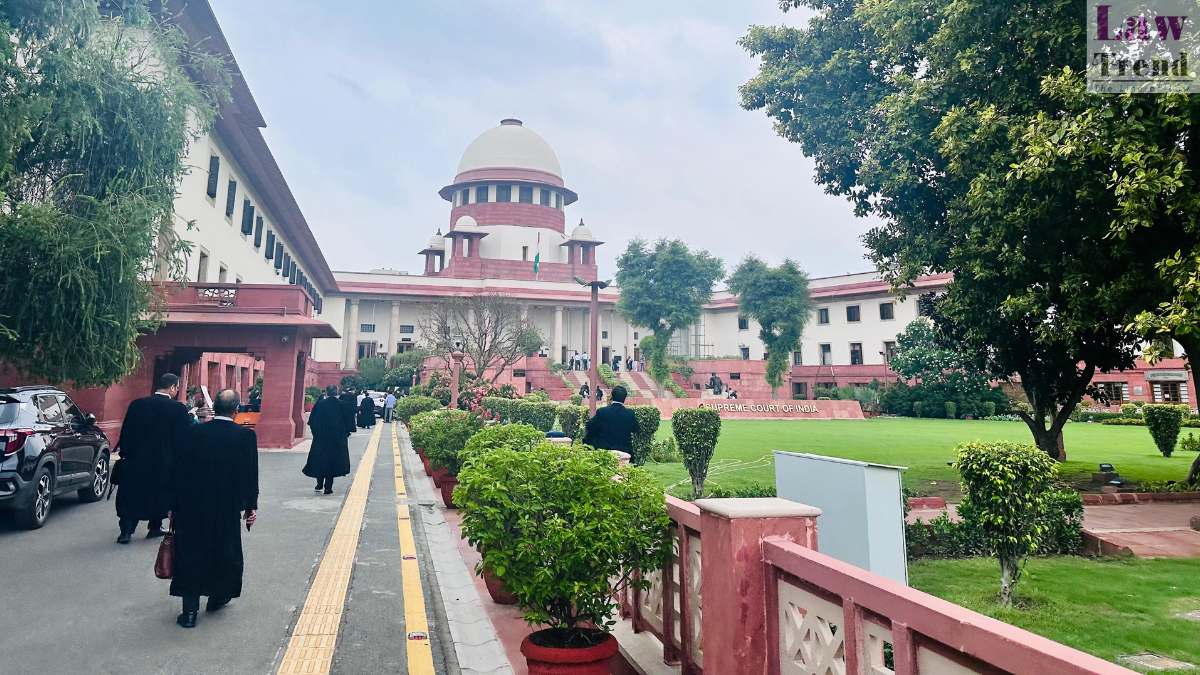
The Supreme Court of India has ruled on a significant question of customary tribal succession, establishing that under the local customs of the Oraon community, an uncle-in-law cannot adopt his niece’s husband as a resident son-in-law (ghardamad) to transfer ancestral property. A Bench comprising Justice Sanjay Karol and Justice N. Kotiswar Singh allowed the civil appeal, setting aside the concurrent findings of the Jharkhand High Court and the lower courts. The Supreme Court decreed the suit in favor of the plaintiff, holding that in the absence of a valid ghardamad or direct male heir, the property of an issueless Oraon landowner must devolve to the nearest male agnate.
Background of the Case
The dispute centers on ancestral land originally owned by a common ancestor, Sukhu Oraon (the grandfather), who had three sons: Dhungru Budhu Oraon, Ledura Oraon, and Bhoula Oraon. The original plaintiff, Sukhu (named after his grandfather), was Dhungru’s second son and claimed sole ownership over the grandfather’s lands. This claim was contested by Budhain Oraon (Defendant No. 1), who is the daughter of Bhoula, and her husband Punai (Defendant No. 2, now deceased).
The defendants argued that because Ledura had no children of his own, he had taken Punai as his ghardamad. Since daughters have no right of inheritance under local Oraon customs, the defendants claimed that Ledura’s property had validly devolved to Punai. Furthermore, they asserted that following Bhoula’s death, Budhain and Ledura had partitioned the properties between themselves through a deed dated February 27, 1975. Conversely, the plaintiff argued that because the defendants lacked any legitimate title, the partition deed was legally non-existent (non est).
The Munsif Court in Gumla, the First Appellate Court (First Additional District Judge, Gumla), and the High Court of Jharkhand concurrently dismissed the plaintiff’s suit, accepting the relationship of Punai as Ledura’s ghardamad. The plaintiff’s legal heirs, represented by appellant Bejla Oraon, challenged these concurrent findings before the Supreme Court.
Arguments of the Parties
The appellant contended that the family remained joint and that no partition had ever taken place between Sukhu’s branch and his uncles, Ledura and Bhoula. Relying on tribal customs, they argued that daughters are strictly barred from inheriting landed property in the Oraon caste, and childless widows only hold a right to maintenance. They asserted that upon the deaths of Bhoula, Ledura, and another family member, Buranga, the plaintiff became the sole legal owner of the ancestral properties as the nearest surviving male heir.
The respondents argued that a ghardamad is customarily treated as a son and acquires full rights over the property of his father-in-law. They asserted that the father of the plaintiff had himself moved to another village as a ghardamad and acquired property there. They further contended that Ledura had validly executed a deed (referred to as a partition or lease deed) in favor of Budhain, thereby legally transferring the land.
The Court’s Analysis
The Supreme Court first addressed its scope of interference regarding concurrent findings of fact under Article 136 of the Constitution of India. Citing the three-judge Bench precedent in Srinivas Ram Kumar v. Mahabir Prasad, the Court noted:
“When the courts below have given concurrent findings on pure questions of fact, this Court would not ordinarily interfere with these findings and review the evidence for the third time unless there are exceptional circumstances justifying departure from this normal practice.”
The Court also referenced Bharwada Bhoginbhai Hirjibhai v. State of Gujarat, Sushma v. Nitin Ganapati Rangole, Mithilesh Kumari v. Prem Behari Khare, and Ramachandran v. Vijayan to outline the parameters under which concurrent findings can be overturned, particularly where the findings run contrary to law or ignore material evidence.
Analyzing the evidence, the Court systematically addressed the key customary issues:
- Inheritance Rights of Daughters: The Court observed that the plaintiff’s witnesses consistently maintained that daughters have no right to property. The defense witnesses gave inconsistent testimonies. Therefore, the Court accepted that Oraon daughters do not inherit ancestral land.
- The Custom of Ghardamad: While the custom of a ghardamad acquiring rights in his father-in-law’s property was proved, the crucial issue was whether an uncle-in-law could adopt his niece’s husband as a ghardamad.
- The Authority to Adopt: The Trial Court had relied heavily on scholar Sarat Chandra Roy’s authoritative treatise, The Oraon of Chotanagpur. However, the Supreme Court pointed out that the Trial Court had misdirected itself. According to S.C. Roy’s work, a ghardamad must be adopted by the “last male owner” or his widow. Budhain was the daughter of Bhoula, making Punai the son-in-law of Bhoula—not Ledura. The Court noted there was no evidence showing that Bhoula had adopted Punai, and it was never established under customary law that an uncle-in-law (Ledura) could adopt his niece’s husband as a ghardamad.
- Validity of the Deed: The Court held that whether the 1975 document was a lease or a partition deed, it could not confer title. A lease deed does not confer ownership, and a partition can only be executed among co-sharers. Since Budhain had no pre-existing share in the property, there could be no valid partition between her and Ledura.
The Supreme Court criticized the High Court’s reasoning, which had suggested that because there was no explicit customary bar against an uncle-in-law adopting a niece’s husband, no adverse inference could be drawn. Highlighting the fundamental rule of evidence in customary law, the Supreme Court observed:
“those who allege a custom must be the one to prove it. Merely observing that the opposite to what has been alleged is not clearly stated, cannot be stated to be sufficient.”
The Decision
The Supreme Court concluded that the respondents had failed to prove the custom allowing an uncle-in-law to adopt a niece’s husband as a ghardamad. Pointing to established tribal customs compiled by S.C. Roy, the Court reaffirmed that in the absence of a valid ghardamad or direct male descendants, the nearest male agnate succeeds to the property.
Consequently, the Supreme Court set aside the judgments of the Jharkhand High Court, the First Appellate Court, and the Civil Court. The appeal was allowed, and the plaintiff’s suit was decreed. The parties were ordered to bear their own costs.
Case Title: Bejla Oraon v. Kali Das Oraon & Ors.
Case No.: SLP (C.) No. 23458 of 2024
Bench: Justice Sanjay Karol, Justice N. Kotiswar Singh
Date: July 9, 2026