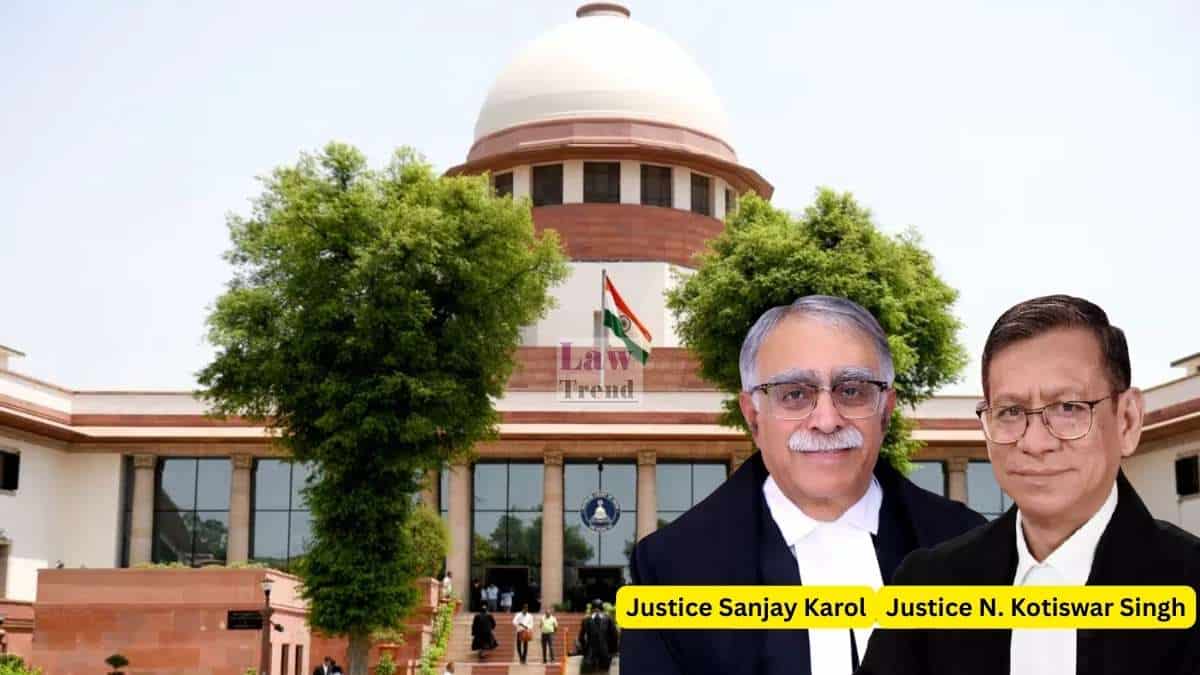
The Supreme Court of India has held that a compromise decree passed without the signatures of a party or the express written authorization of their advocate is legally unsustainable under Order XXIII Rule 3 of the Code of Civil Procedure, 1908. A bench of Justice Sanjay Karol and Justice Nongmeikapam Kotiswar Singh dismissed a civil appeal, upholding the decisions of the lower courts to set aside a 1994 compromise decree in a partition suit. The Court clarified that while the law of limitation is a vital facet of the legal system, it cannot be used as a tool to defeat substantive rights when a compromise is found to be non-compliant with statutory mandates.
Background of the Case
The litigation arose from Partition Suit No. 128 of 1989, filed by the plaintiff, Dinbandhu Ojha, in the Court of Sub-Judge-01, Muzaffarpur, seeking a one-fourth share in the joint property of a common ancestor named Thakur Ojha. Chaturbhuj Chaudhary (Defendant No. 5), the predecessor of the respondents, appeared through his counsel on receiving summons.
During the pendency of the suit, a compromise petition was filed jointly by the plaintiffs and defendants, which was accepted by the Sub-Judge-01 on February 22, 1994. Consequently, a final decree was prepared on May 27, 1997.
Nearly 28 years later, on April 7, 2022, the respondents (the legal heirs of Chaturbhuj Chaudhary) filed Miscellaneous Case No. 07 of 2022 under Section 151 of the Code of Civil Procedure (CPC). They sought to set aside the compromise decree, alleging that it was fraudulent and lacked the signatures of Chaturbhuj Chaudhary.
The Trial Court (Sub-Judge-01, East Muzaffarpur) allowed the petition on February 7, 2024, setting aside the compromise decree. The appellants (the legal heirs of the original plaintiffs and other co-sharers) challenged this before the High Court of Judicature at Patna in Civil Revision No. 103 of 2024, which was dismissed, leading to the present appeal before the Supreme Court.
Arguments of the Parties
The respondents contended that their father, Chaturbhuj Chaudhary, was merely a formal party to the suit and that the plaintiff had sought no relief against him regarding Revisional Survey (R.S.) Khata-77 and 78. They asserted that the compromise petition of February 18, 1994, was fraudulent, lacked their father’s signature, and that the vakalatnama and written statement filed on August 27, 1992, by advocate Ram Krishna Mehta (referred to in pleadings as Ram Kishor Mahto) were fake and collusive. They claimed their father never engaged the said counsel, was unaware of the suit, and they only discovered the decree on April 3, 2022, when the opposite parties tried to dispossess them from the lands under Khata-77 and 78.
Conversely, the appellants argued that Chaturbhuj Chaudhary was the maternal uncle of appellant Krishna Kumar Ojha and resided frequently with them, assisting with cultivation. They alleged that ancestral land belonging to the appellants had been wrongly recorded in Chaturbhuj’s name in the Revisional Survey. To resolve this, Chaturbhuj had allegedly executed a registered Ladavi (disclaimer deed) on December 14, 1988, in favor of the appellants’ predecessors. The appellants contended that Chaturbhuj subsequently filed his written statement admitting these facts, actively participated in the proceedings, and instructed his advocate to record a “no objection” on the compromise petition.
The Court’s Analysis
The Supreme Court framed the issue around whether the compromise complied with the mandate of Order XXIII Rule 3 of the CPC. Examining the legal framework, the Court noted that prior to the 1976 amendment, compromises could be oral or written, but post-amendment, a compromise must be in writing and signed by the parties to prevent false and frivolous claims (Gurpreet Singh v. Chatur Bhuj Goel; Som Dev v. Rati Ram). It must be voluntarily accepted to attain the sanctity of a judicial order (Banwari Lal v. Chando Devi).
The Court recognized that while an advocate, authorized representative, or power of attorney holder can sign a compromise, they must possess express authorization or act under an exigency of circumstance (Byram Pestonji Gariwala v. Union Bank of India; Pushpa Devi Bhagat v. Rajinder Singh).
In this case, the Court found no express authorization in the vakalatnama allowing Mr. Mehta to sign the compromise on behalf of Defendant No. 5, nor any exigent circumstances. Relying on the three-judge bench ruling in Himalayan Coop. Group Housing Society v. Balwan Singh, the Court emphasized that an advocate cannot act on implied authority to surrender substantial legal rights:
“Therefore, it is the solemn duty of an advocate not to transgress the authority conferred on him by the client. It is always better to seek appropriate instructions from the client or his authorised agent before making any concession which may, directly or remotely, affect the rightful legal right of the client.”
The Court further quoted:
“A lawyer generally has no implied or apparent authority to make an admission or statement which would directly surrender or conclude the substantial legal rights of the client unless such an admission or statement is clearly a proper step in accomplishing the purpose for which the lawyer was employed.”
The Supreme Court also pointed to Prasanta Kumar Sahoo v. Charulata Sahoo, which recalled the Madras High Court’s caution in Govindammal v. Marimuthu Maistry that:
“prudence dictates that unless express power is given in the vakalatnama itself to enter into compromise, in accordance with the general practice obtaining a special vakalatnama should be filed or the specific consent of the party to enter into the compromise should be obtained.”
Addressing the delay of 25 years, the Supreme Court supported the trial court’s application of Section 151 CPC to prevent fraud and serve justice, observing that:
“The law of limitation, while undoubtedly an important facet of the legal system, cannot be used as a means to defeat substantive rights.”
Given that vital facts regarding family relationships, property rights, and counsel authorization remain deeply contested, the Court determined that the delay must be overlooked to avoid perpetuating an unlawful compromise.
The Decision
The Supreme Court dismissed the appeal and upheld the trial court’s decision to set aside the compromise decree. The Court directed that the issues of the partition suit must be adjudicated through a full trial. Acknowledging the logistical difficulty of sending a 1989 suit to trial 37 years later, the bench observed:
“it is not possible to decide the rights of the parties without the due process of collection and weighing of evidence, whatever may be available.”
The appeal was dismissed with no order as to costs.
Case Details:
Case Title: Krishna Kumar Ojha & Ors. Versus Jitendra Chaudhary & Ors.
Case No.: Civil Appeal Nos. of 2026 (Arising out of SLP(C) Nos. 13671 of 2025)
Bench: Justice Sanjay Karol, Justice Nongmeikapam Kotiswar Singh
Date: July 1, 2026