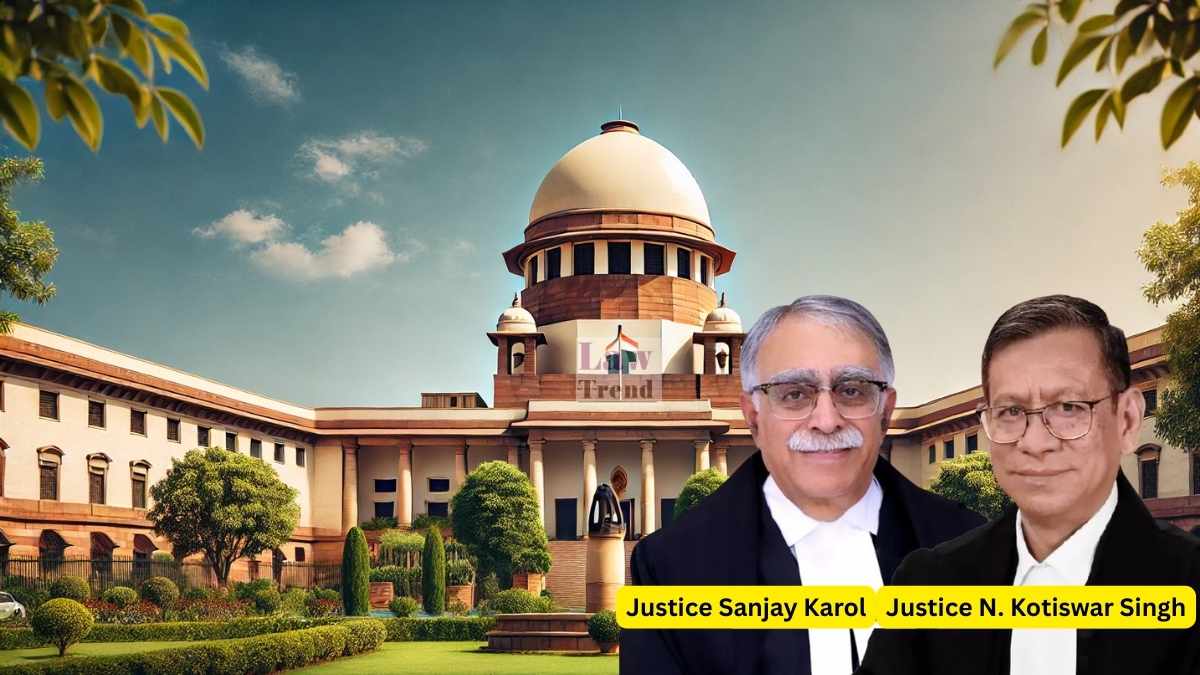
In a milestone ruling governing motor accident compensation claims, the Supreme Court of India has established authoritative guidelines on using Income Tax Returns (ITRs) to determine a victim’s annual income. A bench comprising Justice Sanjay Karol and Justice Nongmeikapam Kotiswar Singh held that there cannot be a uniform, rigid approach to calculating income under the Motor Vehicles Act, 1988. Resolving conflicting practices across lower courts, the apex court ruled that while a single year’s ITR is sufficient for salaried individuals, a multi-year average of up to three years—coupled with an analysis of business nature, potential scale, and growth patterns—must be considered for self-employed individuals. Applying these guidelines across three separate civil appeals, the Court modified the orders of the High Courts of Orissa and Madhya Pradesh to significantly enhance the compensation awarded to the deceased victims’ families.
Background of the Cases
The landmark guidelines were established during the joint consideration of three separate fatal accident appeals where claimants contested the lower courts’ income assessment methodologies:
- The Construction Business Case (Rashmirekha Tripathy v. Sriram General Insurance): On May 29, 2018, Mr. Manoranjan Pandey (aged 39) died when a rashly driven truck struck his vehicle on the National Highway near Kaliabali Chakka. He ran a proprietary construction business. The Motor Accident Claims Tribunal (MACT), Behrampur accepted his Assessment Year (AY) 2018-19 ITR of Rs. 15,00,000 as his annual income, awarding Rs. 2,27,00,064. However, the Orissa High Court reduced this to Rs. 1,87,75,150 by taking a two-year average of his ITRs (reducing his yearly income to Rs. 13,33,226) and lowering the multiplier from 16 to 15.
- The Insurance Agent Case (Rajani v. Mukesh): On January 8, 2017, Mr. Sushil (aged 49), an insurance agent, died on the spot when a dumper crashed into his vehicle. The MACT, Manawar awarded Rs. 49,77,000, which the Madhya Pradesh High Court (Indore Bench) subsequently enhanced to Rs. 76,09,500. The High Court calculated his monthly income at Rs. 62,500 by averaging his last four ITRs.
- The Grocery Merchant Case (Smt. Rekha v. Dinesh Porwal): On June 15, 2015, Mr. Krishnavallabh (aged 28), who ran a wholesale grocery store, died after his motorcycle was struck by a speeding vehicle. The MACT, Mandsaur awarded Rs. 15,36,560, assessing his monthly income at a nominal Rs. 7,000. The Madhya Pradesh High Court (Indore Bench) enhanced the total to Rs. 38,40,850 by taking the average of his AY 2012-13 and AY 2013-14 ITRs, while excluding two ITRs that were filed after his death.
Arguments of the Parties and Amici Curiae
Recognizing the lack of uniformity across different High Courts regarding ITR-based income assessments, the Supreme Court appointed Senior Counsel Mr. J.R. Midha and Counsel Mr. Salil Paul as amici curiae.
Mr. Midha argued that some courts rely on a three-year average, while others rely solely on the latest return. He highlighted that while ITRs serve as prima facie evidence, they may not reflect true long-term financial health in businesses where initial years yield negative returns or income fluctuates. He suggested that if an ITR is filed post-death, courts should scrutinize three years of ITRs alongside the business balance sheets. Mr. Paul cited the precedent in ICICI Lombard General Insurance Co. Ltd. v. Ajay Kumar Mohanty and Anr. (2018), where a three-year average of ITRs was utilized.
The Court’s Analysis and Landmark Guidelines
Delivering the judgment, Justice Sanjay Karol reiterated that the foundational objective of the Motor Vehicles Act, 1988 is to grant “just and fair compensation.” Drawing from recent precedents, the Court quoted its ruling in V. Pathmavathi and Ors. v. Bharthi Axa General Insurance Co. Ltd. and Anr. (2026):
“no amount of money can truly compensate for the loss. Compensation is nothing but a rough estimate, being a token attempt to ease the financial burden on the dependents.”
The Court further observed:
“Considering the income of the deceased, the needs of his dependents and the emotional toll of the loss, the best that can be ensured is that the compensation is fair and reasonable, without being either arbitrary or niggardly.”
The bench also referenced Reshma Kumari v. Madan Mohan (2013), highlighting that:
“the purpose of award of compensation under section 166 read with section 168 of the Act is to place the distressed dependents of the victim of a fatal road accident, if the victim had been the sole bread earner, in almost the same position financially if he lived his natural span of life.”
Additionally, citing Anant v. Pratap and Anr. (2018), the Court reiterated that:
“the purpose of compensation under the Motor Vehicles Act is to fully and adequately restore the aggrieved to the position prior to the accident.”
To achieve these objectives, the Supreme Court ruled that there can be “no hard and fast formula for computing the annual income of a deceased person/claimant.” The Court established a clear legal distinction for calculating income:
- For Salaried Individuals: Only the ITR of the previous year is sufficient to prove annual income. Taking older records ignores the impact of recent promotions. In cases where the individual died shortly after a promotion before filing a return, courts may rely on promotion letters and supporting financial statements.
- For Self-Employed/Business Individuals: The average income shown in the ITRs of up to the preceding three years must be the primary reference point. If fewer returns are available, courts must examine surrounding circumstances, including the nature and location of the business, growth patterns, potential scale of capital-intensive setups, initial-phase losses, and the actual filing dates of the ITRs (to prevent reliance on artificially inflated returns filed post-death).
Supreme Court’s Decisions and Enhanced Calculations
Applying these guidelines, the Supreme Court allowed all three appeals and significantly enhanced the compensation awards:
Case 1: Rashmirekha Tripathy v. Sriram General Insurance Co. Ltd.
The Court noted that the deceased ran a construction business, making him self-employed. Taking his business nature into account, the Court fixed his annual income at Rs. 14,00,000 and enhanced the total compensation to Rs. 1,97,81,505.
Recalculation Breakdown:
- Yearly Income: Rs. 14,00,000
- Future Prospects (40%): Rs. 14,00,000 + Rs. 5,60,000 = Rs. 19,60,000 (as per National Insurance Co. Ltd. v. Pranay Sethi)
- Deduction for Dependents (1/3rd): Rs. 19,60,000 – Rs. 6,53,333 = Rs. 13,06,667
- Loss of Income (Multiplier of 15): Rs. 13,06,667 x 15 = Rs. 1,96,00,005
- Loss of Estate (10% increase): Rs. 18,150
- Funeral Expenses (10% increase): Rs. 18,150
- Loss of Consortium (10% increase for 3 dependents): Rs. 1,45,200 (as per United India Insurance Co. Ltd. v. Satinder Kaur and Rajwati alias Rajjo v. United India Insurance Co. Ltd.)
- Total Recalculated Compensation: Rs. 1,97,81,505 (an increase of Rs. 10,06,355 from the High Court’s order)
Case 2: Rajani & Ors. v. Mukesh & Ors.
The Court ruled that the High Court erred by averaging four years of ITRs for an insurance agent, as performance-based commission fluctuations do not justify stretching back extra years. The average of the preceding three years yielded an annual income of Rs. 6,87,802, leading to a total enhanced award of Rs. 87,09,282.
Recalculation Breakdown:
- Yearly Income: Rs. 6,87,802
- Future Prospects (25%): Rs. 6,87,802 + Rs. 1,71,950 = Rs. 8,59,752
- Deduction (1/4th): Rs. 8,59,752 – Rs. 2,14,938 = Rs. 6,44,824
- Loss of Income (Multiplier of 13): Rs. 6,44,824 x 13 = Rs. 83,82,582
- Loss of Estate: Rs. 18,150
- Funeral Expenses: Rs. 18,150
- Loss of Consortium (6 dependents): Rs. 2,90,400
- Total Recalculated Compensation: Rs. 87,09,282 (an increase of Rs. 11,00,000 from the High Court’s order)
Case 3: Smt. Rekha & Ors. v. Dinesh Porwal & Ors.
The claimants had filed two ITRs after the victim’s death, showing a sudden rise in income. The Court noted that verifying if these were artificially inflated would require detailed surrounding financial statements. To ensure swift justice and avoid remanding the case, the Court fixed his annual income at Rs. 3,25,000, enhancing the final payout to Rs. 60,79,550.
Recalculation Breakdown:
- Yearly Income: Rs. 3,25,000
- Future Prospects (40%): Rs. 3,25,000 + Rs. 1,30,000 = Rs. 4,55,000
- Deduction (1/4th): Rs. 4,55,000 – Rs. 1,13,750 = Rs. 3,41,250
- Loss of Income (Multiplier of 17): Rs. 3,41,250 x 17 = Rs. 58,01,250
- Loss of Estate: Rs. 18,150
- Funeral Expenses: Rs. 18,150
- Loss of Consortium (5 dependents): Rs. 2,42,000
- Total Recalculated Compensation: Rs. 60,79,550 (an increase of Rs. 22,38,700 from the High Court’s order)
Case Details
Case Title: Rashmirekha Tripathy and Anr. v. The Branch Manager (Legal Claims), Sriram General Insurance Company Limited and Ors.
Case No.: Civil Appeal arising out of SLP(C) No. 27220 of 2024
Case Title: Rajani & Ors. v. Mukesh & Ors.
Case No.: Civil Appeal arising out of SLP(C) No. 3088 of 2025
Case Title: Smt. Rekha & Ors. v. Dinesh Porwal & Ors.
Case No.: Civil Appeal arising out of SLP(C) No. 7735 of 2025
Bench: Justice Sanjay Karol, Justice Nongmeikapam Kotiswar Singh
Date: July 1, 2026