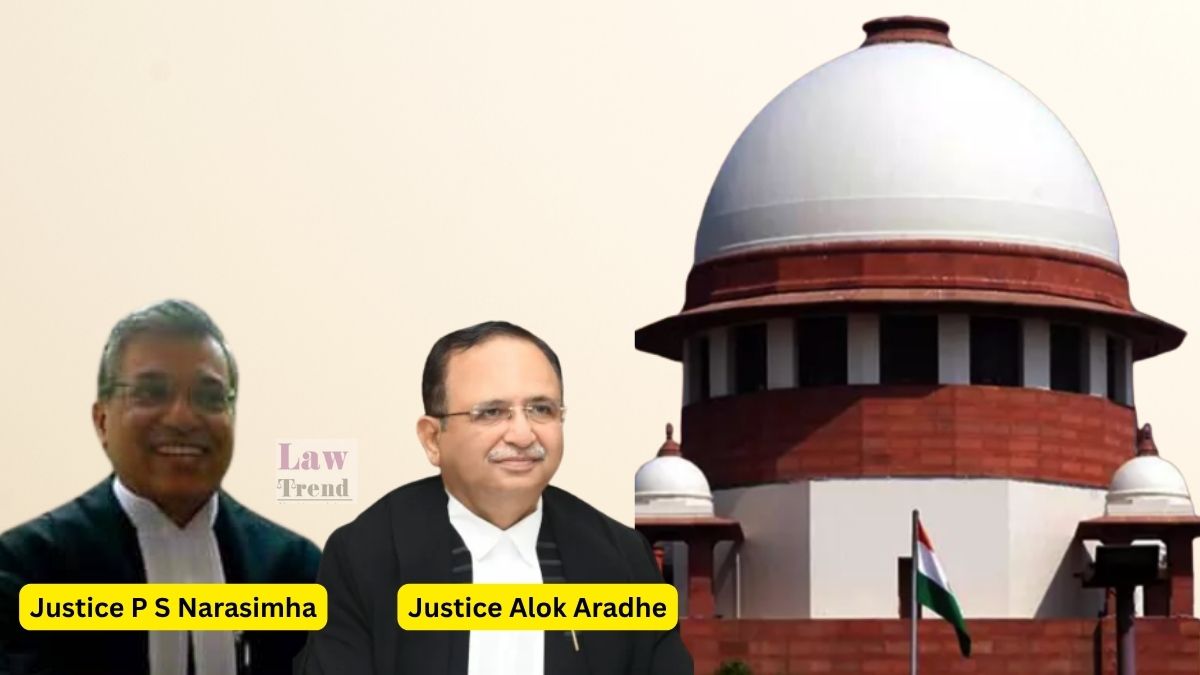
The Supreme Court has held that appellate courts exercising jurisdiction under Order XLIII Rule 1(r) of the Code of Civil Procedure, 1908 (CPC) should not conduct a “mini-trial” or re-appreciate evidence to substitute their own view for that of a trial court granting temporary injunctions. A Bench comprising Justice P. S. Narasimha and Justice Alok Aradhe set aside a Delhi High Court Division Bench judgment that had reversed an interim injunction granted by a Single Judge in a high-value family property dispute. Restoring the Single Judge’s protective order, Justice Alok Aradhe, writing for the Bench, emphasized that appellate interference is impermissible unless the trial court’s discretion was exercised arbitrarily, capriciously, perversely, or contrary to settled principles of law.
Background of the Case
The dispute originates from the estate of late Devinder Singh Chaudhary, who had established various companies, partnerships, and trusts holding substantial family assets before passing away on December 5, 2009. The succession to his estate was contested among family members under competing claims of a 2004 Will, a 2008 Will, and an assertion of intestacy.
Following the testator’s demise, his widow, Mrs. Sita Chaudhary (the original plaintiff), resided in Chandigarh with her granddaughter, Ms. Sunaina Singh (defendant No. 4). Between December 2018 and June 2019, Mrs. Sita Chaudhary executed multiple gift deeds, Limited Liability Partnership (LLP) transfer agreements, interest-free loans, and property sales transferring major shareholdings and capital in family entities—including Amba Promoters & Developers Pvt. Ltd., P.E. Manning (Consultants) Pvt. Ltd., Ruchi Towers LLP, Rama Packing & Wires Industries LLP, and Industrial Cables (India) Ltd.—to Sunaina Singh and her husband, Mr. Ajay Kadyan (defendant No. 9).
In October 2021, Mrs. Sita Chaudhary filed a civil suit, CS (OS) No. 589 of 2021, before the Delhi High Court. She pleaded that as an elderly widow in poor health, defendant Nos. 4 and 9 had taken advantage of her old age to fraudulently procure the transfer of family assets and siphon funds to acquire luxury flats, factories, and vehicles in their own names. She sought declarations declaring the transfers void, mandatory injunctions for restoration of shares, and interim protection under Order XXXIX Rules 1 and 2 of the CPC.
On July 29, 2022, a learned Single Judge of the Delhi High Court granted an interim injunction restraining defendant Nos. 4 and 9 from alienating or creating third-party rights in specified corporate properties and self-acquired real estate, while permitting ongoing plot sales in Madhuban Colony to continue.
Upon appeal by the defendants, a Division Bench of the Delhi High Court on March 20, 2026, set aside the Single Judge’s interim injunction. The Division Bench extensively analyzed the clauses of the 2004 Will, the plaintiff’s delay, Section 89 of the Companies Act, 2013, and held that a clear prima facie nexus had not been established. Mrs. Sita Chaudhary having passed away on January 9, 2025, her legal representatives carried the matter to the Supreme Court.
Arguments of the Parties
Senior Advocate Kapil Sibal, appearing for the appellants, argued that the Division Bench erroneously overturned a well-reasoned order in direct contravention of the law laid down in Wander Ltd. & Anr. v. Antox India P. Ltd. He submitted that defendant No. 4 had exercised undue influence over an elderly widow to usurp 96.3% of the family estate (worth approximately Rs. 1,035 crores), leaving the rest of the family with less than 4% (about Rs. 40 crores).
Senior Advocate Mukul Rohatgi, representing the respondents, contended that the original plaintiff had herself approved every transaction now branded as fraudulent. He argued that the threshold for appellate interference laid down in Wander Ltd. was met because the findings of the learned Single Judge were perverse, and therefore the Division Bench judgment required no interference.
Court’s Analysis and Legal Principles
The Supreme Court examined the statutory framework governing temporary injunctions under Sections 36 and 37 of the Specific Relief Act, 1963, alongside Order XXXIX Rule 1(a), Section 94(c), and Section 151 of the CPC. The Court noted that while statutory in form, interlocutory injunction jurisdiction remains equitable in substance, originating from the Court of Chancery to operate in personam.
Highlighting the core purpose of interim relief, the Court emphasized that an interlocutory injunction is a holding operation designed to preserve the subject-matter for trial. Citing English decisions such as Beddow v. Beddow, North London Railway Co. v. Great Northern Railway Co., Films Rover International Ltd. v. Cannon Film Sales Ltd., and National Commercial Bank Jamaica Ltd. v. Olint Corpn. Ltd., along with its own decisions in Manohar Lal Chopra v. Rai Bahadur Rao Raja Seth Hiralal and Zenit Mataplast Pvt. Ltd. v. State of Maharashtra, the Court reiterated the principle of minimizing irremediable error.
Quoting Lord Diplock’s classical formulation in American Cyanamid Co. v. Ethicon Ltd., the Court observed:
“The object of the interlocutory injunction is to protect the plaintiff against injury by violation of his right for which he could not be adequately compensated in damages recoverable in the action if the uncertainty were resolved in his favour at the trial.”
Addressing the requirement of a ‘prima facie case’, the Supreme Court reaffirmed that the standard is a modest one, requiring only a serious question to be tried rather than full proof of title or a case established to the hilt. Referring to Martin Burn Ltd. v. R.N. Banerjee, Gujarat Bottling Co. Ltd. v. Coca Cola Co., Anand Prasad Agarwalla v. Tarkeshwar Prasad, State of Kerala v. Union of India, and Ramakant Ambalal Choksi v. Harish Ambalal Choksi, the Bench cited Dalpat Kumar v. Prahlad Singh:
“The existence of the prima facie right and infraction of the enjoyment of his property or the right is a condition for the grant of temporary injunction. Prima facie case is not to be confused with prima facie title which has to be established, on evidence at the trial. Only prima facie case is a substantial question raised, bona fide which needs investigation and a decision on merits.”
On the second and third parameters—balance of convenience and irreparable injury—the Court referred to Shiv Kumar Chadha v. Municipal Corporation of Delhi, Seema Arshad Zaheer v. Municipal Corpn. of Greater Mumbai, and Evans Marshall & Co. Ltd. v. Bertola SA. The Bench held that loss of controlling shareholding in family entities or creation of third-party rights in assets during pendency cannot be adequately compensated by monetary damages.
Evaluating the standard of appellate review under Wander Ltd. & Anr. v. Antox India P. Ltd. (as reaffirmed in Shyam Sel and Power Limited v. Shyam Steel Industries Limited), the Apex Court observed that the Single Judge had founded his order on seven concrete preliminary findings. The Division Bench erred by substituting its own interpretation of the Will and statutory provisions.
Expressing strong disquiet over appellate and trial courts entering into detailed merits at the interlocutory stage, the Supreme Court cited Colgate Palmolive (India) Ltd. v. Hindustan Lever Ltd. and cautioned against the practice of conducting “mini-trials”:
“…we accordingly do not approve the practice of writing lengthy, merits-laden orders, whether at the interlocutory stage or in appeal from it, on applications for temporary injunction, and emphasise that courts confine such orders to recording, with reasons, their findings on the three settled conditions of prima facie case, balance of convenience and irreparable injury, without embarking upon an examination of the final merits or the probable outcome of the issues that properly arise for trial.”
The Decision
The Supreme Court allowed the appeals and set aside the Division Bench judgment dated March 20, 2026. The Court restored the learned Single Judge’s interim injunction order dated July 29, 2022, which will remain in operation pending trial.
The Court clarified that its observations are confined to a prima facie appraisal and shall not influence the trial court’s independent determination on the construction of Wills, allegations of undue influence, or applicability of Section 14 of the Hindu Succession Act, 1956 and Section 89 of the Companies Act, 2013. The Supreme Court directed the learned Single Judge to dispose of the suit CS(OS) No. 589 of 2021 as expeditiously as possible, preferably within eight months.
Case Details
Case Title: Shruti Manav Sharma & Anr. v. Sunaina Singh & Ors.
Case No.: Civil Appeal Nos. ______ of 2026 (@ SLP (C) Nos. 12592-12597 of 2026)
Bench: Justice P. S. Narasimha, Justice Alok Aradhe
Date: August 12, 2026