

Deletion of Landlord’s Bona Fide Need Grounds Does Not Extinguish Statutory Right to Seek Rent Enhancement Under UP Rent Act: Supreme Court
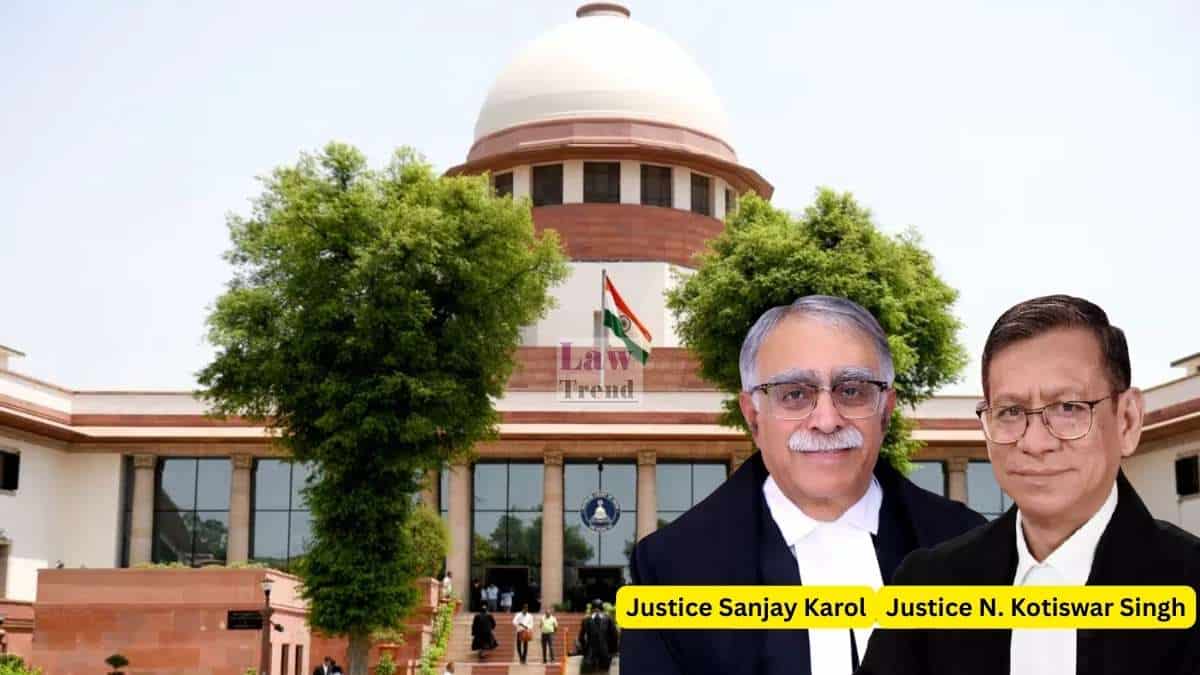

In a significant legal development, the Supreme Court of India has ruled that the deletion of certain explanatory clauses from Section 21 of the Uttar Pradesh Urban Buildings (Regulation of Letting, Rent and Eviction) Act, 1972 does not affect the validity or operation of the statutory proviso enabling landlords to seek rent enhancement. A bench comprising Justice Sanjay Karol and Justice N. Kotiswar Singh held that the High Court cannot routinely exercise its supervisory jurisdiction under Article 227 of the Constitution of India to directly determine and enhance rent when there is no supporting material on record. Consequently, the apex court set aside the decision of the Allahabad High Court and remanded the matter back to the specialized Rent Control Authority for a fresh determination.

Background of the Case

The dispute traces back to 1966 when the forebears of the respondent-landlords let out a building located in Bahraich to the Trade Tax Department of the Government of Uttar Pradesh. The property consists of a total plot area of 5,866 square feet, with a covered area of 3,645.06 square feet. Following unsuccessful attempts in the 1990s to have the property vacated, the landlords filed an application for rent enhancement (Case No. 05/2008) before the City Magistrate/Rent Control Officer, Bahraich, under the proviso of Section 21(8) of the Act.

The Rent Control Officer enhanced the monthly rent to Rs. 14,400, calculated at a rate of Rs. 4 per square foot. This decision took into account the property’s prime, central location and noted that the same government authority was paying a significantly higher rent for another, much smaller building in the vicinity.

On appeal, the Additional District Judge, Bahraich, set aside this order on March 28, 2016. The appellate court observed that the subordinate authority had failed to record findings regarding the date from which the enhancement would take effect, and had not provided directions regarding the mandatory five-year intervals for further rent enhancement. Consequently, the appellate court remanded the matter back to the Rent Control Authority for a fresh hearing.

The landlords subsequently challenged this remand order before the Allahabad High Court under Article 227 of the Constitution. On May 5, 2025, a Single Judge of the High Court accepted the landlords’ oral contention that an adjacent premises, also occupied by the government, was rented at Rs. 14 per square foot. Bypassing the remand to avoid further delay, the High Court modified the rent to Rs. 14 per square foot, effective from the date of the landlords’ original application. The state government’s Special Appeal against this order was dismissed by a Division Bench as non-maintainable, prompting the state to approach the Supreme Court.

READ ALSO  A Point Even If Wrongly Decided Binds The Party Against Whom It Is Decided And The Same Point Cannot Be Urged In A Subsequent Suit Or Proceeding At The Same Level: Supreme Court

Arguments of the Parties

The appellant-tenants (State of Uttar Pradesh) argued before the Supreme Court that the High Court, while exercising its supervisory jurisdiction under Article 227, erred by assuming the functions of the Rent Control Authority to directly enhance the rent. They contended that there was absolutely no evidence or material on record to substantiate the landlords’ claim that an adjoining premises was let out at Rs. 14 per square foot.

Conversely, the respondent-landlords asserted that the state-tenant was not entitled to the standard protections under Section 21 of the Act. They maintained that despite the omission of certain clauses from the Act, the landlord’s right to seek rent enhancement under the proviso to Section 21(8) remained fully operative and unaffected.

Legal Analysis of the Supreme Court

The Supreme Court examined two primary legal issues: the impact of the statutory deletions on the rent enhancement proviso and the scope of the High Court’s supervisory powers under Article 227.

1. Interpretation of Section 21 and the Omitted Clauses

The apex court analyzed Section 21 of the Act, which regulates the eviction of tenants and rent enhancement. Under the 1976 amendment (UP Act No. 28 of 1976), Clauses (ii) and (iv) of the Explanation to sub-section (1)—which previously defined specific conditions of “bona fide need” for landlords—were omitted.

READ ALSO  Punjab & Haryana HC: Cheque Without Interest Component Not Enforceable Under NI Act

The State contended that these deletions rendered the proviso of Section 21(8) inoperative for such premises. Disagreeing with the State’s restrictive interpretation, the Supreme Court ruled that the proviso under Section 21(8) remains the exclusive and operational remedy for landlords where the tenant is a government body. Delivering the judgment, Justice Karol observed:

“the deletion of clauses (ii) and (iv) does not impact the operationality of the proviso. We are of this firm view for the reason that if the contention of the appellant-State is accepted in so far as the interpretation of the clause is concerned it would amount to virtually making the tenant into the landlord. No bonafide requirement; no enhancement of rent: means no way for the landlord to reclaim his own property either physically or financially. No provision can be read so restrictively only because on the other side of the equation, is the Government itself which would defeat the very purpose of the landlord-tenant relationship.”

2. Limits of High Court’s Power Under Article 227

The court then addressed whether the High Court could have directly determined and enhanced the rent. Reviewing its own long-standing precedents—including Waryam Singh v. Amarnath, L. Chandra Kumar v. Union of India, Laxmikant Revchand Bhojwani v. Pratapsing Mohansingh Pardeshi, Koyilerian Janaki v. Rent Controller (Munsiff), Ouseph Mathai v. M. Abdul Khadir, State v. Navjot Sandhu, Surya Dev Rai v. Ram Chander Rai, and Shalini Shyam Shetty—the Supreme Court outlined key parameters governing supervisory jurisdiction.

The court reiterated that Article 227 is a discretionary, supervisory power designed to ensure tribunals act within their statutory bounds, and is not an appellate power to substitute the High Court’s own view for that of a specialized body. In the context of rent legislations, the Bench observed:

READ ALSO  Merely Filing the Charge-Sheet Cannot Be a Ground for Non-suiting a Party in a Petition Under Section 482 Cr.P.C: SC

“although the interference of the High Court under Article 227 in rent matters is not completely barred, it is to be exercised judiciously, sparingly particularly since rent control legislations are considered to be special laws.”

Applying these principles, the Supreme Court noted that the High Court’s enhancement to Rs. 14 per square foot lacked any evidentiary support. It was based entirely on a statement made by the landlords’ counsel, without any lease deeds, documents, or recorded consent from the State to prove that the adjoining premises commanded such a rate.

The Decision

The Supreme Court held that while the landlords’ application for rent enhancement under the proviso of Section 21(8) of the Act is fully maintainable, the High Court’s direct enhancement in this case was legally unsustainable due to the complete lack of material on record.

Accordingly, the Supreme Court set aside the High Court’s judgment. Acknowledging that the matter had already suffered extensive delays, the Bench directed the Rent Control Officer, Bahraich, to decide the rent payable by the state government afresh. The authority must conclude the proceedings within four months from the date of the Supreme Court’s order, adhering to the directions issued by the Appellate Authority on March 28, 2016. The apex court explicitly directed that the newly determined rent will apply retrospectively from the date the original enhancement application was instituted in the year 2008.

Case Details

Case Title: State of U.P. & Ors. v. Raghvendra Nath Srivastava & Ors.

Case No.: Civil Appeal Nos. of 2026 (Arising out of SLP (Civil) Nos. 38495-38496 of 2025)

Bench: Justice Sanjay Karol, Justice N. Kotiswar Singh

Date of Judgment: May 29, 2026

Law Trend
Law Trendhttps://lawtrend.in/
Legal News Website Providing Latest Judgments of Supreme Court and High Court

Related Articles

Latest Articles

