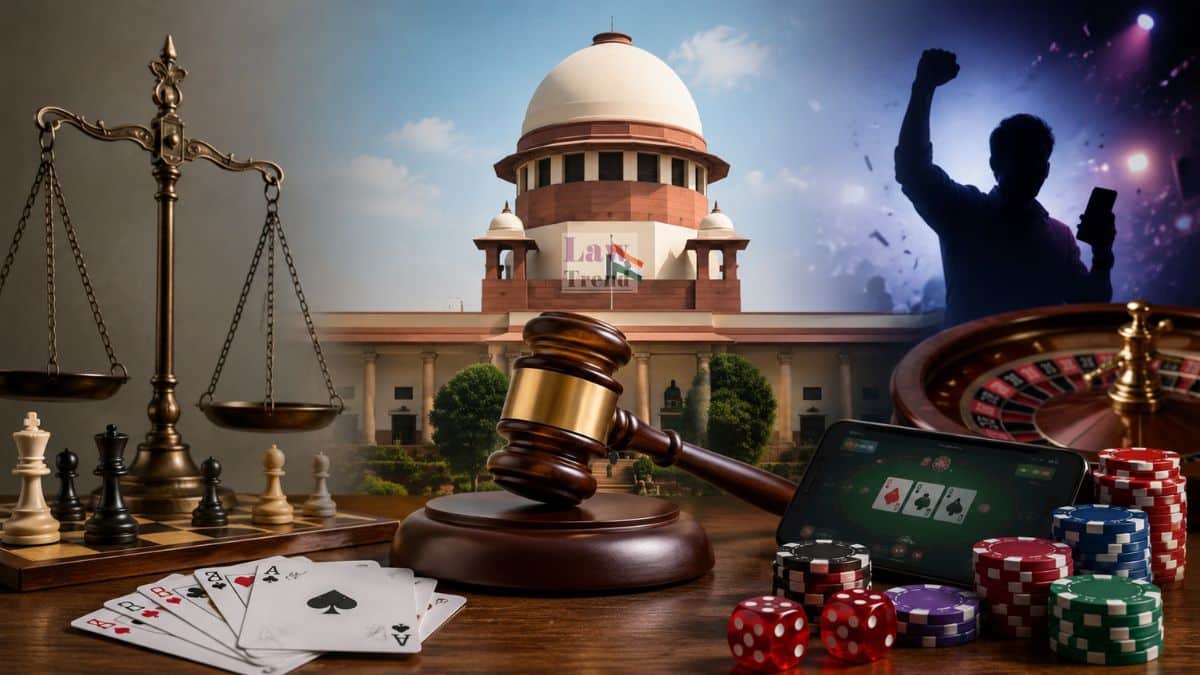
In a landmark decision in fiscal jurisprudence, the Supreme Court of India has upheld the levy of Goods and Services Tax at the rate of 28 percent on the full face value of stakes in online gaming, fantasy sports, and casino transactions. A Division Bench of the Supreme Court, comprising Justice J.B. Pardiwala and Justice R. Mahadevan, set aside the May 11, 2023 judgment of the Karnataka High Court that had quashed a show-cause notice demanding approximately Rs 21,000 crore in tax from Gameskraft Technologies Private Limited. The Court ruled that once participation in online gaming activities is conditioned upon staking money on uncertain outcomes, the transaction acquires the character of betting and gambling, rendering the traditional legal distinction between games of skill and games of chance irrelevant for tax purposes.
Factual Background of the Case
The dispute primarily originated from a show-cause notice dated September 23, 2022, issued by the Directorate General of GST Intelligence under Section 74(1) of the Central Goods and Services Tax Act, 2017 against Gameskraft Technologies Private Limited. The tax authorities proposed a recovery of Rs 2,09,89,31,31,501 (approximately Rs 21,000 crore) in unpaid GST, interest, and penalties for the period between 2017 and 2022. The Revenue asserted that online rummy played for stakes on Gameskraft’s platform constituted “betting and gambling” and that the platform was engaged in the taxable supply of actionable claims.
Prior to the issuance of the notice, online gaming companies paid GST at the rate of 18 percent on their platform commission fee alone, treating it as a service under the Service Accounting Code 998439. The pool of money staked by players (the prize pool) was not subjected to tax, as the platforms maintained it did not accrue to them.
Gameskraft successfully challenged the show-cause notice before the High Court of Karnataka. The High Court quashed the notice on May 11, 2023, ruling that rummy is a game of skill and that games of skill played with stakes do not fall under the definition of “betting and gambling” within the meaning of Entry 6 of Schedule III of the CGST Act. The Revenue subsequently appealed this ruling to the Supreme Court.
During the pendency of this appeal, various other online gaming platforms, fantasy sports operators, and casino interests across India filed writ petitions and transfer cases before the Supreme Court. These operators challenged similar show-cause notices as well as the constitutional and statutory validity of the Central Goods and Services Tax (Amendment) Act, 2023, which explicitly taxed actionable claims in online gaming and casinos based on total player deposits under newly inserted Rules 31B and 31C of the CGST Rules. All the matters were consolidated and heard analogously by the Division Bench.
Arguments of the Parties
Submissions by the Revenue
The Additional Solicitor General, appearing for the Revenue, presented ten central propositions to frame the statutory and constitutional validity of the levy.
The Revenue argued that gambling necessarily occurs the moment stakes are introduced, irrespective of whether the underlying game relies on skill or chance. It was submitted that while a game of skill in itself is not gambling, the act of playing it with stakes transforms the transaction into gambling for the purpose of the GST framework.
The Revenue further contended that real-money gaming platforms do not merely act as passive facilitators or intermediaries. Instead, they create and operate a commercial ecosystem within which participants acquire contingent beneficial interests in movable property. These interests constitute “actionable claims” under Section 3 of the Transfer of Property Act, 1882, which are classified as “goods” under Section 2(52) of the CGST Act. Consequently, the entire amount deposited or staked by players represents the “consideration” under Section 2(31) of the CGST Act, making the full face value of the bet liable to a 28 percent GST.
Finally, the Revenue defended the 2023 amendments to the CGST Act, including the insertion of Rules 31B and 31C, as being purely clarificatory and explanatory in nature, designed to resolve overbroad interpretations of the existing statute, and thus operating retrospectively.
Submissions by the Assessees and Gaming Platforms
The Senior Counsel appearing on behalf of the online gaming platforms and casino operators mounted challenges on both constitutional and statutory grounds.
On the statutory aspect, the assessees argued that a wager is void and legally unenforceable under Section 30 of the Indian Contract Act, 1872. They contended that since a void transaction cannot be enforced in a civil court, it cannot constitute an “actionable claim” or “goods” under Section 2(52) of the CGST Act.
Furthermore, the assessees claimed that the platforms act as mere custodians or trustees of the pooled stakes under the Quistclose trust principle (citing Barclays Bank v. Quistclose Investments Ltd. and Twinsectra v. Yardley). They argued that because title to the stakes never passes to the platform operator, and the money is held in escrow solely for distribution to the winners, it represents a diversion of income by overriding title and cannot be taxed as the platform’s revenue.
The platforms also argued that “betting and gambling” are activities rather than goods, citing the decision in Godfrey Phillips India Ltd. v. State of U.P.. They asserted that the 2023 amendments created a brand-new tax levy on online gaming rather than clarifying an existing one. Therefore, applying the 28 percent tax retrospectively to the entire face value of stakes placed before October 2023 was unconstitutional. They contended that Rule 31A of the CGST Rules was ultra vires Section 15 of the CGST Act, because Section 15(1) mandates taxing the actual transaction value (the platform commission fee) rather than artificially inflating the tax base to 100 percent of the stakes.
The Court’s Analysis and Observations
The Supreme Court examined the constitutional scope of taxation under Article 246A, the definition of actionable claims, and the applicability of the skill versus chance test within fiscal legislation.
The Court began by rejecting the constitutional challenge to the statutory validity of Sections 2(31), 2(52), 7, 9, and 15 of the CGST Act, 2017, along with the corresponding State GST provisions and Rules 31A and 31B of the CGST Rules. It observed that in fiscal matters, the legislature is granted wide latitude to formulate tax policies, and mere commercial hardship, reduction in profitability, or an increase in tax incidence cannot render a legislative measure unconstitutional.
Addressing the central argument regarding games of skill, the Court observed:
“The character of betting and gambling does not depend upon whether the underlying activity is a game of skill or chance, but upon the existence of stakes placed upon uncertain future contingencies.”
The Bench clarified that while the traditional distinction between skill and chance remains relevant for regulatory or criminal prohibitions under state police laws, it holds no relevance when defining the taxable event of “betting” or “gambling” under the GST framework. Once money is staked on an uncertain outcome, it satisfies the legal definition of betting and gambling.
On the role of online gaming operators, the Court held:
“The online gaming operators are not mere intermediaries facilitating transactions inter se between participants, but themselves constitute suppliers of such actionable claims within the framework of the GST legislation. The taxable supply comes into existence upon placement and appropriation of stake amounts towards participation in gameplay itself.”
The Court explained that the platforms supply actionable claims by creating a structural ecosystem where players purchase the right to participate and acquire a contingent beneficial interest in the prize pool. This interest meets the definition of an actionable claim under Section 3 of the Transfer of Property Act, 1882, and is therefore a “good” subject to GST under Section 7 of the CGST Act. The entire pooled stake represents the taxable consideration, with no statutory basis for excluding or deducting the prize pool or winnings.
Analyzing the nature of the 2023 amendments, the Court observed:
“The amendments introduced by the Central Goods and Services Tax (Amendment) Act, 2023, including the amendments to Entry 6 of Schedule III and insertion of Rules 31B and 31C, are clarificatory and explanatory in nature and shall operate retrospectively in the manner indicated.”
Citing the precedent in Central Bank of India v. Workmen, the Court affirmed that where an amendment is enacted to clarify and set at rest doubts or overbroad interpretations of an earlier provision, such legislation is declaratory and retrospective in nature. The 2023 amendments did not introduce a new taxable event or a fresh levy, but merely provided greater statutory specificity and operational clarity to a pre-existing levy on actionable claims.
The Court also addressed the case of State of Tamil Nadu and Others v. Junglee Games India Private Limited and Others, decided alongside the lead matter, noting that state legislatures possess the constitutional power under Entry 34 of List II of the Seventh Schedule to prohibit or regulate betting and gambling, and that such activities do not enjoy protection under Article 19(1)(g) of the Constitution.
The Court’s Decision
The Supreme Court allowed the appeals filed by the Revenue, set aside the May 11, 2023 judgment of the Karnataka High Court, and restored the show-cause notices issued to Gameskraft Technologies Private Limited.
The Court similarly set aside the Bombay High Court’s judgment in the Dream11 case (Gurdeep Singh Sachar) to the extent that it had excluded fantasy sports transactions from the scope of taxable supplies under the GST framework. All connected writ petitions and transferred cases challenging the GST provisions were dismissed.
The Bench directed that all pending show-cause notices, adjudication proceedings, and consequential demands relating to online gaming, fantasy sports, and casino transactions be decided in accordance with the valuation framework embodied in Rules 31B and 31C of the CGST Rules.
The Court granted the assessees a period of eight weeks to file their replies to the restored show-cause notices. The competent adjudicating authorities were directed to consider the replies and pass appropriate adjudication orders within twelve weeks thereafter. All interim protection orders previously granted in these matters were vacated.
Case Details
Case Title: Directorate General of Goods and Services Tax Intelligence (HQS) & Ors. v. Gameskraft Technologies Private Limited and Ors.
Case No.: Civil Appeal No(s). 8241-8244 of 2026
Bench: Justice J.B. Pardiwala and Justice R. Mahadevan
Date: May 27, 2026