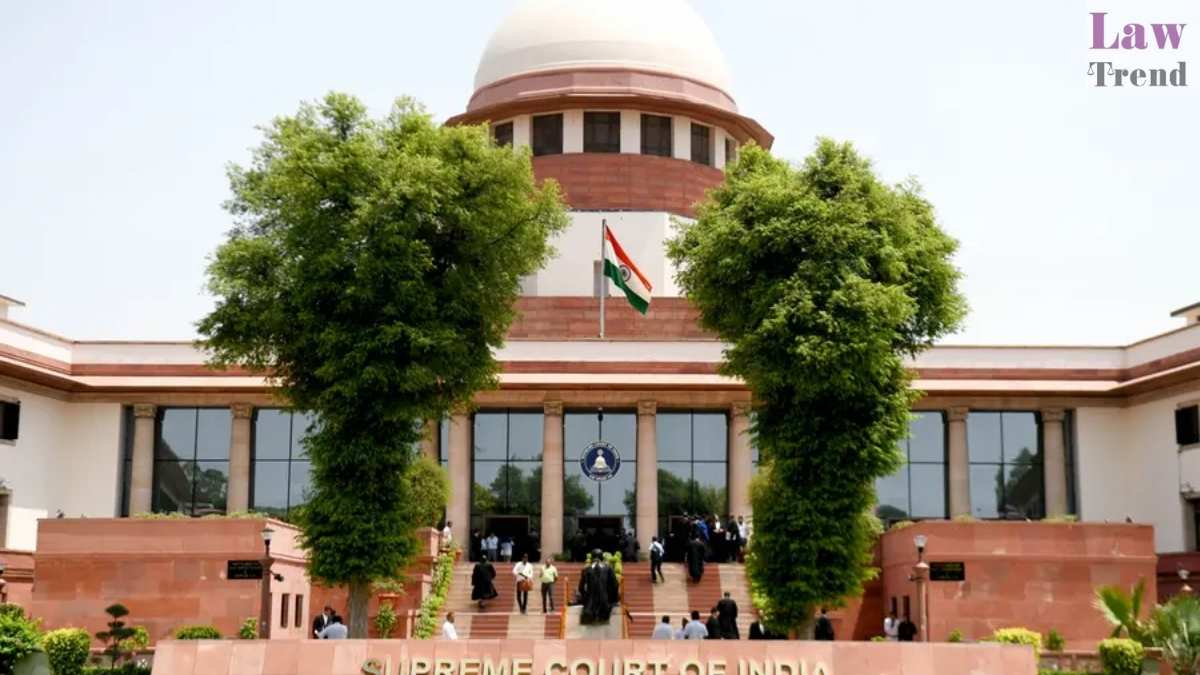
The Supreme Court of India has dismissed the State of Uttar Pradesh’s appeals against the acquittal of Central Excise officials in a thirty-year-old bribery case. A Bench comprising Justice Pankaj Mithal and Justice Prasanna B. Varale ruled that the prosecution failed to prove the essential ingredients of demand and acceptance of a bribe so far as the respondents were concerned, and failed to establish a charge of criminal conspiracy. The Court affirmed that mere recovery of money is insufficient for conviction under the Prevention of Corruption Act, 1988 (P.C. Act), and emphasized the narrow limits of appellate interference with orders of acquittal.
Background of the Case
The case originated on January 5, 1995, when R.K. Srivastava (Superintendent of Central Excise) and Inspectors A.K. Gaba and Alok Gupta inspected M/s Amoli Ceraplast Ltd. in Barabanki and allegedly seized records without issuing a receipt. On January 10, 1995, complainant Kuldeep Tiwari, a Retainer Consultant, met Srivastava, who allegedly demanded a bribe of Rs. 80,000/- to return the documents, leading Tiwari to lodge a First Information Report (F.I.R.) with the CBI.
According to the prosecution, Gaba and Gupta were present when the demand was reiterated on January 10. On January 14, 1995, a CBI trap at Srivastava’s residence led to the recovery of Rs. 60,000/- from a bedroom and Rs. 20,000/- from the jacket of Srivastava’s brother, P.K. Srivastava. A phenolphthalein test on the hands of R.K. Srivastava, P.K. Srivastava, and Dushyant Kumar turned pink.
On July 26, 2014, the Special Judge, Lucknow, convicted R.K. Srivastava, Gaba, Gupta, and Kumar under Section 120-B of the Indian Penal Code (IPC) read with Sections 7 and 13(1)(d) of the P.C. Act, while P.K. Srivastava was acquitted. On May 27, 2019, the High Court of Judicature at Allahabad (Lucknow Bench) set aside the convictions. The State of Uttar Pradesh subsequently appealed to the Supreme Court.
Arguments of the Parties
The State of Uttar Pradesh argued that the respondents were present during the seizure and bribe demands, and that Dushyant Kumar counted the trap money. The State contended that since the respondents were charged with criminal conspiracy under Section 120-B IPC, individual ingredients of the P.C. Act did not need to be proven as substantive offenses against them.
The respondents contended that Gaba and Gupta were junior officers merely following protocol. They argued that because no money was recovered from them and they denied the seizure of records in their statements under Section 313 of the Code of Criminal Procedure (Cr.P.C.), they stood on a better legal footing than those acquitted. Relying on Shyamal Saha & Anr. vs. State of West Bengal, they argued that hostile witnesses were fatal to the prosecution. Citing State of Gujarat vs. Manshankar Prabhashankar Dwivedi and State by Special Police Establishment vs. D. Krishnamurthy, they asserted that abuse of position is a sine qua non under the P.C. Act. They also pointed out that the principal accused, Srivastava, was never charged with conspiracy, making the conspiracy theory unsustainable.
The Court’s Analysis and Findings
1. Absence of Proven Demand and Acceptance
The Supreme Court held that proving demand and acceptance is an indispensable requirement for conviction. Highlighting the High Court’s findings, the Bench noted:
“…it is summarized that the necessary and essential ingredients of “demand” and “acceptance” of the bribe money is absolutely lacking in this case, so far as the accused appellants are concerned.”
The Court noted that Gaba and Gupta were not present in Srivastava’s office during the alleged January 10 meeting and were only performing protocol duties.
2. Deficiencies in the Conspiracy Charge
The Court noted a significant legal gap in the conspiracy charge, as the alleged chief conspirator, R.K. Srivastava, was never charged under Section 120-B IPC. The High Court’s observation was highlighted:
“…while all the three Inspectors, including both the appellants, were charged under Section 120 B (Criminal Conspiracy) of the IPC but main accused and alleged chief conspirator R.K. Srivastava was not charged under Section 120-B of IPC. Thus, the appellants were subjected to trial without linkage with prime accused who alone is allegedly involved in demand, acceptance and recovery of bribe amount in whole case.”
Citing State (NCT of Delhi) v. Navjot Sandhu, the Court observed that a meeting of minds is a sine qua non for conspiracy. It reiterated that circumstantial evidence must form a chain where “the circumstances so proved must form a chain of events from which the only irresistible conclusion about the guilt of the accused can be safely drawn and no other hypothesis against the guilt is possible”. Referring to Esher Singh v. State of A.P., the Court held that conspiracy cannot be inferred on suspicion or association.
3. Adverse Inference on Missing Tape Recording
The complainant claimed to have used a tape recorder to record the bribe conversation, but the prosecution never produced it. Applying Tomaso Bruno v. State of Uttar Pradesh, the Court drew an adverse inference against the prosecution under Section 114 Illustration (g) of the Indian Evidence Act, concluding that the evidence was withheld because its production would have been unfavorable.
4. Erroneous Reliance on Presumptions
The Supreme Court criticized the Trial Court’s reliance on conjectures, noting that the trial judge repeatedly used words like “Sambhavtah” (probably) and “Prateet hota hai” (it appears). Agreeing with the High Court, the Bench observed:
“The Learned trial Court’s order is based on presumption, as the Judge has used the words “Sambhavtah” and “Prateet hota hai” many times before presuming as to why the complainant Kuldeep Tewari did not implicate appellants. This is against the entire spirit of law as no person can be inculpated and exculpated at the same stake. The very uses of these words shake the confidence in the justice system and unless and until the guilt of the accused is proved up to hilt by cogent & corroborative evidence, every accused is liable to be discharged.”
5. Landmark Precedents on Recovery
The Court relied on B. Jayaraj v. State of A.P., P. Satyanarayana Murthy v. District Inspector of Police, Krishan Chander v. State of Delhi, and Rakesh Kapoor v. State of Himachal Pradesh to hold that recovery alone cannot sustain a conviction.
Citing Banarsi Dass v. State of Haryana, the Court noted that “mere recovery of money from the accused by itself is not enough in absence of substantive evidence for demand and acceptance.” Applying C.M. Sharma v. State of Andhra Pradesh, the Court underscored that “mere recovery of tainted money divorced from the circumstances under which it is paid is not sufficient to convict the accused when the substantive evidence in the case is not reliable.” The Court also cited Mukhtiar Singh v. State of Punjab to state that a failure to prove demand is fatal to the prosecution.
The Presumption of Innocence and Limits on Appellate Interference
A major portion of the Court’s reasoning focused on appellate limitations regarding acquittals. Citing Chandrappa v. State of Karnataka, the Court summarized that an acquittal strengthens the presumption of innocence. The Bench highlighted:
“If two reasonable conclusions are possible on the basis of the evidence on record, the appellate court should not disturb the finding of acquittal recorded by the trial court.”
Referring to State of Rajasthan v. Abdul Mannan and Hakeem Khan v. State of M.P., the Court stated that a “possible view” of a lower court cannot be interdicted merely because a superior court disagrees. Under Article 136 of the Constitution, the Supreme Court does not interfere with an acquittal unless the findings are perverse or manifestly illegal. Finding the High Court’s view to be entirely plausible, the Supreme Court dismissed the appeals.
Case Details
Case Title: State of Uttar Pradesh v. A.K. Gaba etc.
Case No.: Criminal Appeal Nos. 3383-3385 of 2025
Bench: Justice Pankaj Mithal, Justice Prasanna B. Varale
Date: May 27, 2026