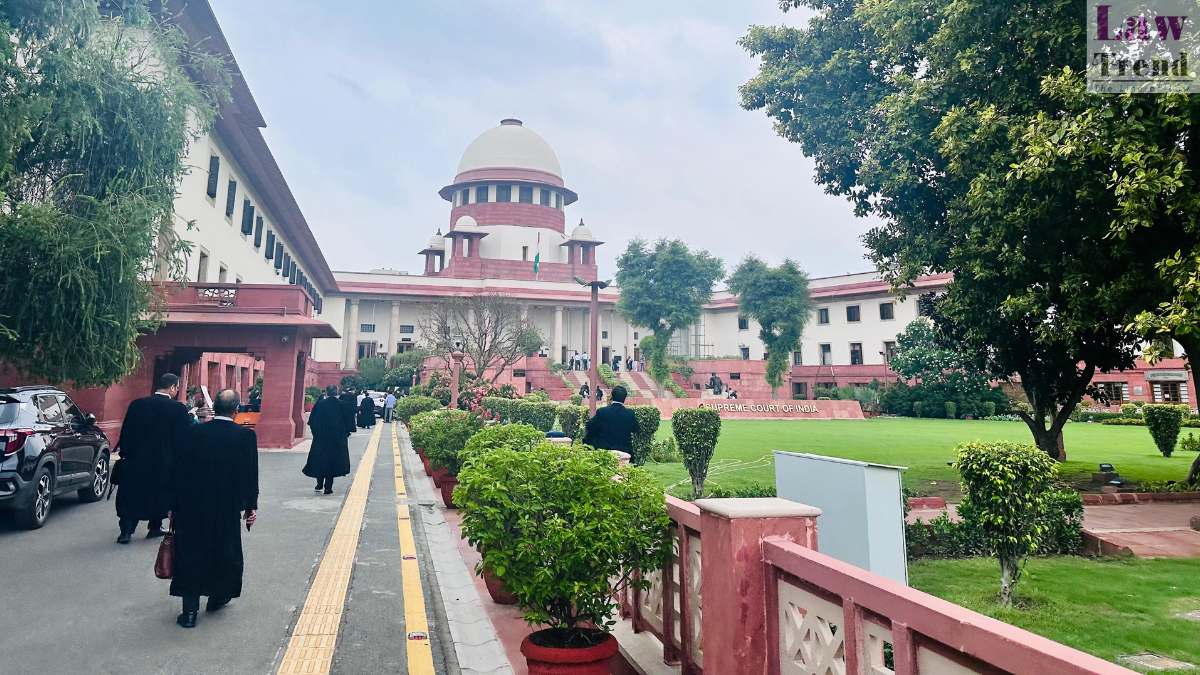
The Supreme Court of India has ruled that heirs inheriting the separate property of a Hindu male under Section 8 of the Hindu Succession Act, 1956, do so as tenants-in-common with definite shares, entirely eliminating the role of a ‘karta’ or manager for such property. A bench comprising Justice Sanjay Karol and Justice Augustine George Masih clarified this legal position while upholding a Bombay High Court order, ultimately dismissing an appeal filed by a step-mother who had attempted to sell a portion of inherited family property by claiming to act as the ‘karta’ out of legal necessity.
Background of the Dispute
The legal battle, which has spanned more than half a century, revolves around the separate property of late Dajiba, comprising land and houses in village Sapti. The dispute arose between Dajiba’s widow, Darubai (the original defendant and appellant), and his four daughters from another marriage (the plaintiffs).
Following Dajiba’s death, the four daughters filed a suit for partition and separate possession, claiming to be 4/5th owners of the property. The conflict escalated because Darubai had agreed to sell a part of the suit property to a buyer named Dattatraya. She defended the sale by claiming she was the ‘karta’ of the family and that the transaction was driven by “legal necessity” to fund the marriage of one of the plaintiff daughters.
The Civil Court initially decreed the suit in favor of the daughters, rejecting Darubai’s claim of legal necessity. However, the First Appellate Court reversed this finding, validating both the ground of legal necessity and the defendant’s right to manage the property. The matter then reached the High Court of Judicature at Bombay, Aurangabad Bench, which overturned the First Appellate Court’s decision and restored the Civil Court’s judgment, prompting Darubai to appeal to the Supreme Court.
Arguments and Core Legal Issue
Before the apex court, the relationship between the parties and the fact that the property was Dajiba’s separate property were not in dispute. The primary question the Court had to answer was whether the defendant could avail the ground of legal necessity as the ‘karta’ of the family, and whether the heirs succeeded to the suit properties as joint tenants or tenants-in-common under Section 8 of the Hindu Succession Act.
The Court’s Analysis
To resolve the dispute, the Supreme Court extensively examined Sections 8, 10, and 19 of the Hindu Succession Act, drawing a sharp distinction between joint tenancy and tenancy-in-common.
The Court observed that in a joint tenancy—governed by the rule of survivorship—all co-owners together constitute ownership, and no co-owner has a separate inheritable share while the tenancy subsists. Referencing the Privy Council’s historical stance in Jogeswar Narain Deo v. Ram Chund Dutt, the Court noted: “The principle of joint tenancy appears to be unknown to Hindu law, except in the case of coparcenary between the members of an undivided family.”
In contrast, under a tenancy-in-common, each co-owner possesses a distinct, undivided share. Upon the death of a co-owner, their share devolves upon their own legal heirs according to the law of succession, rather than passing automatically to the surviving co-owners. Relying on the Lahore High Court judgment in Nawab Nisar Ali Khan v. Sardar Nawazish Ali Khan, the bench highlighted: “where there is a jointness of title, each coparcener is in possession of every portion of the joint property while his share is not defined… Such jointness of title can ordinarily exist in the case of a coparcenary property only, but where the shares of co-owners are known and ascertained, a suit for partition is virtually a suit to enforce a right to a share in joint family property.”
The bench further explored this through the lens of the Allahabad High Court’s decision in Azizun Nisa v. Assistant Custodian, cementing the principle that in a tenancy-in-common, shares can always be separated.
Crucially, the Court relied on landmark judgments like CWT v. Chander Sen and Yudhishter v. Ashok Kumar, which conclusively settled that property devolving upon a son under Section 8 is taken in his individual capacity, not as the karta of his own Hindu Undivided Family. Reaffirming this stance with the recent case of M. Arumugam v. Ammaniammal, the Court noted that lawmakers intended for such heirs to hold the property “as tenants-in-common and not as joint tenants.”
The Court firmly established that in the context of Section 8 succession, the concept of a karta does not arise merely because the property belonged to a paternal ancestor. The inheritance is individual, statutory, and devolves by succession rather than survivorship.
The Decision
Applying these legal principles to the facts, the Supreme Court ruled that upon Dajiba’s death, his widow Darubai and her four step-daughters instantly became tenants-in-common, each securing a definite and separate 1/5th share in the estate.
Because the shares were legally distinct and separate, the Court held that the step-mother had no legal standing to act as a ‘karta’. She could not validly sell the broader family property under the guise of legal necessity.
“When each of them have separate and identifiable shares, in the considered view of this Court, there arises no question of the defendant acting as karta to sell off a part of the property on account of legal necessity, be it for whatever reason, for she only had the right to do whatever she wished with the 1/5th share of the property that vested with her,” the judgment stated.
The Supreme Court dismissed the appeal without any order as to costs, expressing hope that the finality of the judgment would allow the parties to put the long-standing dispute behind them and move forward peacefully.
Case Title: Darubai & Anr. v. Kamalabai & Ors.
Case No.: Civil Appeal No. ___ of 2026 (@ Special Leave Petition(Civil) No. 13232 of 2022)
Bench: Justice Sanjay Karol, Justice Augustine George Masih
Date: June 1, 2026