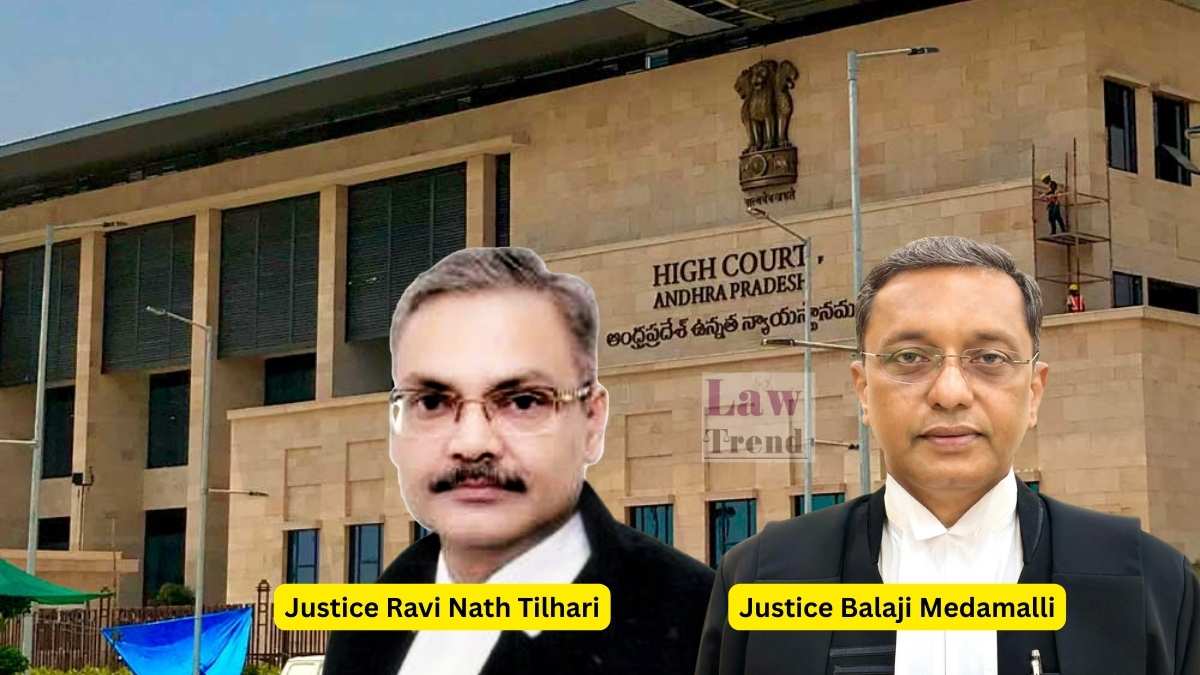
The High Court of Andhra Pradesh, in a division bench comprising Justice Ravi Nath Tilhari and Justice Balaji Medamalli, ruled that a plaint cannot be rejected at the initial registration stage if it discloses a cause of action. Holding that merits must be decided during trial, the Court set aside a lower court’s decree that had rejected a suit against Union Bank of India and directed the trial court to register the matter and proceed in accordance with the law.
Background
The legal dispute arose when the appellant, Lakkavajjula Sai Praneet, filed a suit seeking the rendition of accounts against the Union Bank of India. The suit was presented before the II Additional District Judge, Vijayawada. However, on March 6, 2026, the trial court rejected the plaint at the very stage of registration.
The lower court reasoned that “the plaintiff has no cause of action to maintain the suit for rendition of accounts against the defendant-Bank as he failed to show any such right is created or recognized under a statue or based in his favour and there is fiduciary relationship of beneficiary and trusty between the plaintiff and the defendant or in equity the rendition of accounts is the only relief which will enable to him to assert his legal right never the plaint is not maintainable for want of cause of action and is liable to be rejected”.
Arguments by the Appellant
Challenging this rejection, the appellant’s counsel, Sri T.V.P. Sai Vihari, argued that the plaint explicitly outlined the cause of action under a specific heading. He contended that under Order 7 Rule 11(a) of the Civil Procedure Code (CPC), a plaint can only be rejected if it completely fails to disclose a cause of action.
The counsel emphasized that whether the suit would ultimately succeed based on the stated cause of action is a matter to be determined during the trial through evidence, and thus, non-registration of the suit was legally unsustainable.
The High Court’s Analysis
Analyzing the arguments, the High Court examined Order 7 Rule 11(a) of the CPC and clarified the legal distinction between failing to disclose a cause of action and whether that cause of action will ultimately succeed. The bench noted that while a plaint must be rejected if it does not disclose a cause of action, it cannot be discarded at the threshold when the cause of action is clearly stated.
Relying on the precedent set in Gummadi Usha Rani and another v. Guduru Venkateswara Rao and others, the Court reiterated that a plaint cannot be rejected at the registration stage on grounds of being barred by limitation or lacking a cause of action. The bench further cited Jillellamudi Jagadeesh and Ors v. Jillellamudi Subbayamma and Ors, observing that courts normally should not delve into the merits of the matter at the numbering stage.
The Court noted that if a plaintiff fails to prove their claim during the trial, they will eventually be non-suited, but the suit must first be numbered if a cause of action is apparent on the face of the plaint. The Court conclusively held, “Here the plaint discloses cause of action so the impugned decree cannot be sustained.”
Decision and Refund of Court Fees
Additionally, the Court addressed the issue of court fees. By analyzing Sections 63 and 64 of the Andhra Pradesh Court Fees and Suits Valuation Act, 1956, and referencing the case of Veluru Prabhavathi, the bench found the appellant entitled to a refund of the court fees paid for the appeal.
Ultimately, the High Court allowed the appeal and set aside the rejection order passed by the II Additional District Judge, Vijayawada. The bench directed the lower court to register the suit and proceed further in accordance with the law, while also ordering the registry to refund the court fee deposited in the appeal directly to the appellant’s bank account.
Case Title: Lakkavajjula Sai Praneet v. Union Bank of India
Case No.: Appeal Suit No. 202 of 2026
Bench: Justice Ravi Nath Tilhari and Justice Balaji Medamalli
Date: 24.04.2026