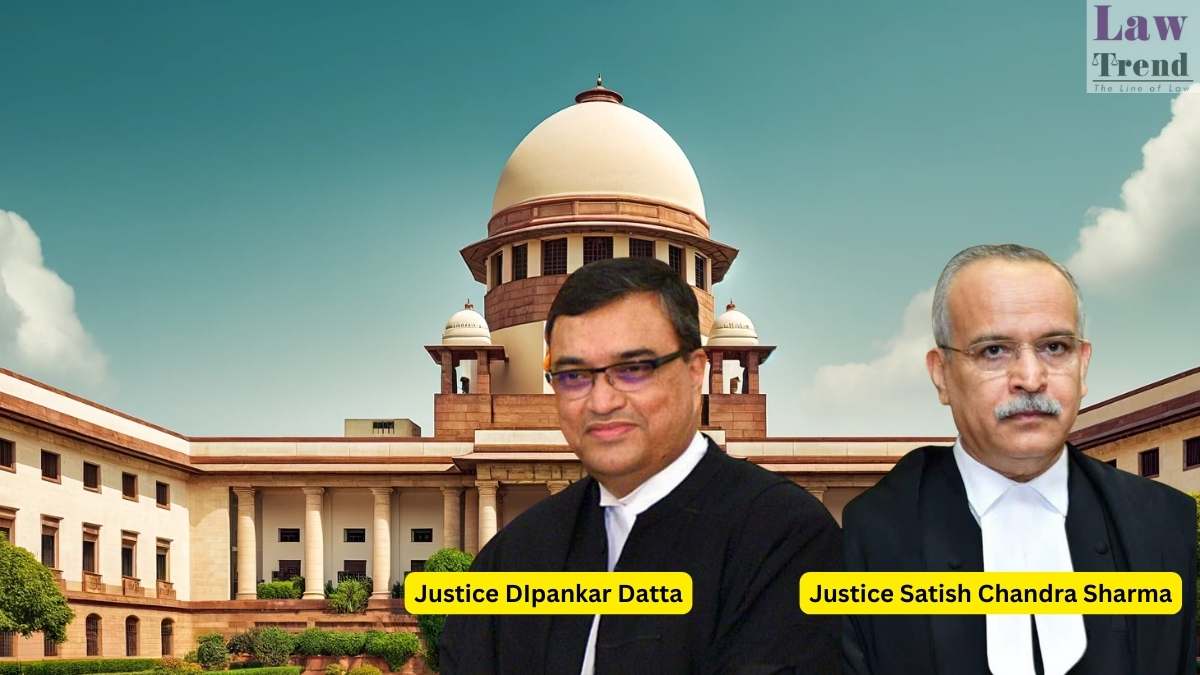
The Supreme Court of India, comprising a bench of Justice Dipankar Datta and Justice Satish Chandra Sharma, has ruled that the wide discretionary power under Section 311 of the Code of Criminal Procedure, 1973 (CrPC) cannot be exercised to fill up lacunae in the defense case or subject victims of heinous crimes to the trauma of repeated cross-examinations. Setting aside an order of the High Court of Tripura that permitted the recall of a prosecutrix for further cross-examination after an unexplained four-year delay, the Court emphasized that recall is not a matter of course and must balance the right to a fair trial with avoiding undue hardship to witnesses. The decision underscores the judiciary’s responsibility to prevent the abuse of procedural laws that prolong trials and inflict secondary trauma on victims of sexual offenses.
Background of the Case
The matter originates from a written complaint lodged by the prosecutrix, which led to the registration of an FIR alleging offenses punishable under Sections 342 (wrongful confinement), 376(1) (rape), and 506 (criminal intimidation) of the Indian Penal Code, 1860 (IPC) against the accused. The complaint asserted that the prosecutrix had visited the residence of the accused to discuss house rent, where she was forcibly confined, her clothes torn, and rape committed upon her under threats of death.
Following an investigation and the recording of her statement under Section 164 CrPC, charges were framed, and the trial commenced in 2017. The prosecutrix was first examined and cross-examined over two sessions in June and July 2018. She was later recalled, re-examined, and re-cross-examined in August and November 2019 following a High Court order.
Four years later, in December 2023, the accused filed an application under Section 311 CrPC to recall the prosecutrix once again, proposing a list of 94 questions. The application claimed that due to oversight, the defense had failed to question her on Call Detail Records (CDRs) of the mobile phones belonging to the prosecutrix and the accused. The Trial Court rejected this application, noting the inordinate delay and the absence of sufficient grounds. However, the High Court of Tripura set aside that rejection, directing the Trial Court to permit further cross-examination with reference to the CDRs. The State subsequently appealed this direction to the Supreme Court.
Arguments of the Parties
The Appellant State contended that the prosecutrix had already been extensively cross-examined across multiple hearings over a considerable period. The State argued that the application under Section 311 CrPC was filed after an unexplained delay of more than four years and was a clear attempt to fill lacunae in the defense’s case while prolonging a trial pending since 2017. Additionally, the State pointed out that the CDRs relied upon by the defense had already been filed by the prosecution along with the chargesheet and were always within the knowledge of the defense.
Conversely, the accused argued that the CDRs were essential as they reflected the frequency, timing, and nature of telephonic contact between the parties around the time of the alleged incident, which had a material bearing on the prosecution’s case. The defense maintained that due to inadvertence, critical questions regarding these records could not be put to the prosecutrix, making her recall necessary for a fair and just decision.
Court’s Analysis and Findings
The Supreme Court analyzed the scope and limits of Section 311 CrPC. Writing for the bench, Justice Sharma highlighted that while the statutory power is wide, it must be exercised with caution and circumspection. The Court referred to a consistent line of precedents to clarify these boundaries.
Citing the decision in Natasha Singh v. Central Bureau of Investigation, the Court reiterated: “An application under Section 311 Cr.P.C. must not be allowed only to fill up a lacuna in the case of the prosecution, or of the defence, or to cause serious prejudice to the defence of the accused, or to give an unfair advantage to the opposite party.”
The Court also invoked Swapan Kumar Chatterjee v. Central Bureau of Investigation, which established that the power should only be invoked for strong and valid reasons: “The power is to be exercised only for strong and valid reasons and it should be exercised with great caution and circumspection.”
Furthermore, referencing Vijay Kumar v. State of Uttar Pradesh, the bench noted that the exercise of this discretionary power largely depends upon the specific facts and circumstances of each case. Addressing the balance between a fair trial and the prevention of procedural abuse, the Court relied on State (NCT of Delhi) v. Shiv Kumar Yadav, quoting: “Recall is not a matter of course and the discretion given to the court has to be exercised judiciously to prevent failure of justice and not arbitrarily.”
Applying these principles, the Supreme Court held that the High Court was unjustified in interfering with the Trial Court’s order. The Court identified three critical reasons for this determination:
- Extensive Prior Cross-Examination: The prosecutrix had already been subjected to detailed examination and cross-examination on four separate occasions spread across 2018 and 2019, providing the defense with ample opportunity to test her testimony.
- Inordinate and Unexplained Delay: The application was filed after a delay of nearly four years from the completion of her cross-examination, and seven years after the registration of the FIR. During this period, 19 other witnesses had been examined, and the trial had progressed substantially.
- No Defense Lacunae: Since the CDRs were filed with the chargesheet and were part of the record from the beginning, the defense had full knowledge of them. The Court ruled that Section 311 CrPC cannot be used to rescue the defense from its own oversight or to fill gaps in its case.
Significantly, the Court emphasized the impact of repeated recalls on victims of sensitive crimes, observing: “It can result in undue hardship for the victims, especially so, of heinous crimes, if they are required to repeatedly appear in Court to face cross-examination.”
Decision / Directions Issued by the Court
The Supreme Court allowed the appeal, setting aside the judgment and order dated March 14, 2024, passed by the High Court of Tripura. The Court restored the Trial Court’s order dated February 6, 2024, which had rejected the application under Section 311 CrPC. Finally, the Court directed the Trial Court, subject to its convenience, to conclude the trial by the end of the year.
Case Details
Case Title: The State of Tripura v. Panna Ahmed
Case Number: Criminal Appeal No. 2848 of 2026
Bench: Justice Dipankar Datta and Justice Satish Chandra Sharma
Date of Judgment: May 26, 2026