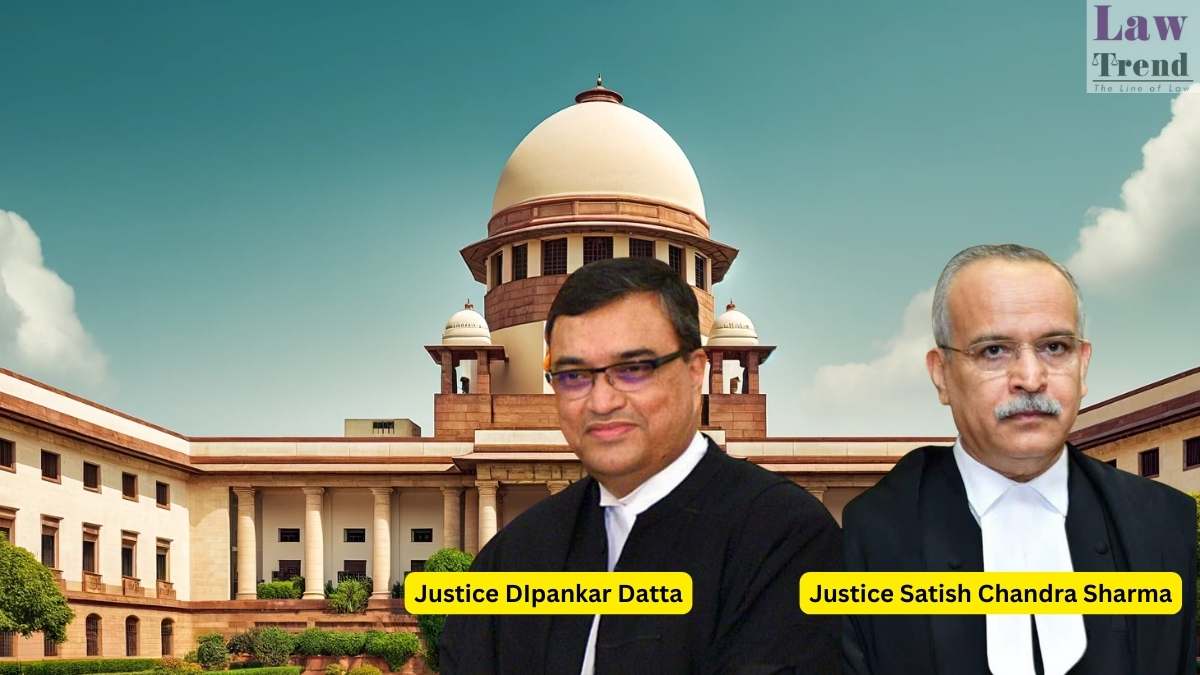
The Supreme Court of India, in the case of Bency John v. Kerala State Electricity Board Ltd & Ors. (2026 INSC 562), ruled that a railway servant does not cease to be a member of the Union civil service merely because separate rules govern their service conditions. A division bench comprising Justice Dipankar Datta and Justice Satish Chandra Sharma held that railway employees hold civil posts under the Union and remain under Central Government administrative control. The Court set aside the High Court of Kerala’s Division Bench judgment and restored the Single Judge’s decision, confirming the appellant’s entitlement to pay weightage for past service.
Background
Appellant Bency John joined the Indian Railways as a Junior Draftsman on August 9, 1990. After ten years of regular pensionable service, he was relieved on February 24, 2001, to join the Kerala State Electricity Board (the Board) as a Sub-Engineer on February 26, 2001. The Railways remitted Rs. 2,16,429/- for pro-rata pension liability, which was recorded in his Service Book.
Under Board Order B.O. 2119/96 and subsequent Settlements of 2000 and 2007, prior government service followed by Board service counted toward qualifying service for weightage. Accordingly, John received weightage benefits. However, on December 1, 2012, the Board’s Chief Internal Auditor cancelled the weightage and ordered recovery, claiming railway service is not Central Government service.
John challenged this before the High Court of Kerala. A Single Judge ruled in his favor on March 21, 2017, but a Division Bench set it aside on August 19, 2019, ruling that railway service was excluded because general Central Civil Services (CCS) Rules do not apply to railway servants. After his review petitions were dismissed, John moved the Supreme Court, as detailed in 20692_2020_8_1501_71563_Judgement_26-May-2026.pdf.
Arguments
Arguments on behalf of the Appellant:
- Indian Railways is a Central Government department under the Ministry of Railways; its regular employees hold civil posts under Article 311 of the Constitution.
- Section 2(34) of the Indian Railways Act, 1989, explicitly defines a “railway servant” as a person employed by the Central Government.
- UPSC Regulations, the Code of Civil Procedure, and successive Pay Commissions consistently recognize the Railways as a department of the Central Government.
- Separate rules, like the Railway Services (Conduct) Rules, 1966, are administrative arrangements that do not alter employees’ fundamental status.
- The Board accepted pro-rata pension contributions and is bound by its settlements under promissory estoppel.
- Denying weightage to railway employees while allowing it for other Central departments is discriminatory under Article 14.
- Retrospective recovery from a retired employee violates the law established in State of Punjab v. Rafiq Masih.
Arguments on behalf of the Respondents:
- “Central Government Service” in Board Order B.O. 2119/96 refers strictly to services under the CCS (Conduct) Rules, 1964, which exclude railway servants.
- Railway employees are governed by the separate Railway Services Rules and the Indian Railway Establishment Code, excluding them from the general definition of “Government servant.”
- Railways operate as a Public Sector Undertaking, with recruitments conducted via the Railway Recruitment Board rather than regular civil service.
- Board orders only allow prior railway service to count for pension benefits (already granted to the appellant), not for pay weightage.
- Appellant cannot introduce new documents at the review stage under the precedent of Balai Chandra Hazra v. Shewdhari Jadav.
Court’s Analysis
The Supreme Court limited its review to the Division Bench orders of August 19, 2019. It framed two central questions: whether a railway servant ceases to be a Union civil service member due to separate service rules, and whether the Board was estopped from withdrawing the pay weightage.
The Court traced the service rules of both the general CCS and the Railways to the proviso of Article 309 of the Constitution. It rejected the argument that separate rules change a railway servant’s status, stating:
“By the very terms of the proviso, a railway servant is also a Government servant though it is not the CCS (Conduct) Rules but the Railway Services (Conduct) Rules that would apply to him.”
Citing Moti Ram Deka v. North East Frontier Railway, the Court noted that railway servants enjoy Article 311 procedural safeguards against arbitrary dismissal, which applies only to civil post-holders:
“Accordingly, once the Court held that the protection of Article 311 was available to railway servants notwithstanding the existence of separate service rules, it necessarily followed that railway employees were holders of civil posts under the Union…”
Referencing State of Assam v. Kanak Chandra Dutta, the Court evaluated the master-servant relationship and concluded that railway employees remain under the administrative control of the Central Government:
“…the delegation of powers to the Railway Board does not have the effect of making a railway servant an employee of the Railway Board as distinct from the Central Government, nor does it alter his status as a member of the civil service of the Union. A railway servant though appointed in a Government Railway under rules made exclusively for the Railways in exercise of powers under the proviso to Article 309 of the Constitution remains a person holding a civil post in connection with the affairs of the Union under the administrative control of the Central Government.”
Regarding the second question, the Court ruled in the affirmative, holding the Board estopped from withdrawing benefits after accepting pension contributions.
Decision
The Supreme Court allowed the appeals with no order as to costs. It set aside the Division Bench judgments dated August 19, 2019, and fully restored the Single Judge’s judgment dated March 21, 2017.
The Court declared the appellant entitled to all benefits flowing from the Single Judge’s judgment and directed the Board to release all consequential benefits within three months from the production of an authenticated copy of the judgment. It also ruled that similarly situated employee D. Vishnu Nampoothiri may approach the Board for identical relief, and hoped that “the Board will not subject D. Vishnu Nampoothiri to any discrimination.”
Case Details
- Case Title: Bency John v. Kerala State Electricity Board Ltd & Ors.
- Case No.: Civil Appeal Nos. of 2026 (Arising out of SLP (C) Nos. 1377-1380 of 2021)
- Bench: Justice Dipankar Datta, Justice Satish Chandra Sharma
- Date of Judgment: May 26, 2026
- Citation: 2026 INSC 562