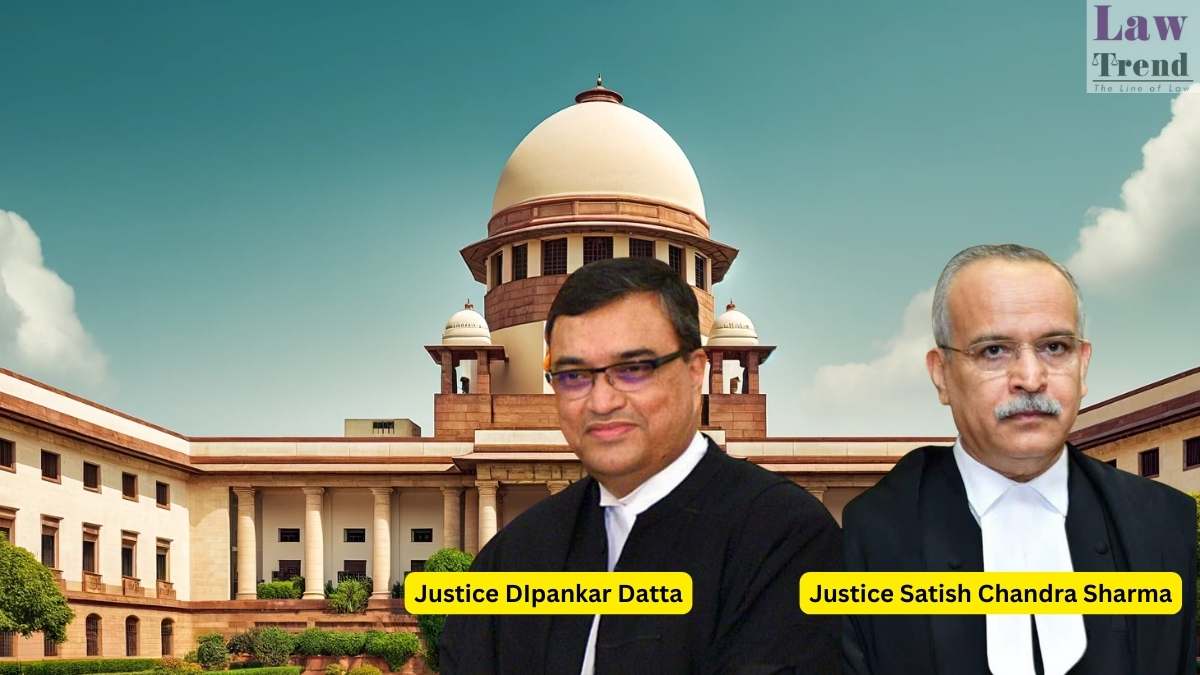
The Supreme Court of India has set aside an order of the High Court of Madhya Pradesh that affirmed a life sentence in a murder case, remanding the matter for a de novo (fresh) hearing. The apex court ruled that the High Court’s hasty appointment of an amicus curiae to represent an incarcerated appellant, without notifying him or affording the amicus an opportunity to confer with him, deprived the appellant of effective legal representation.
Background of the Case
The appellant, 74-year-old Nandkishore Mishra, was convicted of murder under Section 302 of the Indian Penal Code, 1860, and sentenced to life imprisonment by a sessions court on December 20, 2022, for an incident dated October 16, 2020. Mishra has been in custody since the date of the incident.
Mishra subsequently appealed his conviction before the High Court of Madhya Pradesh at Jabalpur. During the pendency of the appeal, a Division Bench listed the matter on November 20, 2025. When the appellant’s engaged advocate failed to appear, the High Court appointed an amicus curiae to assist the Court and listed the matter for hearing the following week.
On November 26, 2025—just six days later—the amicus argued the appeal. The amicus contended that the eyewitness account of one Arun Singh (PW-2) was unreliable, noting he was 100 metres away and only identified the appellant at the instance of the deceased’s brother. The State opposed the appeal, citing the recovery of a blood-stained axe. Following the arguments, the High Court dismissed the appeal and affirmed the trial court’s conviction and sentence.
Arguments Before the Supreme Court
Before the Supreme Court, counsel for the appellant vehemently argued that Mishra was denied justice and an effective opportunity to be heard, in gross violation of the principles of natural justice. The counsel submitted that the appellant’s original advocate was absent on November 20, 2025, due to medical treatment.
While Mishra languished in jail, the High Court did not notify him of his counsel’s absence or the appointment of the amicus. Furthermore, in the brief intervening period before the appeal’s dismissal, the newly appointed amicus did not meet or have any conference with the incarcerated appellant to discuss the case.
The State of Madhya Pradesh offered no submissions to the contrary regarding the lack of communication with the appellant.
The Court’s Analysis
The Supreme Court bench, comprising Justice Dipankar Datta and Justice Satish Chandra Sharma, noted the absence of any material showing that notice was served to the appellant regarding the consideration of his appeal. The Court subsequently drew an adverse inference, accepting the appellant’s submission.
The Court observed that while the High Court acted with a bona fide intention to deliver justice expeditiously, it failed to inform the appellant of the new representation arrangement.
“Legal aid to an accused person must not be a mere ritual or a token formality, but a substantive and meaningful exercise that ensures effective assistance of counsel,” the bench observed. The Court added that it “would perhaps have better served the ends of justice had a formal notice been issued to the appellant informing him of the hearing and the arrangement made for his representation.”
In its analysis, the Supreme Court relied on recent jurisprudence, specifically citing Bhola Mahto v. State of Jharkhand (Criminal Appeal No. 1450 of 2026) and a three-Judge Bench decision in Anokhi Lal vs. State of Madhya Pradesh (2019 20 SCC 196).
The Court emphasized two specific directions from the Anokhi Lal judgment:
- The amicus must be afforded reasonable time to prepare the matter.
- Adequate opportunity must be granted to the amicus to meet and confer with the accused/convict concerned.
The bench concluded, “Admittedly, neither of these directions appear to have been complied with in the present case.”
The Decision
The Supreme Court partly allowed the appeal, setting aside the High Court’s impugned order dated November 26, 2025, and reviving the appeal on the file of the High Court for a de novo hearing.
The Court directed that the appeal be listed within two months, preferably before the same member Judges of the Division Bench, subject to availability. The Court further clarified that since the septuagenarian appellant wishes to be represented by his own counsel, there is no need to appoint an amicus if his counsel fails to appear on the notified date, provided a week’s advance notice is given by the Registry. In such an event, the High Court is advised to decide the appeal as it deems fit.
The appellant will remain in custody until the appeal is disposed of by the High Court on its own merits.
Case Details :
Case Title: Nandkishore Mishra vs. The State of Madhya Pradesh
Case No.: Criminal Appeal No. [Blank]/2026 (Arising out of SLP (CRL) No. 3371 OF 2026)
Bench: Justice Dipankar Datta, Justice Satish Chandra Sharma
Date: May 22, 2026