

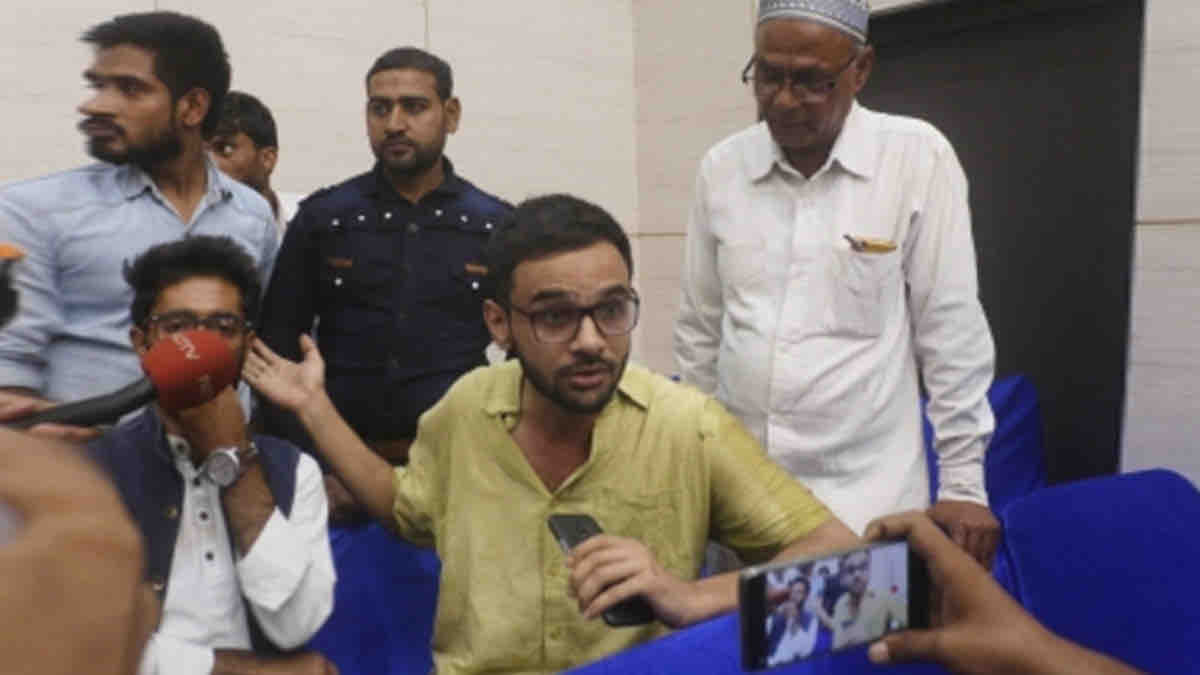
The Delhi High Court on Friday granted a three-day interim bail to jailed student activist Umar Khalid to attend to his mother, who is scheduled to undergo surgery. A division bench comprising Justices Prathiba M. Singh and Madhu Jain ordered Khalid’s temporary release on “empathetic grounds,” rejecting the Delhi Police’s plea to release him only under a strict police custody escort.
Khalid, who was arrested in September 2020 under the stringent Unlawful Activities (Prevention) Act (UAPA) in connection with the alleged larger conspiracy behind the 2020 northeast Delhi communal riots, has remained in continuous pre-trial detention for five years and eight months.
Background of the Case
Umar Khalid approached the High Court to challenge a May 19 order of a Delhi trial court which had declined his application for a 15-day interim bail. Khalid had sought temporary release to attend the 40th-day post-death ritual (Chehlum ceremony) of his late maternal uncle and to care for his mother during her scheduled surgery.
In its May 19 order, the trial court had dismissed his interim bail application, holding that attending the post-death rituals of his uncle was “not that necessary.” On the matter of his mother’s surgery, the trial court observed that other family members were available to take care of her, adding:
“But it doesn’t mean that on every occasion, whenever the accused seeks bail, the court should grant it.”
Arguments of the Parties
Before the High Court division bench, Senior Advocate Trideep Pais, appearing for Khalid, submitted that the student activist had been released on interim bail on three previous occasions during his incarceration—including to attend his sister’s wedding—and had never flouted any of the conditions or terms imposed by the courts.
Opposing the interim release, Additional Solicitor General (ASG) S.V. Raju, representing the Delhi Police, argued that the scheduled medical procedure for Khalid’s mother was a minor surgery and that his sisters and father were available to assist her. The ASG further contended that if any concession were to be made, Khalid should not be granted regular interim bail, but should instead only be permitted to visit his mother under a secure police custody escort and be returned to prison on the same day.
The Court’s Analysis
In its analysis, the division bench weighed the gravity of the prosecution’s allegations against the humanitarian nature of the appellant’s request. The High Court noted that Khalid was denied regular bail by a division bench of the Supreme Court on January 5, which had observed that he appeared to be one of the “prime conspirators” in the conspiracy case.
Despite this, the bench held that the scheduled medical surgery of his mother warranted a humanitarian approach. Writing for the bench, the court recorded:
“The court is also conscious of the fact that the regular bail application was rejected by the SC on January 5, the appellant being one of the prime conspirators… However, taking an empathetic view that his mother is due to undergo surgery, this court is inclined to grant interim bail from June 1, 7 am to June 3, 5 pm.”
The High Court declined to grant Khalid interim bail to attend his late uncle’s death rituals, finding the ground insufficient for temporary release. It also turned down the prosecution’s demand to release him under continuous police escort, opting instead to enforce compliance through strict security and residency conditions.
The Decision
The High Court ordered Khalid’s release on interim bail starting from 7:00 AM on June 1, 2026, until 5:00 PM on June 3, 2026, subject to furnishing a personal bond and surety of Rs 1 lakh.
To govern his conduct during the three-day temporary release, the court imposed the following strict conditions:
- Khalid is restrained from moving beyond the National Capital Region (NCR) during the period of interim bail.
- He is permitted to stay only at his residence in Jamia Nagar, Delhi, and is prohibited from visiting any place other than his home and the hospital where his mother’s surgery is scheduled.
- He must use only one mobile number and remain in continuous touch with the Investigating Officer (IO) of the case.
Jurisprudential Context and Supreme Court Observations
The High Court’s order comes amidst a wider, ongoing judicial debate regarding prolonged pre-trial detention under the UAPA.
On May 18—one day before the trial court originally rejected Khalid’s interim application—a separate division bench of the Supreme Court comprising Justices B.V. Nagarathna and Ujjal Bhuyan expressed “serious reservations” regarding the January 5 order of another coordinate Supreme Court bench that had denied regular bail to Khalid and co-accused activist Sharjeel Imam.
In the January 5 ruling, a division bench of Justices Aravind Kumar and N.V. Anjaria had granted regular bail to five other co-accused in the larger conspiracy case but denied it to Khalid and Imam, observing that they stood on a “higher footing in the hierarchy of participation” and that prolonged incarceration is not an “absolute entitlement” to seek bail in terror cases.
However, the bench of Justices Nagarathna and Bhuyan expressed strong disagreement with that logic. They referred to the binding three-judge bench precedent in Union of India v. K.A. Najeeb (2021), which held that an undertrial accused facing lengthy incarceration under UAPA, with no immediate end to the criminal trial in sight, must be enlarged on bail to protect their constitutional right to a speedy trial.




