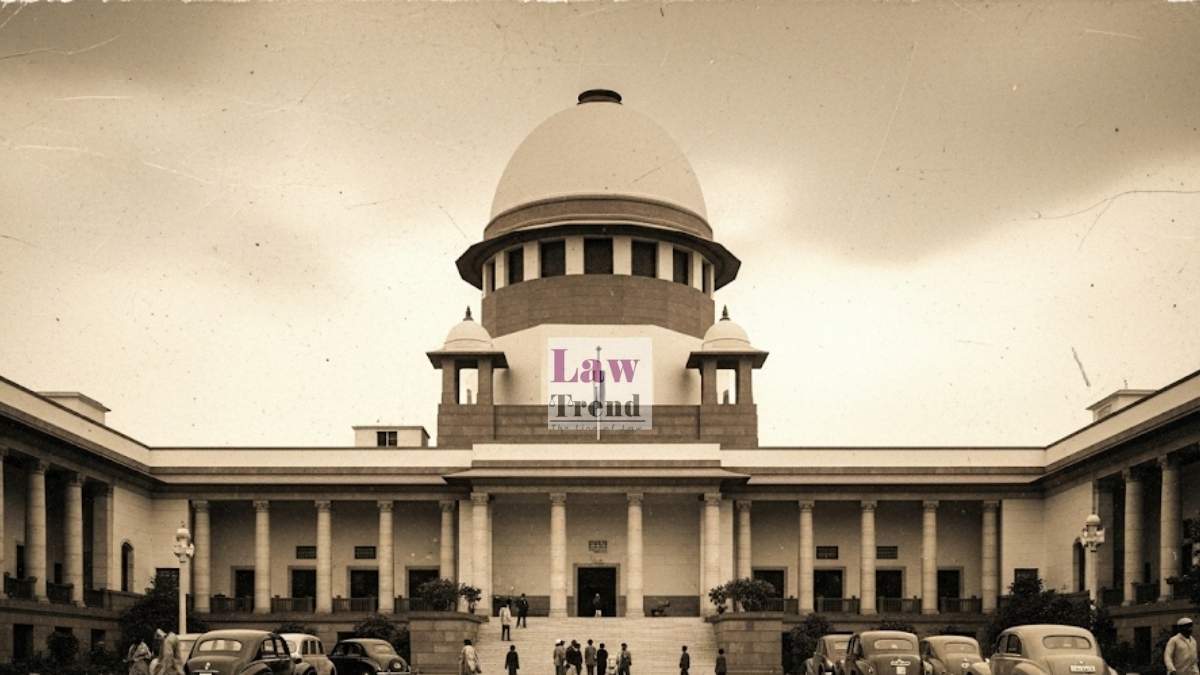
The Supreme Court of India has dismissed an appeal filed by a husband challenging his conviction for the murder of his wife inside their matrimonial home. The Court ruled that the prosecution had established an unbroken chain of circumstantial evidence, and the husband’s failure to provide a plausible explanation for the unnatural death of his wife—under Section 106 of the Indian Evidence Act—served as an additional link to confirm his guilt.
A division bench comprising Justice Pankaj Mithal and Justice Prasanna B. Varale upheld the judgment of the Bombay High Court, which had affirmed the conviction and life sentence handed down to Chetan Dashrath Gade (the appellant/accused no. 1) by the Additional Sessions Judge, Nashik, under Sections 302 and 201 read with Section 34 of the Indian Penal Code (IPC).
Background of the Case
The deceased, Rupali, daughter of Babasaheb Kumbharkar (P.W. 1), married the appellant, Chetan Dashrath Gade, on April 24, 2012. She resided at her matrimonial home in Shindwad, Maharashtra, along with her husband and in-laws. After an unfortunate intrauterine fetal death during her first pregnancy in 2013, Rupali gave birth to a baby boy in March 2015, who was six months old at the time of the incident.
According to the testimony of P.W. 1, Rupali had previously disclosed that she was being harassed and ill-treated by her in-laws for failing to fetch “one Tola Gold” from her parents. P.W. 1 also stated that the accused had demanded ₹1 Lakh for purchasing a pick-up vehicle, a sum which P.W. 1 subsequently handed over to the appellant’s father.
On August 23, 2015, at approximately 1:30 PM, the appellant’s younger brother, Akshay (Accused No. 3), informed P.W. 1 that Rupali was dead. Earlier that day, at around 11:00 AM, the appellant had informed his father, Dashrath Gade, that Rupali had attempted suicide by hanging at their house, but since he suspected she was still alive, he was taking her to a doctor. Dashrath subsequently reported the matter to the Vani Police Station.
When Rupali’s parents reached the Primary Health Centre at Vani Government Hospital, they observed a fresh injury mark on the right side of her cheek and a ligature mark on her neck. Furthermore, P.W. 1 noticed that the earrings on Rupali’s left ear, the anklet on her right leg, and the toe rings on both legs were missing. Following these observations, P.W. 1 lodged a police complaint.
Trial Court and High Court Findings
Following a trial where the prosecution examined 12 witnesses, the Additional Sessions Judge, Nashik, convicted the appellant and his brother (Accused No. 3) under Section 302 read with Section 34 of the IPC, and Section 201 read with Section 34 IPC. Crucially, the Trial Court acquitted all the accused of charges under Sections 498-A (cruelty) and 304-B (dowry death) on the ground that the prosecution failed to establish ongoing cruelty or dowry demands prior to the death.
On appeal, the Bombay High Court partly allowed the appeals. It acquitted Accused No. 3 (Akshay Gade) of murder, extending to him the benefit of doubt. However, it affirmed the conviction and life imprisonment of the appellant (Chetan Dashrath Gade) under Section 302 IPC. The High Court also convicted the father (Accused No. 2) under Section 201 IPC (destruction of evidence), sentencing him to three years of rigorous imprisonment. The appellant then approached the Supreme Court.
Arguments of the Parties
For the Appellant: The learned Senior Counsel for the appellant argued that the conviction was unsustainable because:
- There were no eyewitnesses to the incident, and no motive or common intention to commit murder was established.
- The medical experts gave inconsistent opinions, with one indicating hanging and another indicating both hanging and strangulation, making the cause of death doubtful.
- A suicide note, confirmed by a handwriting expert to be in the deceased’s handwriting, was recovered, stating that no one was responsible for her death.
For the Respondent (State of Maharashtra): The learned Counsel for the State submitted that:
- The concurrent findings of the Sessions Court and the High Court should not be disrupted.
- The death occurred inside the matrimonial home, placing a heavy burden of explanation on the appellant.
- The post-mortem report clearly indicated asphyxia due to strangulation (noting a fractured larynx and trachea), which is inconsistent with suicide.
- The alleged suicide note was suspected to be forcibly obtained or planted.
The Court’s Analysis and Observations
The Supreme Court examined the scope of its interference under Article 136 of the Constitution of India, citing Mekala Sivaiah v. State of Andhra Pradesh (2022) 8 SCC 253:
“It is only in rare and exceptional cases where there is some manifest illegality or grave and serious miscarriage of justice on account of misreading or ignoring material evidence, that this Court would interfere with such finding of fact.”
The Court then applied the “Panchsheel” (five golden principles) of circumstantial evidence laid down in Sharad Birdhichand Sarda v. State of Maharashtra (1984) 4 SCC 116.
Medical Evidence and Missing Jewelry
The Court placed immense weight on the physical evidence surrounding the body, particularly the missing ornaments:
“Both Trial Court and High Court after thorough scrutiny of evidence on record held the circumstances and the medical evidence are strongly suggesting strangulation they mainly relied on circumstances of missing left ear ring, right leg anklet and toe-rings from the fingers of the legs. As rightly recorded by Trial Court and High Court in case of hanging chance of missing these articles is very remote and missing of these articles is a strong circumstance for strangulation.”
Medical testimonies from multiple doctors were assessed. PW-6 (Dr. Amol) of Mauli Clinic testified that the appellant and Akshay brought Rupali in a vehicle at 12:45 PM and were in “very much haste.” Though PW-6 declared her dead and advised taking her to a civil hospital, they instead took her to another private hospital (Radhekishan Hospital), where PW-9 (Dr. Swapnil Mahajan) declared her “brought dead.” The Court noted that the appellant offered “no satisfactory explanation” for redirecting the body to another private clinic instead of the civil hospital.
The post-mortem report conducted by PW-11 (Dr. G.K. Gore) detailed three anti-mortem ligature marks, a bruise on the left side of the mandible, and internal injuries including a fractured hyoid bone and a fractured trachea. The medical officer concluded the cause of death was “asphyxia due to strangulation.”
The Suicide Note and Conduct of the Accused
Regarding the appellant’s defense that Rupali committed suicide as indicated by a recovered suicide note, the Supreme Court noted:
“…the Trial Court on appreciation of the evidence particularly, the handwriting expert’s opinion found that the so-called chit had got written by the accused forcibly prior to the strangulation.”
The Court added that the appellant had caused the “distraction of the evidence of the offence” and provided false information to the police.
Section 106 of the Evidence Act and Motive
Since the death took place inside the matrimonial home, the Court emphasized that the circumstances were within the special knowledge of the appellant as her husband. Citing Nagendra Sah v. State of Bihar (2021) 10 SCC 725, the Court stated:
“When a case is resting on circumstantial evidence, if the accused fails to offer a reasonable explanation in discharge of burden placed on him by virtue of Section 106 of the Evidence Act, such a failure may provide an additional link to the chain of circumstances.”
Addressing the appellant’s argument on the lack of established motive, the Court invoked Mulakh Raj and Others v. Satish Kumar and Others (1992) 3 SCC 43:
“The failure to discover the motive of an offence does not signify its non-existence. The failure to prove motive is not fatal as a matter of law. Proof of motive is never an indispensable for conviction. When facts are clear it is immaterial that no motive has been proved.”
Decision of the Court
The Supreme Court concluded that the prosecution successfully established a complete and unbroken chain of circumstances pointing toward the appellant’s guilt. Finding no perversity or illegality in the appreciation of evidence by the lower courts, the Supreme Court dismissed the appeal and upheld the conviction and sentence under Sections 302 and 201 of the IPC.
However, the Court noted that the appellant remains “at liberty to submit an application for premature release as per the state policy,” which the relevant authority must consider in accordance with the prevalent state guidelines.
Case Details
- Case Title: Chetan Dashrath Gade v. The State of Maharashtra
- Case No.: Criminal Appeal No. 1063/2021
- Bench: Justice Pankaj Mithal, Justice Prasanna B. Varale
- Date: May 21, 2026