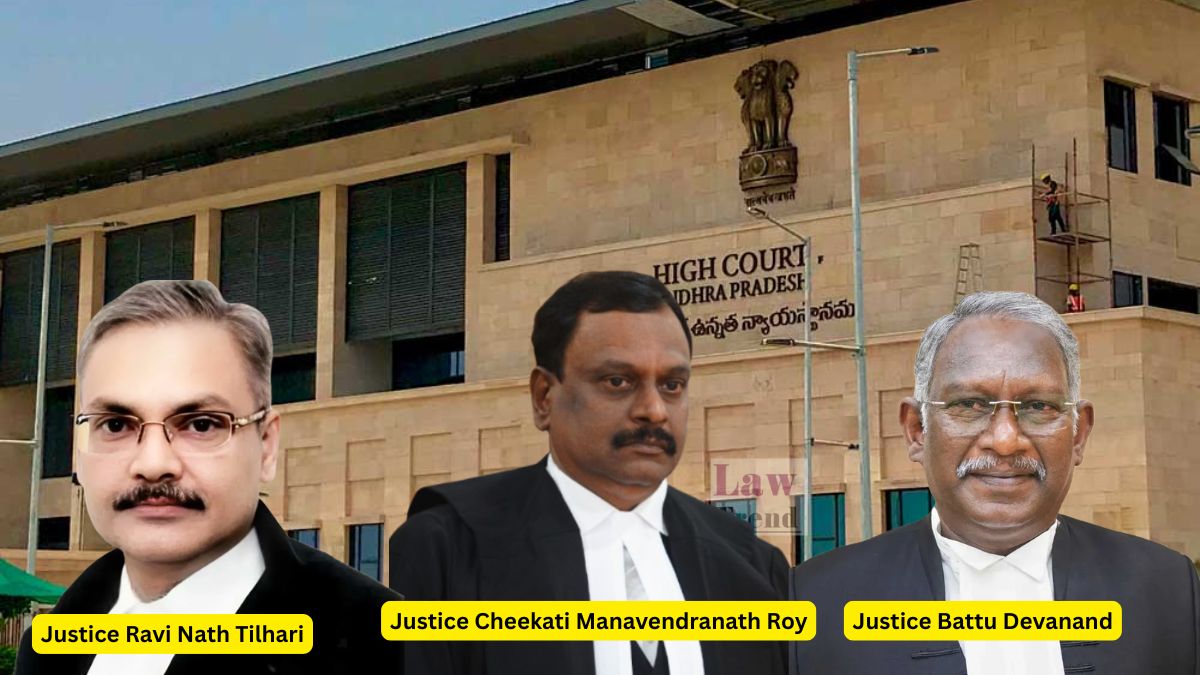
A Full Bench of the Andhra Pradesh High Court comprising Justice Cheekati Manavendranath Roy, Justice Ravi Nath Tilhari, and Justice Battu Devanand, constituted to resolve a conflict between two coordinate Division Bench judgments (Bellam Balakrishna and U.V. Satyanarayana), held by majority (Roy J and Devanand J) that the Amendment Act 28 of 2018 substituting the Specified Value in Section 2(1)(i) of the Commercial Courts Act, 2015 from “not less than one crore rupees” to “not less than three lakh rupees” is self-operative from 03.05.2018 without requiring any notification by the Central Government or the State Government, that “Specified Value” under Section 2(1)(i) and “pecuniary value” under Section 3(1A) are two distinct concepts operating in different fields, that the State Government’s notification power under Section 3(1A) is relevant only when it proposes to constitute Commercial Courts below the level of District Judge and not for bringing the amended Specified Value into force, that Bellam Balakrishna did not lay down the law correctly as it wrongly equated “specified value” with “pecuniary value,” that U.V. Satyanarayana also did not lay down the law correctly as it failed to notice that the subject-matter value was below one crore and the execution petition was filed prior to 03.05.2018, and directed the High Court to immediately issue fresh proceedings to the existing Commercial Courts at Visakhapatnam and Vijayawada specifying the amended Specified Value and for transfer of all pending sub-crore commercial disputes from Civil Courts under Section 15(2) of the Act;
However, Justice Ravi Nath Tilhari, in a separate judgment partly concurring on Question A but differing on Questions B and C, agreed that no Central Government notification is required for the three-lakh threshold but held that for the band from ₹3 lakh to below ₹1 crore, the amended Specified Value cannot become operational in the State of Andhra Pradesh until the State Government issues a notification under Section 3(1A) in consultation with the High Court, reasoning that the non-obstante clause in Section 3(1A) overrides Section 2(1)(i) for this purpose, that the existing two Commercial Courts were constituted only for disputes above one crore and no automatic conferment of pecuniary jurisdiction for the sub-crore band follows from the amendment alone, that implementation without a State notification would create an unworkable and overburdened situation defeating the very object of the Act, that Bellam Balakrishna correctly lays down the law (with the modification that the notification requirement is limited to the sub-crore band), and that U.V. Satyanarayana is incorrect for applying the amended Specified Value to a case filed before 03.05.2018 without noticing Section 19 of the Amendment Act, further directing that pending sub-crore commercial disputes shall continue before regular Civil Courts until the State Government issues the notification under Section 3(1A), and urging the State Government to act on priority.
A Division Bench of the Andhra Pradesh High Court, while hearing CRP No.1847 of 2024, found an apparent conflict between two coordinate Division Bench judgments on the question of jurisdiction of Commercial Courts under the Commercial Courts Act, 2015 as amended by Act 28 of 2018, and referred three questions to a Larger Bench.
The two conflicting Division Bench judgments were:
Bellam Balakrishna v. Greenmount Developers (CRP No.1749/2023, dated 28.08.2023): Held that until the State Government issues a notification in consultation with the High Court, the pecuniary value of three lakhs as fixed in Section 2(1)(i) of the Act will not come into operation.
U.V. Satyanarayana v. M/s. Shriram City Union Finance Ltd. (CRP No.740/2014): Proceeded on the footing that Section 2(1)(i) of the Commercial Courts Act had fixed the Specified Value at not less than ₹3 lakh with effect from 03.05.2018 by virtue of the Amendment Act 28 of 2018, and directed transfer of the execution petition (value ₹46,46,965) to the Commercial Court.
The underlying facts of the referring CRP involved an arbitral award of ₹78,66,839 in favour of Transparent Technologies Solutions Pvt. Ltd., which was sought to be executed before the XI Additional District Judge, Tadepalligudem. The petitioner/judgment debtor contended that the Civil Court lacked inherent jurisdiction and that only the Commercial Court had jurisdiction in view of Sections 10 and 15 read with Section 2(1)(i) of the Act.
THE THREE REFERENCE QUESTIONS
Question A: Whether the Amendment Act No.28 of 2018, in respect of Sections 2(1)(i) & 3(1A) of the Commercial Courts Act, 2015, by itself amends the ‘Specified Value’ as ‘not less than three lakh rupees’ for the jurisdiction of the Commercial Court, or it only enables the Central Government & the State Government(s) to do so by notification, and it is only after such notification that the Specified Value shall stand amended?
Question B: Whether the ‘Specified Value’ in Section 2(1)(i) as substituted by Act 28 of 2018 shall be operative and effective from — (i) the date of amendment i.e., 03.05.2018; or (ii) the date notified in the notification by the Central Government under Section 2(1)(i); or (iii) the date notified in the notification by the Andhra Pradesh State Government in consultation with the High Court under Section 3(1A)?
Question C: Which judgment lays down the law correctly — U.V. Satyanarayana or Bellam Balakrishna?
THE MAJORITY JUDGMENT (Roy J, concurred in by Devanand J)
On Question A:
The majority held that Sections 2(1)(i) and 3(1A) of the Act are two distinct and separate provisions and they are not one and the same. Section 2(1)(i) defines “Specified Value” which focuses on the value of the subject-matter of the suit in relation to a commercial dispute to decide whether the said commercial dispute is to be adjudicated by the Commercial Court or not. Section 3(1A), on the other hand, is concerned with the pecuniary limits of the Commercial Courts when they are being presided over by officers of various cadres.
The majority held that amending Section 2(1)(i) by way of substituting “not less than one crore rupees” with “not less than three lakh rupees” by the Amendment Act 28 of 2018 by itself amends the Specified Value as “not less than three lakh rupees” and no separate notification by the Central Government is required. It is only when the Central Government intends to fix such higher value that a separate notification in exercise of its power of delegated legislation is required, and such notification comes into force on the date of its issuance and publication in the Gazette.
On Question B:
The majority held that the Amendment Act 28 of 2018 relating to Section 2(1)(i) shall be operative and effective from the date of the amendment itself, i.e., with effect from 03.05.2018. No notification is required by the Central Government to make the said amendment operative. As regards sub-question (iii), the majority held that the amendment to Section 2(1)(i) has absolutely nothing to do with the notification to be issued by the State Government under Section 3(1A). “Specified Value” under Section 2(1)(i) is altogether different from “pecuniary value” as contained in Section 3(1A) and they are two separate and distinct terms which operate in two different fields.
On Question C:
The majority held that the judgment in Bellam Balakrishna — that “until the State Government issues a notification in consultation with the High Court, the pecuniary value of three lakh rupees as fixed in Section 2(1)(i) of the Act will not come into operation” — is not correct. Section 2(1)(i) does not deal with pecuniary value. It only defines the “Specified Value.” The law was therefore not correctly laid down in Bellam Balakrishna.
As regards U.V. Satyanarayana, the majority found that the controversy as per the reference questions was not dealt with in that case. What was decided there was only whether the Civil Court had jurisdiction to entertain the execution petition. The majority further found that the Bench in U.V. Satyanarayana failed to notice that the Specified Value of the subject-matter of the arbitration was only ₹45 lakhs — below one crore rupees — and the execution petition was filed prior to 03.05.2018. Under Section 19 of the Amendment Act (which limits the amendments to cases filed on or after commencement), and under the unamended threshold of one crore applicable at that time, the dispute did not qualify as a commercial dispute at all. To that extent, the law was not correctly decided in U.V. Satyanarayana either.
Directions and Observations by the Majority:
The majority recorded that no effect has been given to the amendments to Sections 2(1)(i), 3(1A) and 3(3) of the Act by either the High Court or the State Government. The two Commercial Courts at Vijayawada and Visakhapatnam are still operating on the one-crore threshold. The majority directed:
1. Fresh proceedings must be immediately issued by the High Court to the two existing Commercial Courts specifying the Specified Value as not less than three lakh rupees in terms of amended Section 2(1)(i). The two Commercial Courts shall receive all commercial suits involving more than three lakh rupees and resolve them.
2. After such fresh proceedings, all commercial disputes of more than three lakh rupees pending in ordinary Civil Courts shall stand transferred to the Commercial Courts under Section 15(2) of the Act with effect from 03.05.2018.
3. The State Government may, in consultation with the High Court, thereafter take steps to appoint officers below the level of District Judge to preside over Commercial Courts under Section 3(1A) if the pendency so requires, specifying the pecuniary value for such courts.
4. Copies of the judgment directed to be sent to the Advocate General, the Chief Secretary, and the Law Secretary of the State of Andhra Pradesh.
THE SEPARATE JUDGMENT OF TILHARI J
(Partly Concurring on Question A; Differing on Questions B & C)
On Question A — Concurrence with Modification:
Tilhari J agreed that no Central Government notification is required for the Specified Value of three lakhs to operate as the base. He analysed the language of Section 2(1)(i) and held that the word “or” between “not less than three lakh rupees” and “such higher value, as may be notified by the Central Government” is disjunctive. The expression “as may be notified by the Central Government” governs only “such higher value.” The word “may” carries its ordinary discretionary meaning — conferring an option on the Central Government to raise the base value. In the absence of any notification, the Specified Value starts from three lakhs without any upper cap.
On Question B — The Dissent:
Tilhari J held that while the Specified Value is three lakhs as a matter of legislative definition from 03.05.2018, the operational implementation of the amended threshold for commercial disputes valued between ₹3 lakh and below ₹1 crore requires a notification by the State Government under Section 3(1A).
His reasoning was as follows:
On ‘Specified Value’ vs. ‘Pecuniary Value’: Tilhari J accepted that both are different concepts, but held that pecuniary value relates to the pecuniary jurisdiction of the Commercial Court at different levels, whereas Specified Value relates to the minimum value of the subject-matter of a commercial dispute. Section 3(1A) is placed within Section 3, which deals with the constitution of Commercial Courts. Sub-Section (1A) was specifically inserted by the same Amendment Act 28 of 2018 to enable the State Government to specify the pecuniary value for Commercial Courts for whole or part of the State. In the absence of any such notification, no Commercial Court has been conferred pecuniary jurisdiction for the band from ₹3 lakh to below ₹1 crore.
On automatic conferment of pecuniary jurisdiction: The change in Specified Value by amendment would not automatically confer pecuniary jurisdiction (below ₹1 crore) on the existing Commercial Courts unless it is so conferred by the State Government by notification under Section 3(1A). It is settled that where power is given to do a certain thing in a certain manner, the thing must be done in that way or not at all. The two existing Commercial Courts at Visakhapatnam and Vijayawada were constituted for the Specified Value not below one crore, in the cadre of District & Sessions Judges.
On the non-obstante clause in Section 3(1A): Section 3(1A) opens with “Notwithstanding anything contained in this Act.” This non-obstante clause takes away the implementation of Section 2(1)(i) to the extent of the sub-crore band (from ₹3 lakh to below ₹1 crore) till the notification is issued by the State Government. Section 3(1A) must be given full effect until that notification is issued.
On practical unworkability: If the amended Specified Value is taken as operative from 03.05.2018 without a State notification, all commercial dispute cases from ₹3 lakh to below ₹1 crore filed across the entire State from 03.05.2018 would have to be transferred to only two Commercial Courts. This would include execution petitions arising out of fresh cases instituted after 03.05.2018, execution petitions arising from cases decided after 03.05.2018 but instituted earlier, and even EPs in cases decided before 03.05.2018 but where the EP was filed after 03.05.2018. This would certainly overburden the two Commercial Courts, defeat the object of the Amendment Act 2018, and make the entire scheme unworkable.
Conclusion of Tilhari J on Question B: The Specified Value under amended Section 2(1)(i) shall be operative in the State of Andhra Pradesh on issuance of the notification by the State Government under Section 3(1A), for the part of the Specified Value from ₹3 lakh up to less than ₹1 crore. It shall not come into effect to that extent from 03.05.2018. A notification by the State Government in terms of Section 3(1A), constituting the Commercial Courts with the pecuniary jurisdiction of that part of the Specified Value (from ₹3 lakh to below ₹1 crore), after consultation with the High Court, is mandatory.
On Question C:
Tilhari J held that the judgment in Bellam Balakrishna lays down the law correctly to the effect that unless the State Government issues a notification in consultation with the High Court, the amended Specified Value in Section 2(1)(i) shall not come into operation — but with the modification and clarification that this is so only for the Specified Value from three lakhs up to less than one crore.
Tilhari J held that U.V. Satyanarayana does not lay down the correct law. The execution petition in that case was filed in 2017, i.e., before the commencement of the Amendment Act 28 of 2018. Section 19 of the Amendment Act provides that its provisions apply only to cases filed on or after the date of commencement. This provision was not brought to the notice of the Division Bench in U.V. Satyanarayana. The direction for transfer of that EP to the Commercial Court was therefore incorrect.
Directions of Tilhari J:
1. Commercial disputes of Specified Value from ₹1 crore and upwards including execution petitions shall be before the Commercial Courts at Visakhapatnam District and at Krishna District (Vijayawada) for their respective territorial limits.
2. Commercial disputes including execution petitions of Specified Value from ₹3 lakh to below ₹1 crore shall not be filed in those Commercial Courts so long as the notification under Section 3(1A) is not issued by the State Government, but shall be before the regular Civil Courts as per their pecuniary jurisdiction and territorial limits.
3. Commercial dispute cases of Specified Value from ₹3 lakh to below ₹1 crore — (a) pending in regular Civil Courts on 03.05.2018 shall continue to be tried by those Civil Courts in terms of Section 19 of the Amendment Act; and (b) filed on or after 03.05.2018 in regular Civil Courts shall also continue in those Courts, subject to the issuance of the notification under Section 3(1A).
4. The same position applies to execution petitions arising from commercial disputes in the sub-crore band, irrespective of the date of institution of the underlying case and irrespective of whether the EP arises from a case filed before, on, or after 03.05.2018.
5. It is expected that the State Government shall take necessary steps in terms of Section 3 including sub-Section 1A of the Commercial Courts Act, 2015, on priority basis.
6. Copies of the judgment directed to be sent to the Advocate General, the Chief Secretary, and the Law Secretary of the State of Andhra Pradesh.
Court: High Court of Andhra Pradesh (Full Bench — Three Judges)
Case: 3F Industries Limited & Others v. Transparent Technologies Solutions Pvt. Ltd. & Others
CRPs: Nos. 1847/2024, 1172/2022 & 1685, 1686, 1688,
1689 of 2024
Date of Judgment: 18 May 2026
Counsel for Petitioners: Sri Venkat Challa, Sri G.V.S. Kishore Kumar, Sri S.V.S.S. Siva Ram. Counsel for Respondents: Sri V. Yatendra Kumar, Sri Somu Krishna Murthy.