

Bypassing Order 38 Rule 5 CPC Remedy to Invoke Article 227 Cannot Be Encouraged: Andhra Pradesh High Court
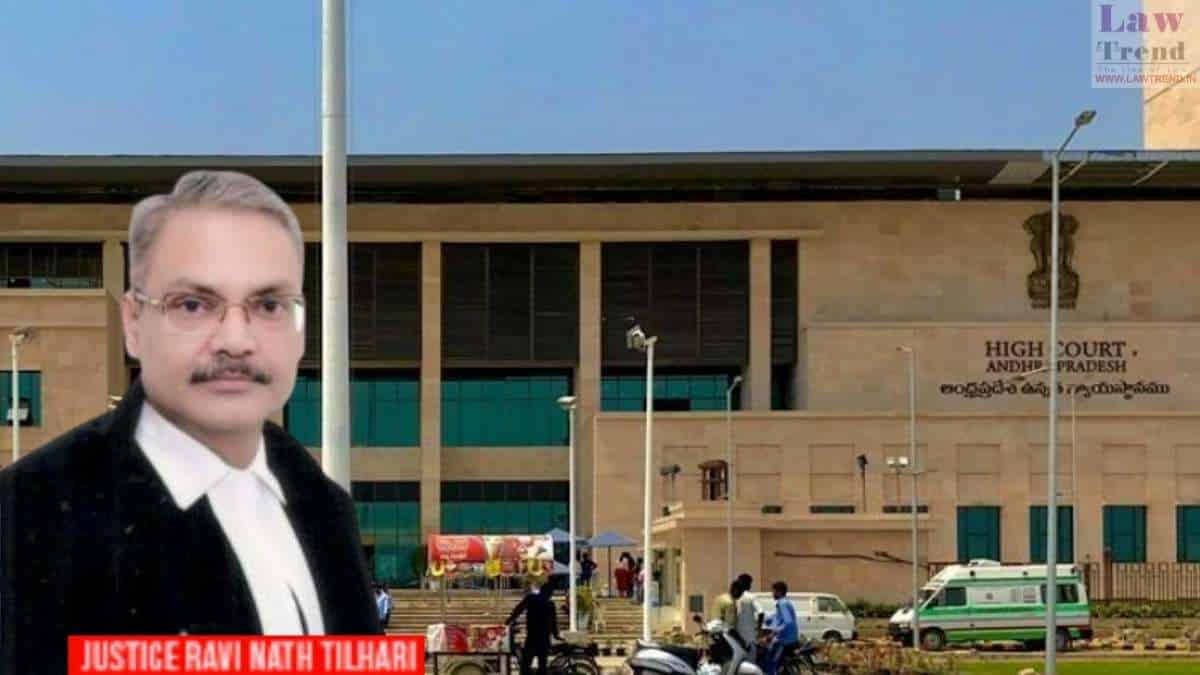

The High Court of Andhra Pradesh at Amaravati has ruled that a party cannot directly invoke the supervisory jurisdiction of the High Court under Article 227 of the Constitution of India by bypassing the statutory remedy available under Order 38 Rule 5 of the Code of Civil Procedure, 1908 (CPC). Dismissing the Civil Revision Petition filed by the defendants in a pending commercial suit, Justice Ravi Nath Tilhari held that approaching the High Court without first availing the remedy under the CPC is an approach that “shall not be encouraged.”

Background

The petitioners — M/s. V.Digitals and two others — are defendants in O.S. No. 57 of 2026, a civil suit instituted by the respondent, M/s. Baba Flex, and pending before the Court of the XII Additional District Judge, Visakhapatnam.

During the course of the suit, the plaintiff filed an application seeking attachment of the defendants’ property. Acting on this application, the Trial Court issued a show cause notice to the petitioners under Order 38 Rule 5 of the CPC, directing them to furnish security for the suit amount within a specified period. The notice further provided that, upon failure to comply, the petition schedule property — which stands in the name of the second defendant — would be attached.

Aggrieved by the issuance of this notice, the petitioners bypassed the remedy available before the Trial Court and directly filed the present Civil Revision Petition before the High Court under Article 227 of the Constitution of India.

Petitioners’ Arguments

Sri P.S.P. Suresh Kumar, learned counsel for the petitioners, contended that the power and jurisdiction under Order 38 Rule 5 of the CPC cannot be exercised mechanically, and submitted that the impugned notice had been issued in precisely such a mechanical manner.

READ ALSO  Merely Because a Person Was Seen Near the Place Where Crime Occurred It Cannot Be Said That the Deceased Was Last Seen in the Company of That Person: Supreme Court

Counsel placed reliance on the Supreme Court’s judgment in Raman Tech. & Process Engg. Co. v. Solanki Traders, (2008) 2 SCC 302, wherein the Apex Court had cautioned against the misuse of Order 38 Rule 5 and observed:

“The power under Order 38 Rule 5 CPC is a drastic and extraordinary power. Such power should not be exercised mechanically or merely for the asking. It should be used sparingly and strictly in accordance with the Rule. The purpose of Order 38 Rule 5 is not to convert an unsecured debt into a secured debt. Any attempt by a plaintiff to utilise the provisions of Order 38 Rule 5 as a leverage for coercing the defendant to settle the suit claim should be discouraged. Instances are not wanting where bloated and doubtful claims are realised by unscrupulous plaintiffs by obtaining orders of attachment before judgment and forcing the defendants for out-of-court settlements under threat of attachment.”

No counsel appeared on record for the respondent, M/s. Baba Flex.

The Statutory Provision

Order 38 Rule 5 of the CPC, as reproduced by the Court in its order, provides:

“5. Where defendant may be called upon to furnish security for production of property.—

(1) Where, at any stage of a suit, the Court is satisfied, by affidavit or otherwise, that the defendant, with intent to obstruct or delay the execution of any decree that may be passed against him—

(a) is about to dispose of the whole or any part of his property, or

(b) is about to remove the whole or any part of his property from the local limits of the jurisdiction of the Court,

the Court may direct the defendant, within a time to be fixed by it, either to furnish security, in such sum as may be specified in the order, to produce and place at the disposal of the Court, when required, the said property or the value of the same, or such portion thereof as may be sufficient to satisfy the decree, or to appear and show cause why he should not furnish security.

(2) The plaintiff shall, unless the Court otherwise directs, specify the property required to be attached and the estimated value thereof.

(3) The Court may also in the order direct the conditional attachment of the whole or any portion of the property so specified.

(4) If an order of attachment is made without complying with the provisions of sub-rule (1) of this rule, such attachment shall be void.”

Court’s Analysis

The Court acknowledged that there was no dispute on the settled legal position laid down by the Supreme Court in Raman Tech. & Process Engg. Co. (supra). However, it drew a decisive distinction between the stage at which the petitioners had approached the High Court and the stage at which such intervention could be warranted.

The Court noted that the Trial Court had, at this point, only issued a show cause notice — it had not yet passed any order of attachment. Consequently, the petitioners retained a full opportunity to appear before the Trial Court, file objections in response to the notice, and place reliance on the very judgment in Raman Tech. & Process Engg. Co. (supra) that their counsel had cited before the High Court.

READ ALSO  आंध्र प्रदेश हाई कोर्ट ने कौशल विकास निगम घोटाला मामले में चंद्रबाबू नायडू को जमानत दे दी

On the question of invoking Article 227 of the Constitution, the Court reiterated the settled position that the jurisdiction thereunder is supervisory in nature and is not to be exercised in a routine or mechanical fashion. It observed:

“Approaching directly to this Court under Article 227 of Constitution of India without availing the statutory remedy available under Order 38 Rule 5 CPC shall not be encouraged by-passing the remedy under CPC.”

The Court further held that it was accordingly not inclined to entertain the Civil Revision Petition, and that the supervisory jurisdiction under Article 227 is to be invoked only in exceptional circumstances — not as a matter of course.

Decision

The Civil Revision Petition was dismissed. The Court made the following directions:

  • The petitioners are at liberty to file objections before the Trial Court pursuant to the impugned show cause notice.
  • Upon the filing of such objections, the Trial Court is expected to consider the same in accordance with law, affording due opportunity to all concerned parties, and to do so expeditiously.
  • No order as to costs was made.
  • All miscellaneous petitions pending as a sequel to the CRP were also directed to stand closed.
READ ALSO  अंतिम रिपोर्ट न्यायिक मजिस्ट्रेट के समक्ष दायर की जानी चाहिए न कि कार्यकारी मजिस्ट्रेट के समक्ष: आंध्र प्रदेश हाई कोर्ट

Case Details 

Case Title: M/s. V.Digitals & 2 others v. M/s. Baba Flex

Case No.: CIVIL REVISION PETITION NO. 1095 OF 2026

Bench: Justice Ravi Nath Tilhari

Date: 01.05.2026

Law Trend
Law Trendhttps://lawtrend.in/
Legal News Website Providing Latest Judgments of Supreme Court and High Court

Related Articles

Latest Articles

