The Supreme Court of India has set aside the orders of the National Company Law Appellate Tribunal (NCLAT) and the National Company Law Tribunal (NCLT) admitting a corporate insolvency process, clarifying that the period of limitation for a Section 7 application under the Insolvency and Bankruptcy Code (IBC) must be reckoned from the date the account was declared a Non-Performing Asset (NPA).
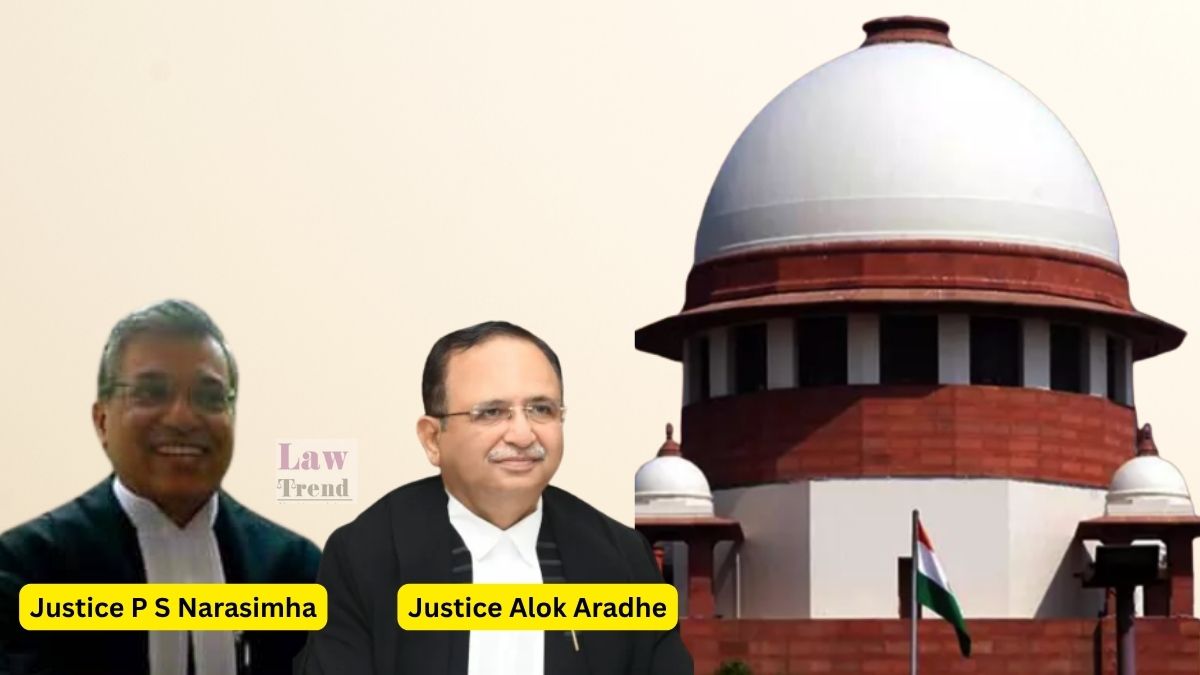
The Bench, comprising Justice Pamidighantam Sri Narasimha and Justice Alok Aradhe, further held that the admission of a debt by an Interim Resolution Professional (IRP) or Resolution Professional (RP) is an “administrative function” and does not constitute an acknowledgment of liability under Section 18 of the Limitation Act, 1963.
Background of the Case
The dispute arose from loans sanctioned in 2014 by Dewan Housing Finance Corporation Ltd. (DHFL) to Shrinathji Business Ventures Private Limited and Samaria Business Ventures Private Limited. Due to repayment defaults, DHFL classified the accounts as NPA on December 6, 2016. After DHFL itself underwent insolvency and its assets were assigned to Omkara Asset Reconstruction Pvt. Ltd. (the secured financial creditor), a Section 7 application was filed against the corporate debtors on September 23, 2024.
Both the NCLT and NCLAT had previously held the application to be within limitation, citing that the IRP’s admission of the claim in an earlier, terminated CIRP (on May 22, 2022) served as a valid acknowledgment of debt.
Arguments of the Parties
Senior Counsel for the Appellant: The appellant, Shankar Khandelwal, argued that the three-year limitation period triggered on the date of NPA (December 6, 2016) and expired in 2019, subject to statutory exclusions. It was contended that the IRP’s collation of claims is merely a clerical task under Section 18 of the Code and cannot revive a time-barred debt or be treated as a “conscious acknowledgment” of liability.
Senior Counsel for the Respondents: The respondents argued that the limitation period should only commence after the expiry of statutory notices under the SARFAESI Act. They also relied on the extension of limitation periods granted by the Supreme Court due to the Covid-19 pandemic and the IRP’s admission of the debt in 2022 to maintain that the petition was timely.
Court’s Analysis and Observations
The Supreme Court addressed three critical legal questions regarding the IBC and the Limitation Act:
1. Reckoning the Limitation Period: The Court affirmed that Article 137 of the Limitation Act governs Section 7 applications and that the right to apply accrues upon the date of default.
“The limitation begins to run from the date of classification of the account as NPA, being the date of default, and not from any subsequent proceeding initiated for recovery.”
Consequently, the limitation period in this case commenced on December 6, 2016.
2. Calculation of Time: The Court noted that even after excluding the periods during which DHFL was under CIRP (per Section 60(6) of the Code) and the Suo Motu Covid-19 pandemic extensions, only three days remained as of July 29, 2024. Therefore, the limitation expired on August 1, 2024, making the September 23 filing “well beyond the period of limitation.”
3. Status of IRP’s Admission of Claim: The Court drew a sharp distinction between the administrative duties of an RP and the legal requirements for an acknowledgment of debt. Referencing Swiss Ribbons Private Limited v. Union of India, the Bench observed:
“RP performs its administrative duties under Section 18 of the Code. The admission of a claim by RP is merely an administrative/clerical task… and, therefore, admission of claim by RP only means induction/entry of a claim. An admission of a claim by RP is akin to mere recital/reference of debt, which does not amount to an acknowledgment under Section 18 of the 1963 Act.”
The Court also emphasized that an acknowledgment under Section 18 can only extend a limitation period that has not already expired.
Decision
The Supreme Court held that the IRP’s admission of the secured financial creditor’s debt did not enure to the creditor’s benefit. Finding the petition to be time-barred, the Court allowed the appeals and quashed the judgments of the NCLAT (October 15, 2025) and the NCLT (January 22, 2025).
Case Details:
- Case Title: Shankar Khandelwal v. Omkara Asset Reconstruction Pvt. Ltd & Anr.
- Case No.: Civil Appeal No(s). 13158-13159 of 2025
- Bench: Justice Pamidighantam Sri Narasimha and Justice Alok Aradhe
- Date: April 29, 2026