

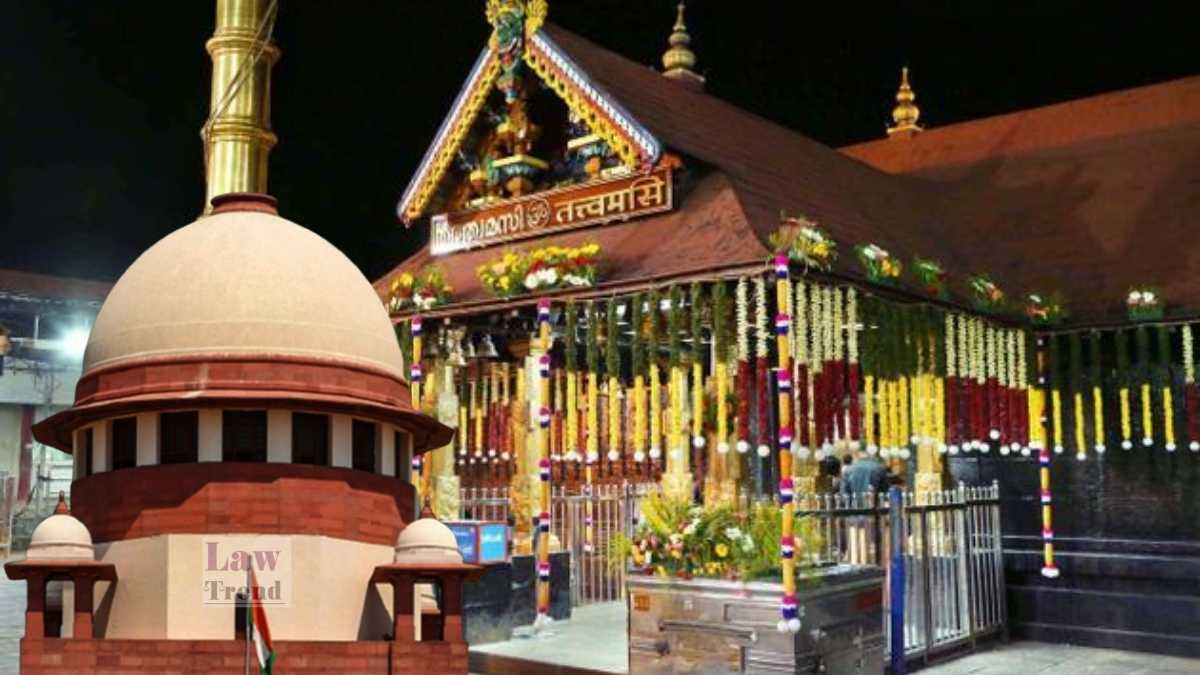
The Supreme Court of India on Wednesday raised critical questions regarding who holds the legal standing to challenge religious practices, specifically whether a non-believer residing far from a place of worship can claim a right of entry.
A nine-judge Constitution bench, led by Chief Justice of India Surya Kant, is currently examining the ambit of religious freedom and discrimination against women at various religious sites, including the Sabarimala Ayyappa temple in Kerala. During the proceedings, the bench emphasized the need to distinguish between a “devotee” and a “non-devotee” when deciding on the right to enter a temple.
The observation came during submissions by Senior Advocate Indira Jaising, who appeared for Bindu Ammini and Kanakadurga—the two women who successfully entered the Sabarimala temple following the 2018 verdict.
Justice B.V. Nagarathna questioned the geographical and personal connection of petitioners to the temple. “Who is claiming this right? Is a devotee claiming the right or a non-devotee at whose instance? A person who has nothing to do with this temple is somewhere in North India. This temple is in South India. If they are claiming a right of entry, that also has to be addressed,” the Justice noted.
Justice Nagarathna further remarked on the importance of respecting denominational diversity under Article 26(b) of the Constitution, stating, “We are strong because we are diverse. Diversity is our strength… By giving that protection, there is unity in the country. Therefore, respect diversity.”
Advocate Indira Jaising argued that the exclusion of women aged 10 to 50 is a modern-day form of untouchability. She pointed out that one of the women she represents belongs to a Scheduled Caste, and preventing her entry violates Article 17 (Abolition of Untouchability).
“Today we are told that non-caste Hindus can enter Sabarimala, but not women,” Jaising submitted. She argued that while Article 17 has effectively allowed all men to enter regardless of caste, women in their “most creative and fertile” years are still barred.
“What is the status of a woman during this period?… You cannot tell me to live half a life. Avoid living between 10 and 50, and then live before 10 and after 50. That will lead to substantial deprivation,” Jaising contended, asserting that the right to worship is a fundamental right under Article 25(1).
The hearing stems from the fallout of the September 2018 verdict, where a five-judge bench, by a 4:1 majority, lifted the centuries-old ban on women of menstruating age entering the Sabarimala temple, declaring the practice unconstitutional.
Jaising informed the court that despite the 2018 ruling, state cooperation has been lacking. She noted that after her clients performed ‘darshan,’ certain groups performed a ‘shuddhi karan’ (purification ceremony). “These were the only two women who succeeded in climbing up and performing ‘darshan’. No one else has succeeded since then because the State has refused to give protection,” she alleged.
The nine-judge bench had previously noted the extreme difficulty for a judicial forum to define which religious practices are “essential” or “non-essential” to a faith. The hearing remains underway as the court seeks to balance individual fundamental rights with the collective rights of religious denominations.




