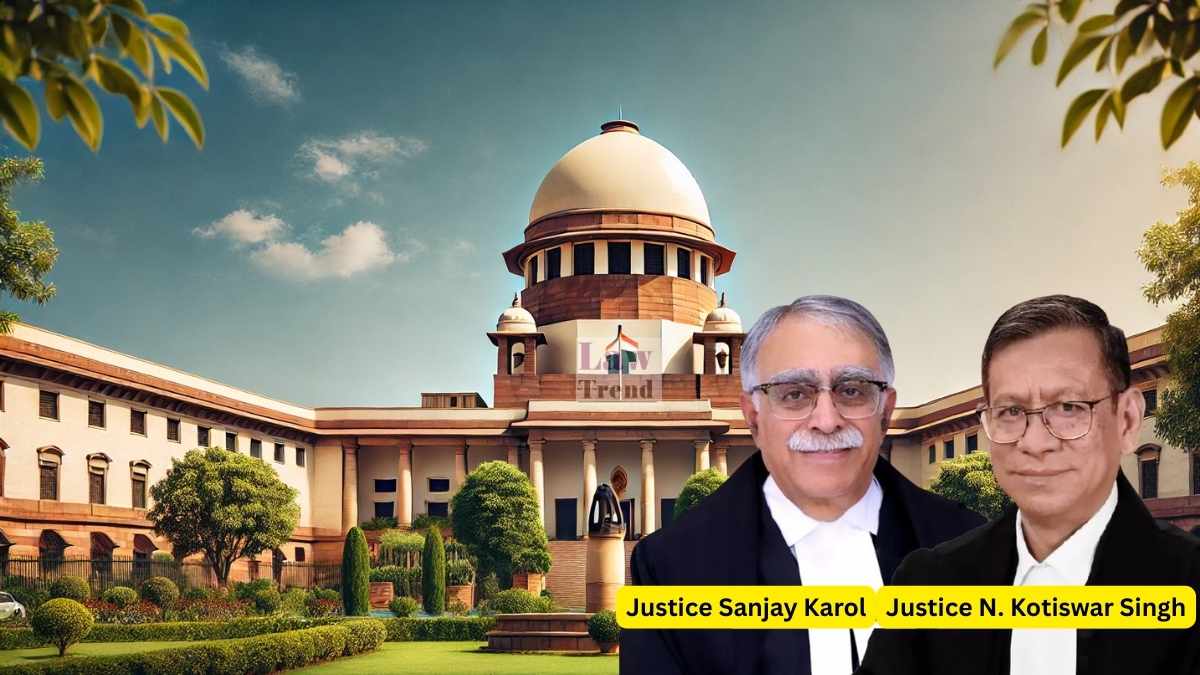
The Supreme Court of India has allowed an appeal filed by an employee seeking a cadre change from Uttar Pradesh to Uttarakhand, setting aside a 2018 judgment of the High Court of Judicature at Allahabad. The Court held that the appellant was entitled to the reallocation based on his original recruitment options, his domicile, and medical hardship involving his cognitively disabled son.
Background
The appellant, Rajendra Singh Bora, appeared for the Combined Lower Subordinate Service Examinations in 1995. While applying for the position of Sub-Deputy Inspector of Schools, he had explicitly opted for the ‘hill area of Uttar Pradesh’ (now Uttarakhand). Although he cleared the exam with 672 out of 900 marks, his appointment was initially denied because he submitted his B.Ed marksheet at the time of the interview instead of with the application form.
This led to a series of litigations. In 2004, a learned Single Judge of the High Court allowed his petition, observing that a “hyper-technical view” should not be adopted and directed his appointment with consequential benefits. The State’s appeal against this was dismissed in 2009. He was finally appointed in 2011, with notional effect from June 11, 1997. Following his appointment, he submitted multiple representations for reallocation to the Uttarakhand cadre, which remained unaddressed by the State of Uttar Pradesh.
The High Court eventually dismissed his plea in 2018, holding that once he was allotted the Uttar Pradesh service, no question of transfer to Uttarakhand arose.
Court’s Analysis: Transfer vs. Cadre Change
A Bench of Justices Sanjay Karol and Nongmeikapam Kotiswar Singh disagreed with the High Court’s reasoning, clarifying that a transfer and a change in cadre are distinct legal concepts.
The Court observed:
“A transfer refers to a change in the place of posting of an employee within the same cadre or service. The individual continues to belong to the same service structure… A change in cadre, by contrast, involves a shift from one cadre to another and, therefore, alters the very framework within which the employee’s service is regulated. It is not a mere relocation but a structural change that may affect seniority, promotional avenues, and applicable service conditions.”
The Bench emphasized that while a transfer is a matter of administrative convenience, a change in cadre entails a reconfiguration of the employee’s “service identity.”
Criteria for Cadre Allocation
The Court noted that the appellant’s exam predated the reorganization of the States. Referring to the Department of Personnel and Training (DoPT) guidelines, the Bench highlighted that cadre allocation is governed by three criteria: option, domicile, and juniority in reverse order of seniority.
The Bench found that the appellant qualified on multiple grounds:
- Option and Domicile: He had opted for the hill cadre and is a resident of present-day Uttarakhand.
- Medical Hardship: The allocation policy provides exceptions for family members with “mental illness.” The appellant’s son is cognitively challenged, which falls under the exceptions allowing allocation based on the employee’s option.
The Court remarked, “On a cumulative assessment of the above factors, the appeal deserves to be allowed.”
Observations on State Apathy
The Supreme Court expressed a “deep sense of anguish” regarding the delay. The appellant, eligible since 1997, was only appointed in 2011 and continued to fight for his rights until 2026.
Justice Karol noted:
“This is in no way, shape or form, anything other than apathy on part of the State… Even if we exclude the initial few years till his appointment was confirmed… 22 years have passed. The entire time that being close to family would have been a great sense of support in raising his son, he has spent away from family at least since 2011.”
The Decision
The Supreme Court set aside the High Court judgment and directed the Chief Secretary of Uttar Pradesh to facilitate the reallocation of the appellant to the State of Uttarakhand “forthwith.” The Court ordered that his seniority and all relevant benefits be protected.
The Court further awarded costs of Rs. 1,00,000/- to be paid by the State of Uttar Pradesh to the appellant within four weeks. Additionally, the Bench requested the Chief Justice of the High Court to identify long-pending service disputes and endeavor to decide them expeditiously.
Case Details:
- Case Title: Rajendra Singh Bora v. Union of India & Ors.
- Case No.: Civil Appeal No. ___ of 2026 (Arising out of SLP (C) No. 29304 of 2018)
- Bench: Justice Sanjay Karol and Justice Nongmeikapam Kotiswar Singh
- Date of Judgment: April 22, 2026