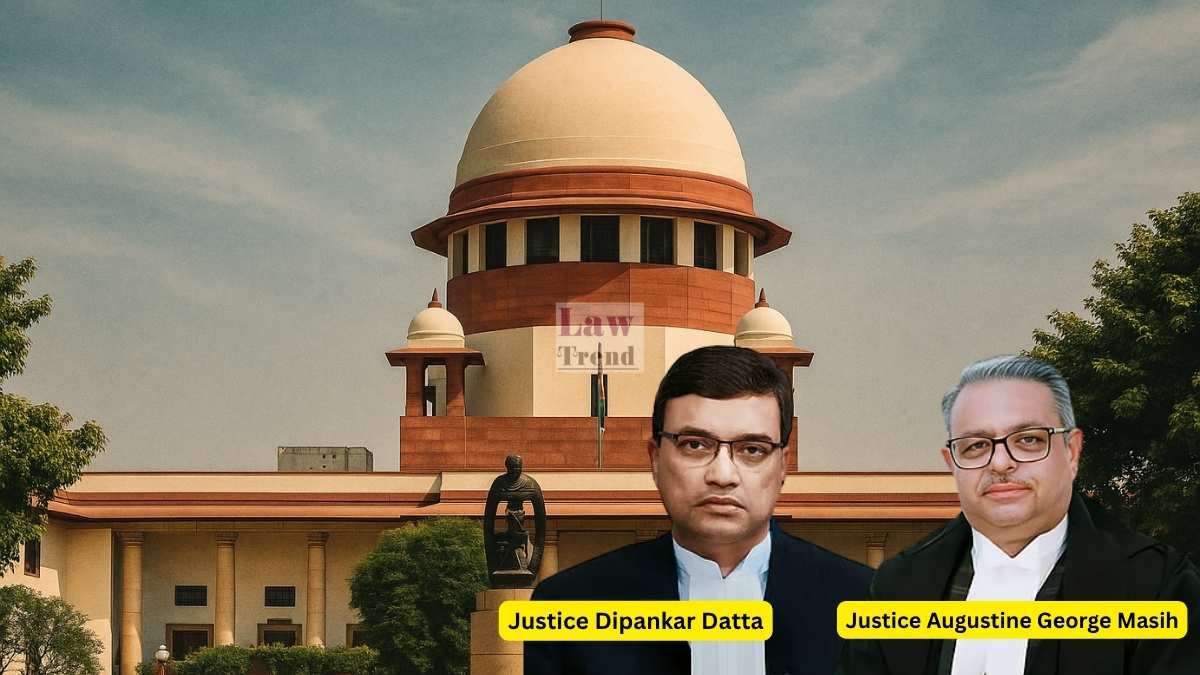
The Supreme Court of India has allowed a civil appeal, setting aside a judgment of the High Court of Karnataka and holding that a subsequent suit filed for declaration of title and possession was barred by the principles of res judicata and Order II Rule 2 of the Code of Civil Procedure (CPC). The Bench, comprising Justice Dipankar Datta and Justice Augustine George Masih, observed that a plaintiff who omits to seek all consequential reliefs arising from a single cause of action in an earlier proceeding is precluded from instituting a subsequent suit for the same.
Background of the Case
The dispute originated from a claim of adoption. Following the death of her husband in January 1961, Parvatewwa allegedly adopted Channappa on March 23, 1961. Decades later, in 2002, Parvatewwa filed a suit (Suit I) seeking a declaration that the adoption deed was null and void and requested a permanent injunction to prevent Channappa from alienating the property.
Suit I was dismissed by the Trial Court in 2006 on the grounds of limitation. While an appeal (R.A. No. 116 of 2006) was pending, Parvatewwa filed a fresh suit in 2007 (Suit II), alleging that Channappa had illegally dispossessed her and seeking a declaration of ownership and recovery of possession of the same property.
The Trial Court and the First Appellate Court dismissed Suit II, concurrently finding it barred by limitation, res judicata, and Order II Rule 2 of the CPC. However, the High Court of Karnataka, in a second appeal, reversed these findings and decreed Suit II in favor of Parvatewwa’s legal representative.
Arguments of the Parties
The appellants (legal representatives of Channappa) argued that Parvatewwa was fully aware of Channappa’s claim to ownership during Suit I. They contended that under Order II Rule 2 CPC, she was required to claim all reliefs, including declaration of title, in the first instance.
Conversely, the respondents (represented by Prema, Parvatewwa’s LR) argued that the two suits were based on distinct causes of action: Suit I focused on the validity of the adoption deed, while Suit II arose from the subsequent act of dispossession.
Court’s Analysis and Observations
The Supreme Court addressed whether the rejection of an interlocutory application (I.A. No. 4) under Order II Rule 2 during the trial operated as a bar to re-agitating the issue later. Referring to Section 105(1) CPC, the Court clarified that non-appealable interlocutory orders can be challenged when the final decree is appealed.
On the merits of the bar under Order II Rule 2, the Court examined the pleadings of Suit I. The Bench noted that Parvatewwa had already acknowledged in Suit I that Channappa was asserting ownership. The Court stated:
“The foundational facts giving rise to the cause of action, namely the claim regarding entitlement to the property, were already in existence at the time of the earlier suit… The omission to seek such relief in Suit I is significant and cannot be cured through a subsequent suit.”
The Court relied on the Constitution Bench decision in Gurbux Singh v. Bhooralal (1964) and the recent ruling in Cuddalore Powergen Corporation Ltd. v. Chemplast Cuddalore Vinyls Limited (2025). It emphasized that the object of Order II Rule 2 is to prevent a defendant from being “vexed twice for the same cause of action.”
Furthermore, the Court invoked the principle of constructive res judicata under Explanation IV to Section 11 CPC, noting:
“An adjudication is conclusive and final not only as to the actual matter determined but as to every other matter which the parties might and ought to have litigated and have had it decided as incidental to or essentially connected with the subject-matter of the litigation.”
Regarding the High Court’s interference under Section 100 CPC, the Supreme Court held that the High Court exceeded its jurisdiction by reassessing facts without demonstrating perversity in the concurrent findings of the lower courts.
Decision
The Supreme Court concluded that the High Court committed a “manifest error of law” by interfering with the well-reasoned concurrent findings.
“In view of the conclusions recorded on the preceding issues, Parvatewwa’s claim for declaration of title and recovery of possession cannot be sustained,” the Bench ruled. The judgment of the High Court was set aside, and Suit II (O.S. No. 13 of 2007) was dismissed.
Case Details:
- Case Title: Channappa (D) Thr. LRS. vs. Parvatewwa (D) Thr. LRS.
- Case Number: Civil Appeal No. ___ of 2026 (Arising out of SLP (C) No. 8536 of 2024)
- Bench: Justice Dipankar Datta and Justice Augustine George Masih
- Date: April 9, 2026