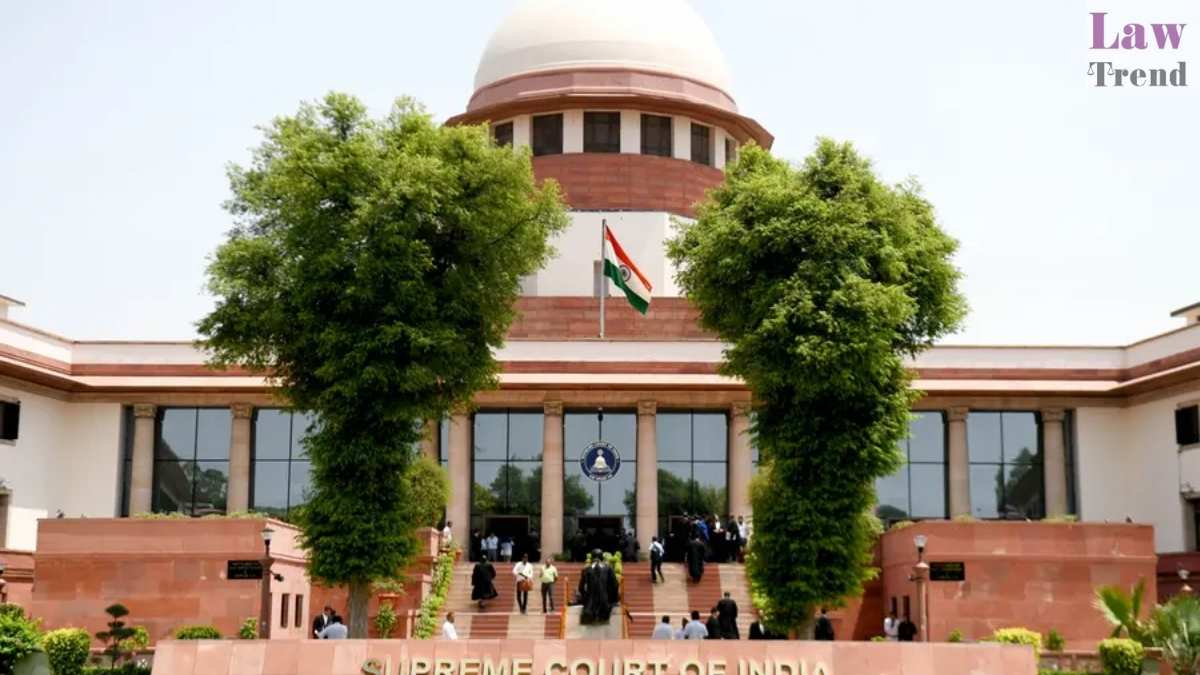
The Supreme Court of India has set aside a Delhi High Court order that quashed a criminal case on the grounds of limitation, clarifying that the relevant date for computing the limitation period under Section 468 of the Code of Criminal Procedure (CrPC) is the date of filing the complaint or initiating prosecution, not the date the Magistrate takes cognizance.
A Bench comprising Justice Prashant Kumar Mishra and Justice N.V. Anjaria allowed the appeals filed by the complainant, Roma Ahuja, ruling that the High Court committed a “patent error” by focusing on the date of cognizance. The Court reiterated that the law on this issue is firmly settled by a Constitution Bench and criticized attempts by counsel to argue against established precedents.
Background of the Case
The matter originated from an incident on May 9, 2011, at the premises of the Special Executive Magistrate in Moti Nagar, Delhi. The appellant, Roma Ahuja, alleged that she was abused and beaten by Respondent No. 2, an advocate named Ashutosh, leading to injuries on her head, eye, and shoulder. This resulted in cross-FIRs: FIR No. 120/2011 filed by the respondent against the appellant, and FIR No. 121/2011 (the subject of this appeal) filed by the appellant against the respondent.
In FIR No. 121/2011, the offences alleged were under Sections 323 (voluntarily causing hurt) and 341 (wrongful restraint) read with Section 34 of the Indian Penal Code (IPC). While the charge-sheet in the respondent’s cross-FIR was filed promptly on July 13, 2011, the charge-sheet in the appellant’s case was filed on May 29, 2012—one year and 20 days after the incident.
The Trial Court took cognizance of the offences in FIR No. 121/2011. The respondent repeatedly sought discharge and quashing, arguing that since the maximum punishment for the offences was one year, the one-year limitation period under Section 468(2)(b) CrPC had expired before the Magistrate took cognizance. On January 30, 2025, the Delhi High Court accepted this argument and quashed the FIR, holding that the bar under Section 468 was absolute.
Arguments of the Parties
Counsel for the appellant and the State argued that the High Court’s view contradicted established Supreme Court precedents. They maintained that the delay in filing the charge-sheet was due to the “lackadaisical approach” of the Investigating Officer and that a complainant should not be penalized for the negligence of the state machinery.
The respondent’s counsel argued that there is a distinction between a “complaint” (Section 2(d) CrPC) and a “police report” (Section 2(r) CrPC). They contended that while the rule might apply to private complaints, in cases initiated via FIR and police report, the date of cognizance should remain decisive. They further suggested that the landmark rulings on this subject required reconsideration as certain aspects of Chapter XXXVI CrPC were allegedly not fully considered.
The Court’s Analysis
The Supreme Court rejected the respondent’s distinction between private complaints and police reports. Justice N.V. Anjaria, writing for the Bench, noted:
“The criminal proceedings can be said to have been initiated in both categories of complaint when the complaint is filed before the Magistrate or FIR is lodged before the police, as the case may be.”
The Court relied heavily on the Constitution Bench judgment in Sarah Mathew v. Institute of Cardio Vascular Diseases (2014), which resolved a conflict in earlier decisions. The Bench noted that Sarah Mathew affirmed the view taken in Bharat Damodar Kale v. State of A.P. (2003) and Japani Sahoo v. Chandra Sekhar Mohanty (2007), while declaring Krishna Pillai v. T.A. Rajendran (1990) as incorrect law.
The Court emphasized that “taking cognizance” is an act of the court over which a complainant has no control. Referencing the legal maxim actus curiae neminem gravabit (an act of the court shall prejudice no one), the Court observed:
“…a diligent complainant or the prosecuting agency which promptly files the complaint or initiates prosecution would be severely prejudiced if it is held that the relevant point for computing limitation would be the date on which the Magistrate takes cognizance.”
The Bench also addressed the conduct of the advocates, noting that “giving up an argument where a point of law is already decided is a professional virtue.” It asserted that the Constitution Bench judgment is a “beckoning binding precedent” and cannot be diluted by “spacious arguments” that certain aspects were missed.
The Decision
The Supreme Court concluded that since the FIR was lodged on the day of the incident (May 9, 2011), the initiation of criminal proceedings was well within the one-year limitation period prescribed under Section 468(2)(b) CrPC.
The Court held:
“As held by the Constitution Bench in Sarah Mathew, the relevant date for the purpose of reckoning the limitation under Section 468, Cr.PC is the date of filing of complaint or the date of initiation of criminal proceedings.”
Consequently, the Court set aside the High Court’s order dated January 30, 2025, and directed that the trial proceed expeditiously in accordance with the law.
Case Details
- Case Title: Roma Ahuja v. The State and Another
- Case Numbers: Criminal Appeal Nos. 1831-1832 of 2026 (Arising out of SLP (Crl.) Nos. 9971-9972 of 2025)
- Bench: Justice Prashant Kumar Mishra and Justice N.V. Anjaria
- Date: April 09, 2026