

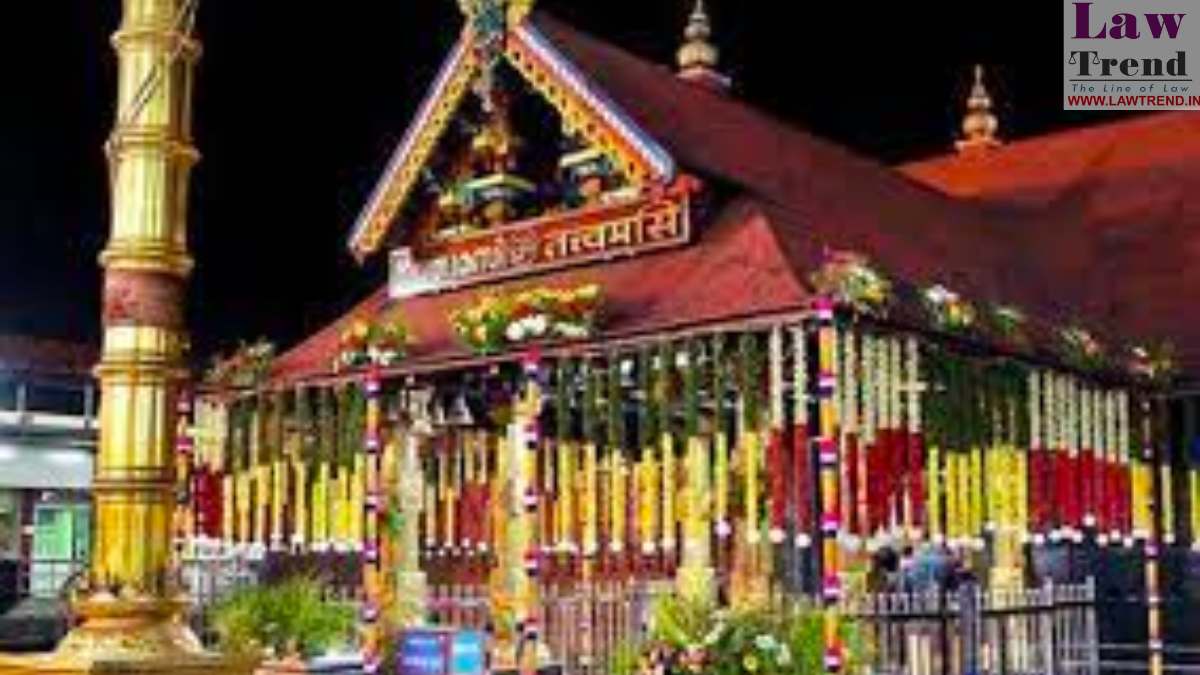
The Union Government on Thursday voiced its support for the long-standing restrictions on the entry of women of menstruating age into Kerala’s Sabarimala temple. Appearing before a nine-judge Constitution bench of the Supreme Court, the Centre argued that the landmark 2018 judgment—which lifted the ban—was based on a flawed assumption that religious traditions necessarily place women on a “lower pedestal.”
The hearing, presided over by Chief Justice Surya Kant, is part of a broader judicial review of discrimination against women at religious sites and the overall scope of religious freedom across multiple faiths.
Solicitor General Tushar Mehta, representing the Centre, contended that religious practices are often rooted in specific faiths and beliefs rather than gender hierarchies. He argued that the 2018 verdict proceeded on the premise that such restrictions imply men are superior.
To counter the narrative of “male-centric” discrimination, Mehta provided the court with instances where men are restricted or required to follow unconventional protocols in other shrines. He cited the Kottankulangara Sree Devi Temple in Kerala as an example of unique religious diversity.
“It is a Devi Bhagwati temple; there are certain faiths and beliefs attached,” Mehta told the bench. “There is one temple in Kerala where men will go dressed as women. They go to beauty parlours and female family members help them dress in sarees. So it is not a question of male-centric or female-centric religious beliefs. In the present case, it happens to be woman-centric.”
The Centre’s legal team further argued that the standards for judging religious traditions should be revisited. Additional Solicitor General KM Nataraj stated that “public morality” should be the governing standard in these matters, rather than “constitutional morality” as interpreted by the court in earlier rulings.
The nine-judge bench—which includes Justices B V Nagarathna, M M Sundresh, Ahsanuddin Amanullah, Aravind Kumar, Augustine George Masih, Prasanna B Varale, R Mahadevan, and Joymalya Bagchi—is currently examining broad issues of religious freedom that were framed following a referral in 2019.
The legal controversy dates back to September 2018, when a five-judge Constitution bench, in a 4:1 majority verdict, declared the ban on women aged 10 to 50 at the Sabarimala Ayyappa temple illegal and unconstitutional. The court had then ruled that the practice violated the fundamental right to equality.
However, the ruling sparked nationwide debate and led to a series of review petitions. In November 2019, a subsequent five-judge bench headed by then-CJI Ranjan Gogoi referred the matter to a larger bench, noting that issues regarding the entry of women into mosques, the practice of female genital mutilation in the Dawoodi Bohra community, and the rights of Parsi women married to non-Parsis also required consideration.
The current proceedings aim to define the intersection between individual fundamental rights and the collective right of religious denominations to manage their own internal affairs.




