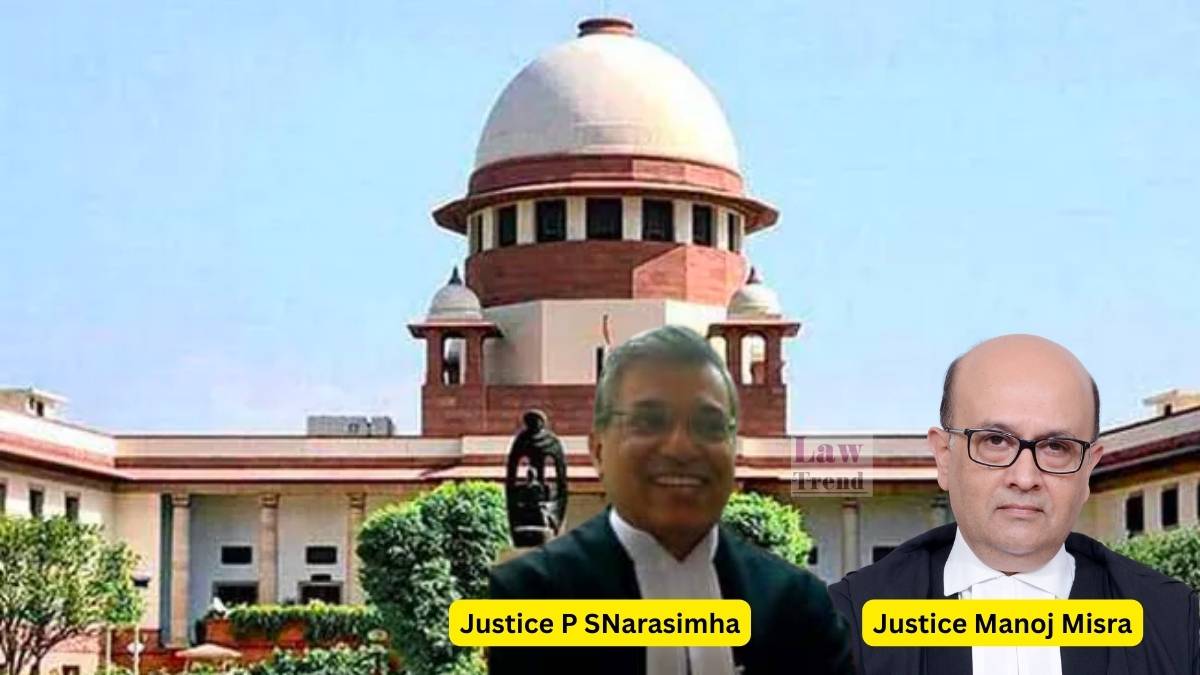
The Supreme Court of India has set aside the conviction of two appellants under Section 294(b) of the Indian Penal Code (IPC), observing that the mere use of abusive language like the word “bastard” during a heated altercation does not constitute “obscenity.”
A Bench comprising Justice Pamidighantam Sri Narasimha and Justice Manoj Misra also modified the convictions and sentences of the appellants, Senthil (A-1) and Sivakumar (A-2), in a case involving the death of a relative during a dispute over a common property boundary. While the Court confirmed A-2’s conviction for culpable homicide not amounting to murder, it reduced his sentence from five years to three years of rigorous imprisonment.
Background of the Case
The incident dates back to September 20, 2014, in the jurisdiction of Police Station Thiruvidaimaruthur. The dispute involved real brothers, Ganesan (deceased prior to the incident) and Kaliyamurthy (the deceased in this case), who shared a common boundary. The appellants are Senthil (A-1, son of Ganesan) and Sivakumar (A-2, husband of Ganesan’s daughter).
According to the prosecution, the altercation began when the deceased insisted on fencing the property despite objections from the accused. In the ensuing melee, A-1 allegedly attacked the deceased’s brother (PW-4) with an Aruval (a sickle-like tool), causing non-grievous injuries. Simultaneously, A-2 struck the deceased on the head with a wooden log. The deceased fell unconscious and later succumbed to a depressed fracture of the skull and internal brain hemorrhaging.
The Trial Court originally convicted A-1 under Section 324 IPC (voluntarily causing hurt by dangerous weapons) and A-2 under Section 325 IPC (voluntarily causing grievous hurt). On appeal, the High Court of Madras at Madurai enhanced the charges, convicting both under Section 294(b) (obscene acts/words) and Section 304 Part II (culpable homicide not amounting to murder).
Arguments of the Parties
The appellants argued that there was no evidence to justify a conviction under Section 294(b) IPC. Regarding the homicide charge, they contended there was no intention to cause death or knowledge that the act was likely to cause death. They emphasized that the incident occurred in the “heat of the moment” during a surge of passion over a boundary dispute, and the solitary blow to the head was accidental.
The State countered that the use of the word “bastard” was sufficient to invoke Section 294(b). It further argued that since A-1 initiated the attack, he shared a common intention with A-2 under Section 34 IPC to cause bodily injury likely to cause death.
Court’s Analysis and Observations
On Obscenity [Section 294(b) IPC]: The Court examined the definition of “obscene,” noting that the IPC does not specifically define it but legal precedents link it to material that appeals to “prurient interest.” Referring to Apoorva Arora v. State (Govt. of NCT of Delhi), the Bench noted:
“It is well established… that vulgarity and profanities do not per se amount to obscenity. While a person may find vulgar and expletive-filled language to be distasteful, unpalatable, uncivil, and improper, that by itself is not sufficient to be ‘obscene’.”
The Court held that the word “bastard” evokes “disgust, revulsion, or shock” rather than sexual or lustful thoughts, especially when used during heated conversations in the modern era.
On Common Intention [Section 34 IPC]: The Court found that A-1 did not share a common intention with A-2 to kill the deceased. It noted that A-1’s attack was directed at PW-4 and there was no evidence he exhorted A-2 to strike the deceased. Consequently, A-1’s conviction under Section 304 Part II read with Section 34 was set aside.
On Culpable Homicide [Section 304 Part II IPC]: For A-2, the Court upheld the High Court’s finding of culpable homicide. It noted the medical evidence of a skull fracture and the fact that A-2 targeted the deceased to “finish him off.” However, considering the context—a sudden fight between relatives over a boundary using a log found at the spot—the Court found the five-year sentence too harsh.
Decision
The Supreme Court passed the following orders:
- Acquittal under Section 294(b): The conviction of both A-1 and A-2 for using obscene words was set aside.
- Appellant Senthil (A-1): Conviction under Section 324 IPC was confirmed, but the sentence was reduced to the period already undergone (approximately 1 month and 25 days). He remains on bail.
- Appellant Sivakumar (A-2): Conviction under Section 304 Part II IPC was confirmed, but the sentence was reduced from five years to three years of rigorous imprisonment. He was ordered to surrender to serve the remaining term.
Case Details
- Case Title: Sivakumar v. State Rep. by the Inspector of Police (with connected matter)
- Case Number: Criminal Appeal No. 1807 of 2019 & 677 of 2020
- Bench: Justice Pamidighantam Sri Narasimha and Justice Manoj Misra
- Date: April 06, 2026