

Conviction Based on Dying Declaration Can Be Sustained If Found Reliable: Supreme Court Upholds Life Sentence for Man Who Set Wife on Fire
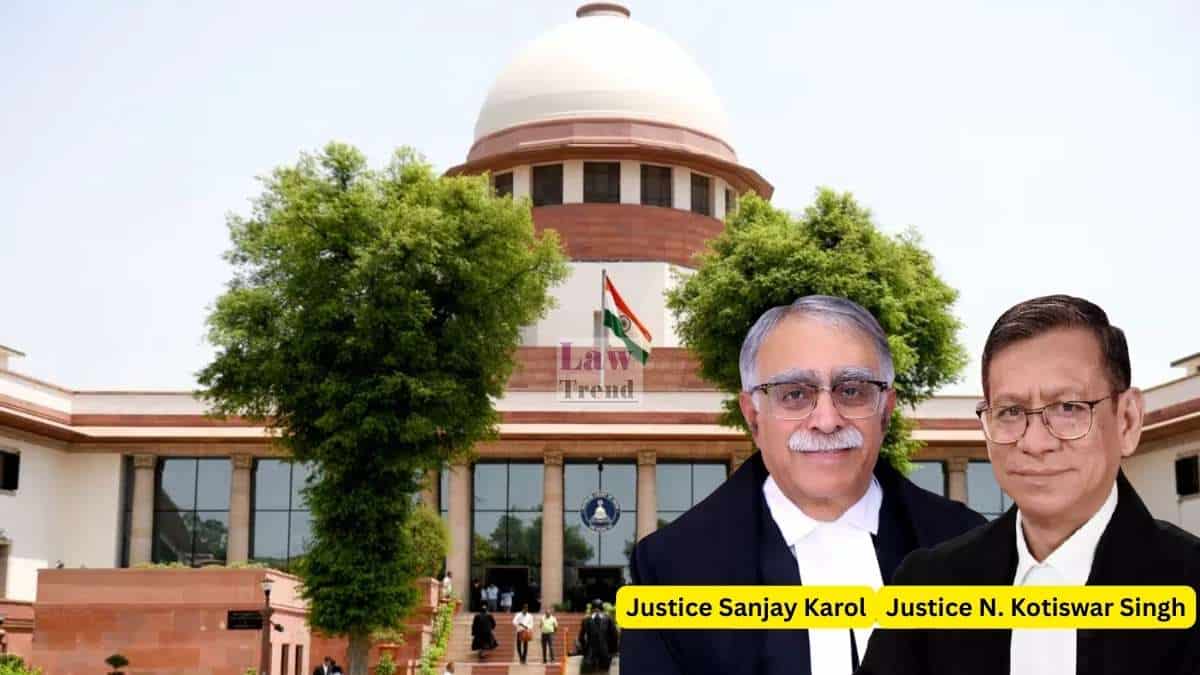

The Supreme Court of India has dismissed a criminal appeal filed by a man convicted of murdering his wife by pouring kerosene and setting her on fire. The Court, while upholding the concurrent findings of the Trial Court and the Rajasthan High Court, expressed profound concern over the persistence of patriarchy and domestic violence despite decades of legal and social reforms.

The Division Bench, comprising Justice Sanjay Karol and Justice Nongmeikapam Kotiswar Singh, delivered the judgment in Shankar v. State of Rajasthan (Criminal Appeal No. of 2026).

Background of the Case

The appellant, Shankar, was married to the deceased, Sugna Bai, approximately one month prior to her death on October 19, 2012. According to the prosecution, the relationship soured within 20 days due to the appellant’s excessive alcohol consumption and violent behavior.

On October 15, 2012, while the deceased was at her parental home, the appellant demanded she return to their rented room to cook for him. While she was preparing vegetables, a drunk Shankar allegedly beat her, strangled her, locked the room from the inside, poured kerosene on her, and set her on fire with a matchstick. Despite the appellant and neighbors later attempting to extinguish the flames with water and a blanket, Sugna Bai suffered extensive burns and succumbed to septicaemia at MBSH Hospital, Rajasthan, four days later.

The Trial Court (Sessions Judge, Bundi) convicted Shankar on December 10, 2014, under Sections 302 (Murder) and 342 (Wrongful Confinement) of the Indian Penal Code (IPC), sentencing him to life imprisonment. The Rajasthan High Court dismissed his appeal in 2019, leading to the present proceedings before the Supreme Court.

READ ALSO  Supreme Court Frames Guideline on Payment of Maintenance in Matrimonial Cases

Arguments of the Parties

The appellant’s counsel, Senior Advocate Ms. Kaveeta Wadia, challenged the conviction primarily on the grounds that the dying declaration was unreliable. It was argued that the Magistrate who recorded the statement reported the victim’s mental condition as “not good” and that she was not in a position to give a statement. The defense also claimed the Magistrate had taken certifications on blank papers and that the deceased’s parents had tutored her.

Per contra, the counsel for the State of Rajasthan, Mr. Divynk Panwar, supported the findings of the lower courts, emphasizing the consistency between the medical evidence and the dying declaration.

Court’s Analysis

The Supreme Court focused its analysis on the validity of the dying declaration recorded under Section 32 of the Indian Evidence Act, 1872 (now Section 26 of the Bhartiya Sakshya Adhiniyam, 2023).

The Court observed that dying declarations enjoy a special position based on the “philosophical understanding that when a person is about to meet his maker… what does fall from them would, therefore, be only the truth.”

READ ALSO  सुप्रीम कोर्ट ने जीएमआर ग्रुप से फार्महाउस खाली कराने के दिल्ली हाईकोर्ट के आदेश पर लगाई रोक

Upon reviewing the testimony of the Magistrate (PW-12, Ajay Kumar Sharma), the Court found that:

  • The Magistrate explicitly stated the victim was conscious and in a position to give a statement.
  • A certificate of fitness was obtained from the duty doctor (PW-15) prior to recording the statement.
  • The fact that the certification was on the reverse side of the paper did not affect its “sanctity.”

Regarding the hostile witnesses (PW-2 and PW-3), the Court held that their change in stance did not benefit the accused because the medical evidence provided by Dr. Navneet Parashar (PW-9) and Dr. Rakesh Sharma (PW-10) remained consistent with the victim’s dying declaration. The Court also dismissed the challenge to Dr. Rakesh Sharma’s testimony, stating that being a “medical jurist” rather than a “practicing doctor” did not disqualify him.

The “Postscript”: A Reflection on Society

In a significant postscript, Justice Karol reflected on the status of women’s rights in India. The Court noted a “paradox” where economic growth and legal reforms coexist with persistent violence.

The judgment highlighted several landmark cases and legislations:

  • Legislations: Dowry Prohibition Act (1961), Section 498A IPC, and the Protection of Women from Domestic Violence Act (2005).
  • Judicial Precedents: Shayara Bano v. Union of India (Triple Talaq), Joseph Shine v. Union of India (Adultery), Secretary, Ministry of Defence v. Babita Puniya (Permanent Commission for Women), and Vineeta Sharma v. Rakesh Sharma (Coparcenary rights).
READ ALSO  UP Cow Slaughter Act | Revision Under Section 397 Cr.P.C Can Be Filed Regarding Confiscation and Release of a Vehicle: Allahabad HC

Despite these, the Court cited National Crime Records Bureau (NCRB) data showing over 4.48 lakh crimes against women in 2023. The Court observed:

“The coexistence of progress and violence signals to a paradox… Legal and economic advancements are visible on a macro-level, but patriarchy still permeates the everyday… practices such as domestic abuse or even extreme acts like burning a wife (such as in this case) persist not as aberrations, but as indications of a disease afflicted social order.”

Final Decision

The Supreme Court concluded that there were no manifest errors in the lower courts’ findings. The appeal was dismissed, and the conviction and sentence of life imprisonment were upheld.

Case Details:

  • Case Title: Shankar v. State of Rajasthan
  • Case Number: Criminal Appeal No. of 2026 (@SLP(Crl) No. 13899 of 2025)
  • Bench: Justice Sanjay Karol, Justice Nongmeikapam Kotiswar Singh
  • Date: April 2, 2026

Law Trend
Law Trendhttps://lawtrend.in/
Legal News Website Providing Latest Judgments of Supreme Court and High Court

Related Articles

Latest Articles

