

Show Cause Notice Can Be Quashed Where Foundational Facts Collapse; Supreme Court Sets Aside FEMA Proceedings
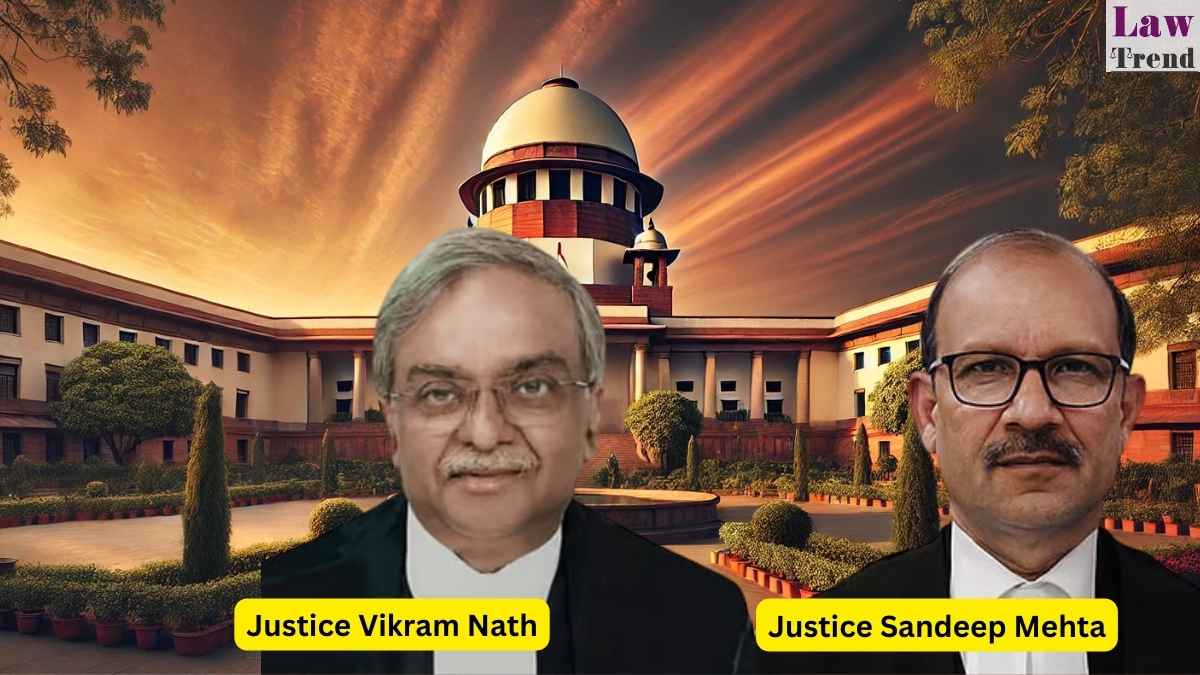

The Supreme Court of India has ruled that interference at the stage of a Show Cause Notice (SCN) is permissible in exceptional circumstances, particularly where the foundational requirement of a “reason to believe” is not satisfied. A Bench comprising Justice Vikram Nath and Justice Sandeep Mehta set aside a final adjudication order and a Madras High Court judgment, holding that an Adjudicating Authority cannot proceed with a case when the underlying basis for the allegations has been found wanting by a Competent Authority.

The central legal issue was whether a Show Cause Notice issued under the Foreign Exchange Management Act (FEMA), 1999, could be sustained after a Competent Authority had already recorded a categorical finding that there was no evidence of a violation. The Supreme Court held that the rejection of the appellants’ challenge to the SCN by the High Court was unjustified. The Court declared the subsequent adjudication order “arbitrary and contrary to law,” reviving the proceedings only from the stage of the SCN, pending a final decision on the legality of the asset seizure.

Background of the Case

The case involved $M/s$. Accord Distilleries & Breweries Pvt. Ltd. and its Directors (the appellants), who were accused of acquiring 70 lakh shares of a Singapore-based entity, $M/s$. Silver Park International Pte. Ltd., without Reserve Bank of India (RBI) approval. Following these allegations, the Authorised Officer seized properties of the appellants under Section 37A(1) of FEMA.

However, the Competent Authority, exercising powers under Section 37A(3), refused to confirm the seizure on February 3, 2021. The Authority observed:

“The Enforcement Directorate has not proved by way of evidence that the money indicated in the ‘subscribed shares’ have been paid either ‘legally or illegally’… In this case no share of any value was held in Singapore. Therefore suspicion has no foundation.”

Despite this finding, the Directorate of Enforcement issued an SCN and proceeded to pass a final adjudication order on August 26, 2024, imposing penalties and ordering confiscation, while the Department’s appeal against the seizure refusal was still pending.

Arguments of the Parties

For the Appellants: Senior Counsel Mr. Siddharth Luthra and Mr. Harin P. Raval argued that once the Competent Authority concluded there was no basis for seizure, the “foundational facts” for the SCN were effaced. They contended that the High Court erred in holding that a writ petition against an SCN is not maintainable, especially when the notice lacks a jurisdictional foundation.

READ ALSO  मध्य प्रदेश में न्यायिक सेवा में दृष्टिबाधित लोगों को बाहर करने पर सुप्रीम कोर्ट ने स्वत: संज्ञान लेते हुए मामला दर्ज किया

For the Respondents: Additional Solicitor General Mr. Anil Kaushik argued that seizure proceedings under Section 37A are independent of adjudication proceedings under Section 16. He maintained that the Adjudicating Authority has independent jurisdiction to decide the SCN on its merits regardless of the Competent Authority’s findings on seizure.

The Court’s Analysis

The Supreme Court emphasized that while courts generally do not interfere at the SCN stage, this is not an “inviolable rule.” Citing Union of India v. VICCO Laboratories (2007), the Court noted that interference is justified if a notice is issued without jurisdiction or in an abuse of the process of law.

READ ALSO  Regularizing the Services of Only Some Employees and Not of Other Entitled Employees, Is Discriminatory and Violative of Article 14: SC

The Bench observed that the Competent Authority’s refusal to confirm the seizure reflected a substantive evaluation that the “reason to believe” was missing. The Court noted:

“The refusal to confirm the seizure, therefore, reflects a considered finding that the foundational requirement of a ‘reason to believe’ was not satisfied on the material available.”

The Court found that the Adjudicating Authority had “undone” the order of the Competent Authority while the matter was still sub-judice before the Appellate Tribunal. The Bench held:

“Such a course of action… tantamounts to abdicating the powers of the Appellate Authority, even when the order of the Competent Authority was still under challenge in appeal at the instance of the department.”

The Decision

The Supreme Court set aside the Madras High Court’s judgments and the final adjudication order dated August 26, 2024.

The Court directed:

  1. The Appellate Authority must decide the Department’s appeal against the Competent Authority’s order (refusing seizure) within two months.
  2. Adjudication proceedings arising from the SCN are revived but can only proceed after the Appellate Authority’s decision.
  3. The proceedings must be taken to their logical conclusion without being prejudiced by the previous observations of the High Court or the Adjudicating Authority’s set-aside order.
READ ALSO  इलेक्ट्रॉनिक उपकरणों की जब्ती पर दिशानिर्देश तैयार करने के लिए समिति का गठन किया जा रहा है: केंद्र ने सुप्रीम कोर्ट से कहा

Case Details Block:

  • Case Title: J. Sri Nisha v. The Special Director, Adjudicating Authority, Directorate of Enforcement and Anr.
  • Case Number: Civil Appeal arising out of SLP(Civil) No(s). 23415 of 2025 (and connected matters)
  • Bench: Justice Vikram Nath and Justice Sandeep Mehta
  • Date: April 01, 2026

Law Trend
Law Trendhttps://lawtrend.in/
Legal News Website Providing Latest Judgments of Supreme Court and High Court

Related Articles

Latest Articles

