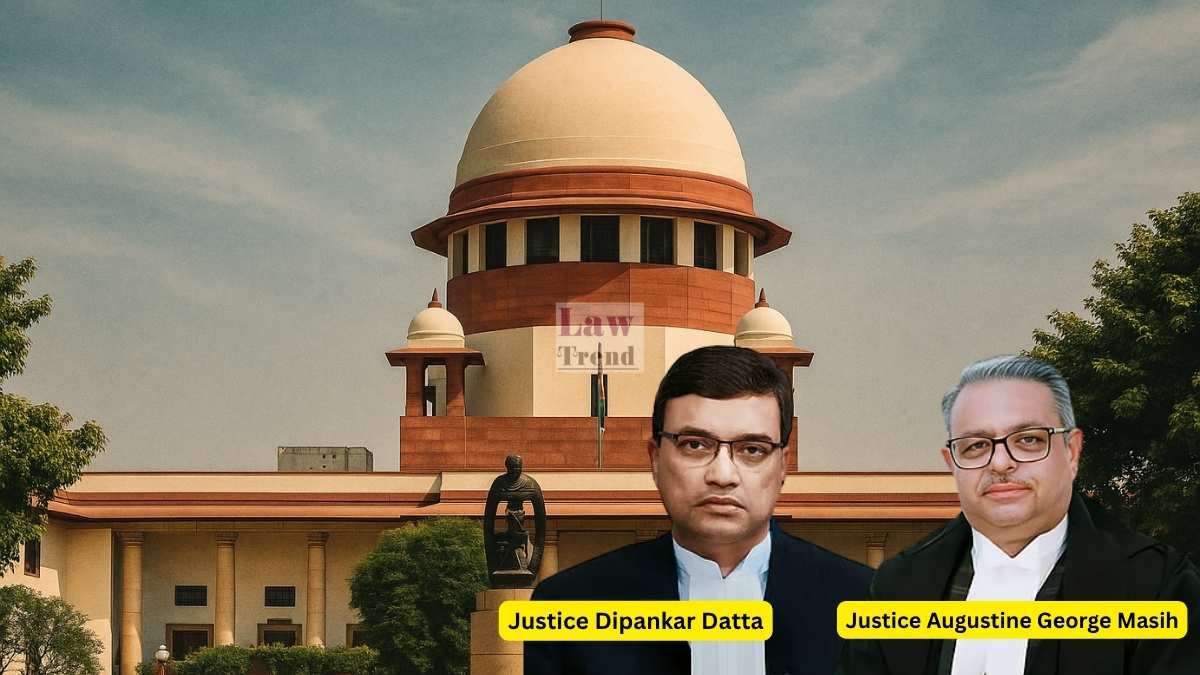
The Supreme Court of India has dismissed an appeal by decree-holders seeking to execute a specific performance decree against third-party objectors, holding that the appellants’ failure to pursue earlier suits challenging the objectors’ title precluded them from doing so in execution proceedings.
A Bench comprising Justice Dipankar Datta and Justice Augustine George Masih, while clarifying that a dismissal for default does not strictly constitute res judicata under Section 11 of the CPC, ruled that the appellants’ conduct amounted to an “utter abuse of the process of court.” The Court upheld the High Court of Andhra Pradesh’s decision, which directed the appellants to seek remedies through a separate civil suit.
Factual Background
The dispute originated from an agreement for sale dated December 15, 1986, for a property in Himayat Nagar, Hyderabad. The appellants (plaintiffs) sued the owner’s son, Abdul Mujeeb Mahmood, for specific performance (O.S. No. 329 of 1988). The Trial Court decreed the suit in 1998, and a sale deed was executed through the court in 2001.
However, during the delivery of possession, Respondents 1 to 3 filed an objection petition under Order XXI Rules 99 to 101 of the CPC. They claimed independent title via sale deeds from 1990, executed by a Power of Attorney holder for one Mir Sadat Ali, who allegedly received the property through an oral gift from the original owner.
Crucially, in 1990, the appellants had filed two separate suits (O.S. Nos. 892 and 893 of 1990) seeking to cancel these very sale deeds. Both suits were dismissed for default in 1996 and 1998, and subsequent restoration applications also failed.
Arguments of the Parties
Appellants’ Submissions: Senior Advocate Huzefa Ahmadi, representing the appellants, argued that the 1990 sale deeds were hit by the doctrine of lis pendens (Section 52, Transfer of Property Act) as they were executed during the pendency of the specific performance suit. He further contended that under Order XXI Rule 101, the executing court has the power to decide all questions of title and should not have relegated the parties to a fresh suit. He relied on Shreenath v. Rajesh (1998) to argue against driving parties to separate litigation.
Respondents’ Submissions: Senior Advocate Raval, for the respondents, argued that they were in settled possession since 1990 and were not parties to the specific performance suit. He emphasized that the appellants, having allowed their independent challenges to the sale deeds to lapse, were barred by Order IX Rule 9 of the CPC from reagitating the same cause of action. He also alleged suppression of material facts, noting the appellants did not inform the Trial Court in the specific performance suit about the existence of the respondents’ registered sale deeds.
Court’s Analysis
The Supreme Court addressed two primary issues: the applicability of res judicata and the impact of the appellants’ conduct.
1. On Res Judicata: The Court disagreed with the Appellate Court’s finding that dismissal for default operates as res judicata.
“Section 11 postulates that the matter must have been ‘heard and finally decided’. Dismissal of a suit for default, not being a decision on merits, cannot ordinarily be regarded as a final adjudication so as to attract the strict application of Section 11, CPC.”
2. On Conduct and Abuse of Process: Despite the non-application of Section 11, the Court found the appellants’ conduct disqualifying. It invoked the maxim nemo debet bis vexari (no one should be twice troubled for the same cause).
The Court noted that the appellants were fully aware of the respondents’ claims in 1990 but failed to implead them in the specific performance suit. Furthermore, they abandoned their direct challenges to the sale deeds.
“The cumulative effect of these events is that the appellants not only permitted the original suits to be dismissed for default but also allowed the restoration proceedings to meet the same fate… it manifests that the appellants intended to steal a march (over the defendants in such suits) by resorting to dubious methods, deliberately avoiding direct proceedings and instead securing orders through proceedings wherein they were not parties.”
Citing K.K. Modi v. K.N. Modi (1998), the Bench observed that relitigation of an issue already raised or capable of being raised constitutes an abuse of process.
“A party cannot act recklessly with the judicial process, invoking it as per his convenience and abandoning it when inconvenient, only to resurrect advantage in execution.”
The Court also referenced Sarguja Transport Service v. State Transport Appellate Tribunal (1987), noting that public policy prevents a litigant from repeatedly invoking jurisdiction on the same cause of action and then abandoning it.
“It would, thus, be contrary to public policy too, as enunciated in Sarguja Transport Service (supra), to permit the appellants to reap the benefits of the decree for its execution against the respondents 1 to 3 and have them dispossessed from the property.”
The Decision
The Supreme Court concluded that in the absence of any exceptional circumstance, the appellants stand precluded from reaping the benefit of the decree through execution proceedings having chosen not to pursue O.S. Nos. 892 and 893 of 1990.
The Court upheld the impugned judgment of the High Court, though for reasons other than those assigned therein, dismissing the appeal and directing parties to bear their own costs.
Case Details:
- Case Title: Sharada Sanghi & Ors. v. Asha Agarwal & Ors.
- Case Number: Civil Appeal No. 2609 of 2013
- Bench: Justice Dipankar Datta and Justice Augustine George Masih
- Date of Judgment: March 25, 2026