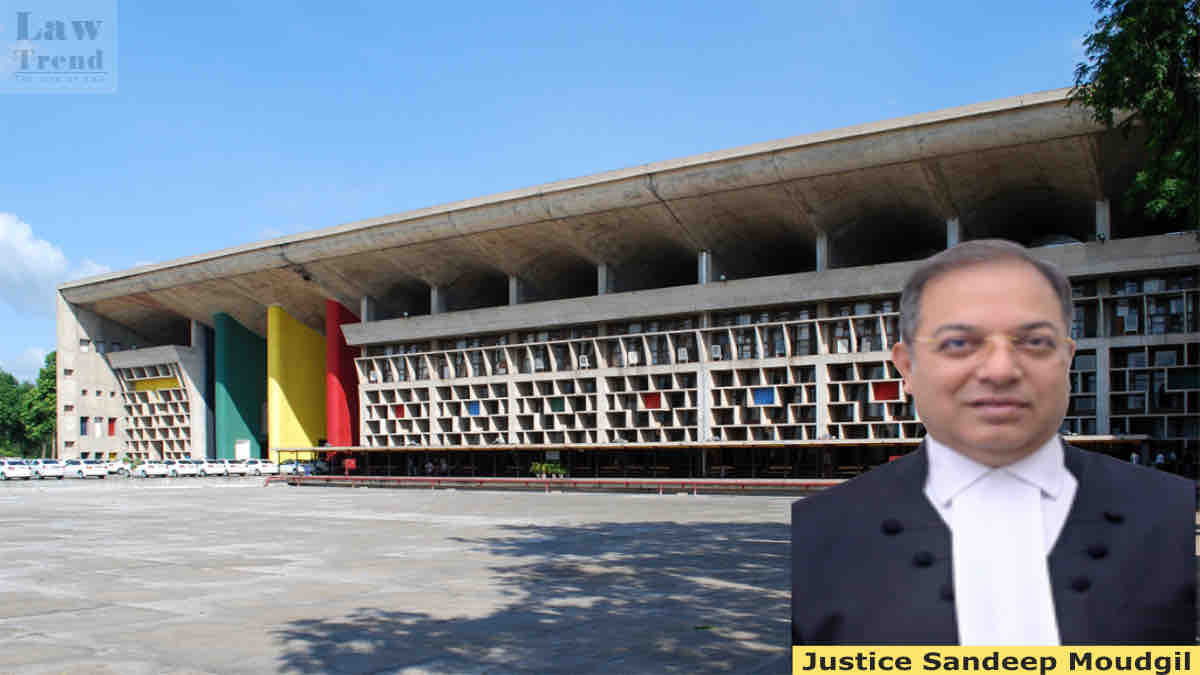
The High Court of Punjab and Haryana has held that a conviction under Section 498-A of the Indian Penal Code (IPC), arising out of matrimonial discord, does not automatically constitute an offence involving “moral turpitude.” Presiding over the case, Justice Sandeep Moudgil set aside the discharge of a State Bank of India (SBI) Branch Manager, noting that the bank had mechanically terminated his services without evaluating the specific facts of the case or the nature of the conduct involved.
The Court directed the respondents to reinstate the petitioner’s consequential benefits from December 15, 2018, along with 6% interest per annum.
Background of the Case
The petitioner, Brahmjeet Kaushal, was working as a Branch Manager (MMGS-III) at Panipat. In May 2000, an FIR was registered against him and his family members under Sections 304-B, 406, and 498-A of the IPC following the suicide of his wife. In October 2002, the Sessions Court acquitted the petitioner of the graver charges under Sections 304-B (dowry death) and 406 (criminal breach of trust) but convicted him under Section 498-A (cruelty) and sentenced him to three years of rigorous imprisonment.
The conviction was upheld by a Division Bench of the High Court in 2018. Consequently, SBI issued an order on June 27, 2019, discharging the petitioner from service effective from December 14, 2018. The Bank invoked Rule 68(7)(i) of the State Bank of India Officers’ Service Rules, 1992, and Section 10(1)(b)(i) of the Banking Regulation Act, 1949, asserting that conviction under Section 498-A IPC involves “moral turpitude.”
Arguments of the Parties
Petitioner’s Submissions: Counsel for the petitioner argued that the Appointing Authority failed to disclose any reasons as to how a conviction arising from a domestic matrimonial dispute answered the description of “moral turpitude.” It was contended that the Bank neither prescribed a list of such offences nor applied the well-settled tests for moral turpitude established by the Supreme Court in State Bank of India & Others v. P. Soupramaniane (2019).
The petitioner highlighted his “unblemished service record” and promotions earned while the criminal case was pending. He further pointed to a suicide note left by the deceased wife, which stated she was responsible for her own actions, as evidence that there was no “depraved conduct” that would shock the moral conscience of society.
Respondents’ Submissions: The respondent Bank argued that the discharge was legally justified as Section 10(1)(b)(i) of the Banking Regulation Act prohibits a bank officer convicted of an offence involving moral turpitude from continuing in service. Citing the Andhra Pradesh High Court’s decision in J. Ranga Raju v. State of Andhra Pradesh (2019), the Bank maintained that harassing a woman and subjecting her to cruelty is “undoubtedly an offence involving moral turpitude.” The Bank emphasized that as a public financial institution, it could not ignore a subsisting conviction for cruelty that resulted in the loss of human life.
The Court’s Analysis
Justice Sandeep Moudgil observed that the expression “moral turpitude” is not defined in the Banking Regulation Act or the service rules. Referring to Pawan Kumar v. State of Haryana (1996) and Allahabad Bank v. Deepak Kumar Bhola (1997), the Court noted that moral turpitude implies conduct that is “inherently base, vile, depraved or having any connection showing depravity.”
The Court criticized the Bank for its mechanical approach:
“The disciplinary authority cannot simply reproduce the phrase ‘conviction involving moral turpitude’ and proceed to terminate service. The authority is obligated to evaluate the nature of the offence, its nexus with official duties, the surrounding circumstances, the employee’s service record, and the proportionality of the proposed punishment.”
On the specific issue of Section 498-A IPC, the Court remarked that there is no uniform judicial consensus. However, it drew a “careful distinction” between cases of “egregious dowry-related cruelty” and personal disputes within a matrimonial home.
The Court held:
“Categorisation of a particular case under Section 498-A IPC may or may not involve moral turpitude depends on its own facts… To elevate every prosecution under Section 498-A… into an ‘offence against society’ and, on that abstract footing, to brand it in all cases as an offence involving moral turpitude, is a proposition which cannot withstand legal scrutiny.”
The Court further stated that the law demands a “fact-sensitive inquiry” and that the label of moral turpitude can only be imposed where the facts disclose “genuine moral depravity, rather than merely a strained matrimonial relationship.”
Decision of the Court
The Court found that the petitioner had been acquitted of the graver charges and that his conviction under Section 498-A was rooted in matrimonial discord. It concluded that such an offence does not, by its very nature, satisfy the tests of “inherent baseness or depravity.”
Finding the discharge order to be “cryptic and arbitrary,” the High Court allowed the writ petition and set aside the order dated June 27, 2019. The respondents were directed to grant all consequential benefits to the petitioner from December 15, 2018, with interest at 6% per annum within two months.
Case Details Block
- Case Title: Brahmjeet Kaushal v. Union of India & Ors.
- Case Number: CWP-24038-2021 (O&M)
- Bench: Justice Sandeep Moudgil
- Date: March 13, 2026