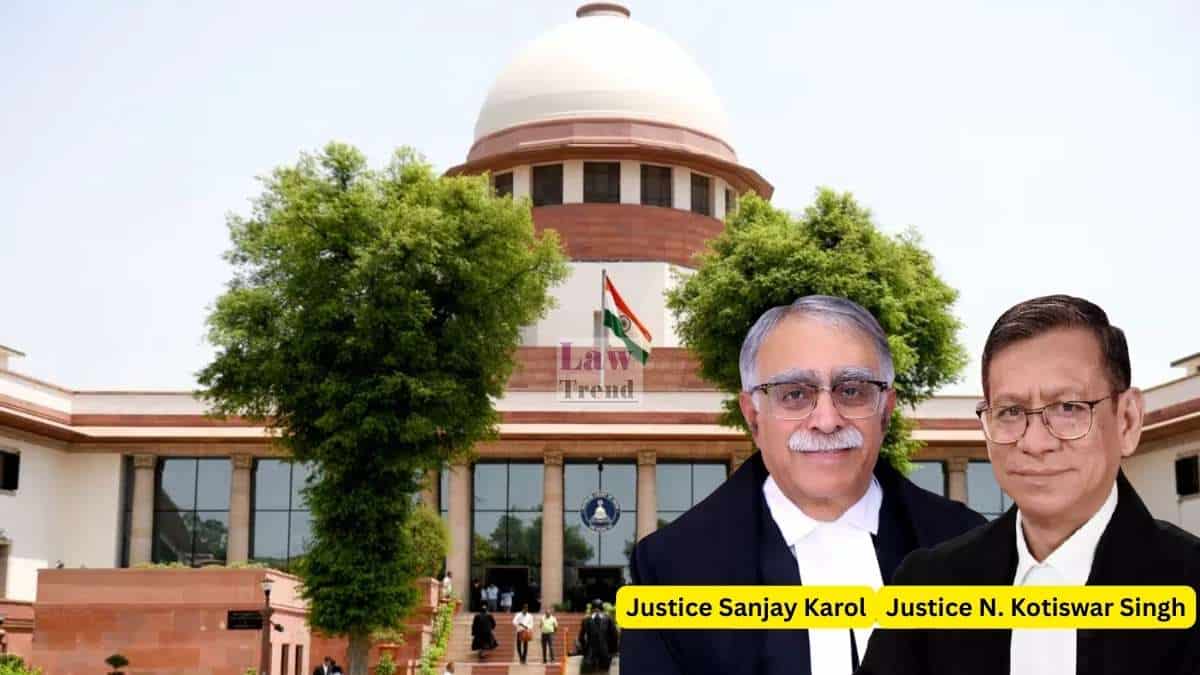
The Supreme Court of India has held that when a private vehicle is requisitioned by a public authority for governmental functions, such as election duty, the liability for any accident occurring during that period rests with the requisitioning authority and not the private insurance company.
A Division Bench comprising Justice Sanjay Karol and Justice Nongmeikapam Kotiswar Singh dismissed an appeal filed by the District Magistrate and Collector, Gwalior, challenging a High Court order that shifted the liability to compensate accident victims from the National Insurance Company to the State administration.
Background of the Case
The case originated from a fatal accident on January 23, 2010, involving a bus (MP-07-MG-9897) and a motorcycle. The motorcyclist was killed in the collision. At the time of the accident, the bus—owned by Kidzee Corner School, Gwalior—had been requisitioned by the District Magistrate for Gram Panchayat Elections.
The Motor Accident Claims Tribunal (MACT), Gwalior, initially awarded a compensation of ₹5,13,500. Subsequently, the High Court of Madhya Pradesh enhanced the compensation to ₹27,01,556 and shifted the entire liability to the District Magistrate, exonerating the insurance company. The appellant (District Magistrate) challenged this shifting of liability, arguing that the vehicle was covered by an insurance policy and that public authorities lack “insurable interest” or ownership of such vehicles.
Arguments Presented
The appellant contended that the High Court erred because the offending vehicle was under a valid insurance policy at the relevant time. They further argued that fastening liability on public authorities for vehicles used for public purposes would “send a wrong message,” as authorities do not own the vehicles.
Conversely, the Court examined whether the State, as a requisitioning authority, falls under the definition of “owner” during the period of use.
Court’s Analysis and Legal Observations
The Court relied on the definition of “requisition,” noting it implies an official request or command where the owner is “divested of custody and decision-making power.”
The Bench cited the precedent in National Insurance Co. Ltd. v. Deepa Devi (2008), which observed:
“While the vehicle remains under requisition, the owner does not exercise any control thereover… for all intent and purport, the registered owner of the vehicle loses entire control thereover.”
The Court also referred to the three-judge bench decision in Purnya Kala Devi v. State of Assam (2014), which clarified that a person in control and possession of the vehicle should be construed as the “owner” under Section 2(30) of the Motor Vehicles Act, 1988, not just the registered owner.
The Court observed:
“Once requisitioned, the vehicle is operated under official directions… To fasten liability upon the insurer in these circumstances would be to extend the contract beyond the risk that was agreed to be covered. Requiring the insurer to answer for consequences arising from a use neither authorised nor controlled by the insured would be unfair.”
The Court further noted that while Section 160 of the Representation of the People Act, 1950, does not expressly mention requisitioning manpower (drivers), authorities often utilize the owner’s driver for “operational convenience.” By doing so, the State “implicitly recognized such a driver’s competence” and assumed control.
The Decision
The Supreme Court concluded that since the requisition was a “command issued under statutory authority” and not a voluntary arrangement, the State assumes the corresponding responsibility for risks generated by its actions.
The Court distinguished this case from U.P. SRTC v. Kulsum, noting that the latter involved vehicles operated under a voluntary agreement, whereas the present case involved a mandatory statutory requisition.
Decision: The appeal was dismissed, affirming that the requisitioning authority (the State) is liable to meet the award.
Case Details
- Case Title: District Magistrate and District Election Officer and Collector, Gwalior, M.P. v. National Insurance Company Limited & Ors.
- Case Number: Civil Appeal No. ___ of 2026 (@ SLP (Civil) No. 22910 of 2025)
- Bench: Justice Sanjay Karol and Justice Nongmeikapam Kotiswar Singh
- Date: March 23, 2026