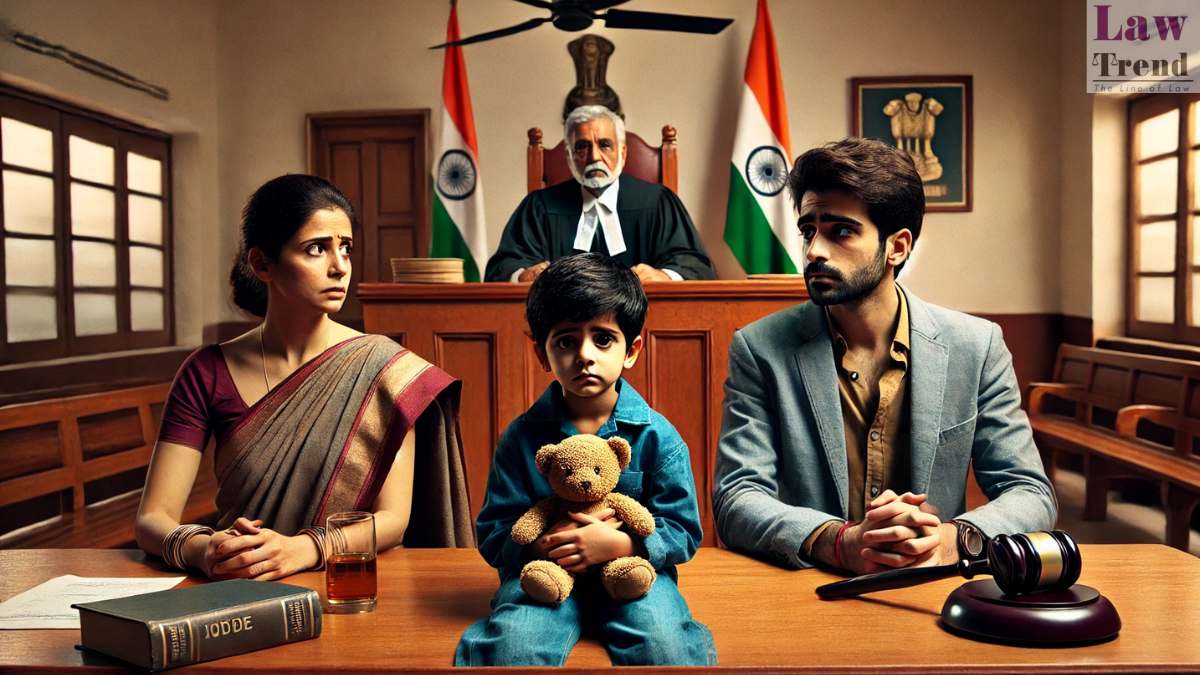
The Gujarat High Court has ordered the restoration of custody of a five-year-old minor child to his mother, directing his immediate return to Canada. A Division Bench comprising Justice N.S. Sanjay Gowda and Justice D.M. Vyas held that the father’s act of removing the child from Canada without the mother’s consent, particularly while legal proceedings were pending in a Canadian court, rendered his custody “unlawful.”
Background
The case involves a couple who married in Toronto, Ontario, in 2018 under Canadian civil law. Their son was born in Canada in 2020 and is a naturalized Canadian citizen. Following marital discord, the father sent an email in March 2024 stating that the marriage had ended and acknowledging that “laws also say that the kid has to be with the mom until a certain age.” Consequently, the mother had sole custody of the minor from September 2024 until April 2025 while the father was in India.
In August 2025, the mother initiated custody and support proceedings before the Ontario Court of Justice. While these proceedings were active, and after the father had filed his formal reply, he brought the child to India on December 7, 2025, without the mother’s permission. On December 12, 2025, the Ontario Court passed an ex-parte order declaring the child a “habitual resident” of Ontario and directing his immediate return. The mother subsequently filed a writ of habeas corpus before the Gujarat High Court.
Arguments of the Parties
For the Mother: Counsel appearing for the mother argued that the parties, having married under Canadian law, were subject to the jurisdiction of Canadian courts. They contended that since the father breached an informal parenting arrangement and defied a foreign court’s order to return the child, his custody was illegal. They further emphasized that the child had been in the sole care of the mother for over a year with the father’s prior written consent.
For the Father: Senior Counsel appearing for the father argued that as the parties were Hindus, custody should be governed by the Hindu Minority and Guardianship Act (HMGA) rather than Canadian law. He asserted that there was no formal restraint order preventing the father from traveling to India at the time of departure. Furthermore, the father alleged that the mother’s personal lifestyle was not in the child’s “best interest” and argued that the son should be raised in an Indian joint family environment.
Court’s Analysis
The Court addressed two primary questions: whether the removal was unlawful and what constituted the “best interests” of the child.
On Unlawful Removal: The Bench noted that the father had explicitly conceded custody to the mother in his March 2024 correspondence. The Court observed:
“If the father… categorically states at an undisputed point of time… that the mother could have custody of the child and this was in accordance with law, it would not be open for him to now contend that the best interests of the child would be if his son stayed with him.”
The Court rejected the father’s claim of “joint custody,” noting that his voluntary relocation to India in 2024 left the child in the mother’s sole care. The Bench held that the father could not defy the jurisdiction of the Ontario Court after having participated in its proceedings.
On Best Interests of the Child: Regarding the welfare of the minor, the Court emphasized the child’s Canadian citizenship and his lifelong upbringing in that country. The Bench remarked:
“Displacing such a child to a country like India and forcing the child to stay away from the mother would, in our view, be traumatic to the child. The secure atmosphere that the child enjoyed would be transformed into a new and alien atmosphere where he would be forced to adopt to come to terms with people who are fundamentally strangers to him.”
The Court dismissed the father’s allegations regarding the mother’s personal life, stating that since the father was aware of these circumstances previously and still conceded custody, they could not now be used to deny her custody. The Bench also noted that the child was enrolled in the Canadian educational system and was accustomed to a standard of living there which should not be disrupted.
Decision
The High Court allowed the writ petition and issued the following directions:
- The father is directed to hand over custody of the minor son to either the mother or the grandfather (through whom the petition was filed) forthwith.
- The mother/grandfather is permitted to collect the child’s passport and OCI card from the Court Registry to transport him to Canada.
- The father is at liberty to approach the Canadian court before whom the proceedings are pending for resolution of disputes, including visitation rights.
The Court stayed the operation of this order for a period of two weeks to enable the father to approach the Hon’ble Supreme Court of India, on the condition that the earlier order regarding online and physical access for the mother and grandfather remains in force.
Case Details
- Case Title: Tillana Shripal Shah W/O Shripal Shreyaskumar Shah vs. State of Gujarat & Anr.
- Case No.: R/Special Criminal Application (Habeas Corpus) No. 17368 of 2025
- Bench: Justice N.S. Sanjay Gowda and Justice D.M. Vyas
- Date: March 18, 2026