

Disciplinary Punishment Of Pay Reduction Valid Post-Retirement If Proceedings Initiated During Service: Supreme Court
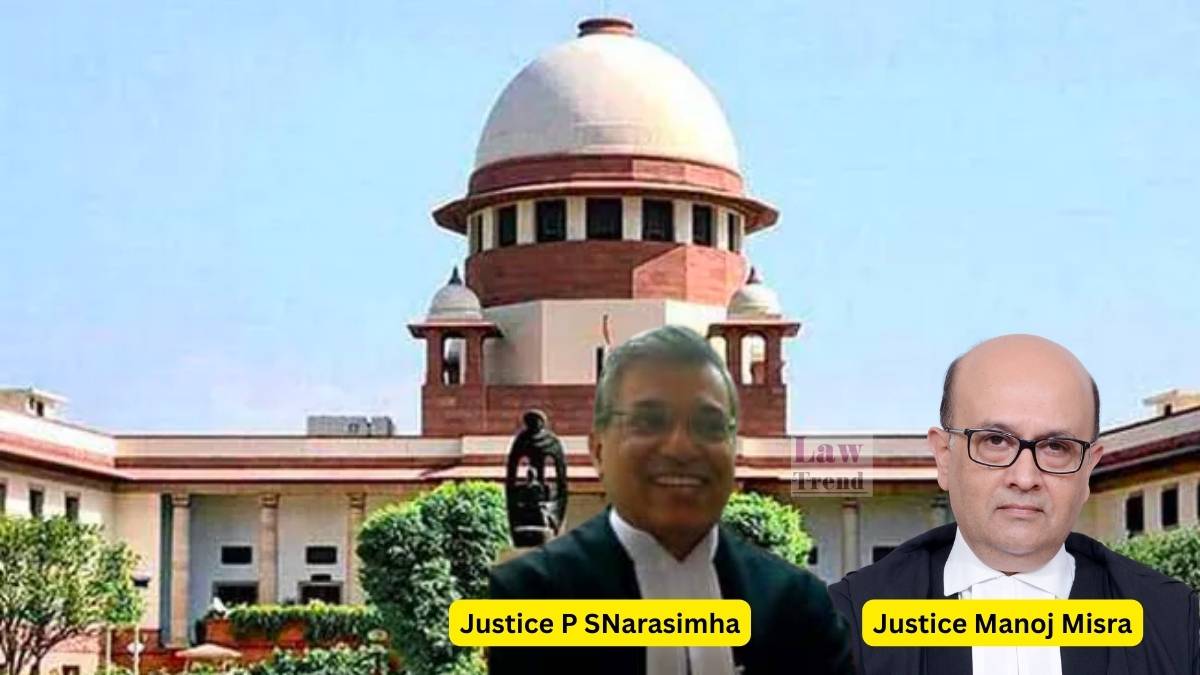

The Supreme Court of India has held that a punishment of reduction in the time scale of pay, even if imposed after an employee’s superannuation, is legally permissible provided the disciplinary proceedings were initiated while the employee was still in service.

A Bench comprising Justice Pamidighantam Sri Narasimha and Justice Manoj Misra dismissed an appeal filed by an ex-employee of Punjab and Sind Bank, affirming the decision of the Division Bench of the High Court of Punjab and Haryana. The Court clarified that such a punishment is implementable as it directly affects the computation of pension based on the last pay drawn.

Background of the Case

The appellant, Virinder Pal Singh, was served a charge sheet by Punjab and Sind Bank on September 30, 2011, the same day he superannuated from service. The allegations pertained to irregularities in the disbursement of loans. Although he retired, the disciplinary proceedings continued under the bank’s regulations.

The Inquiry Officer found Charge No. 2—failing to ensure the end-use of the loan—partly proved, noting that cash withdrawals of approximately ₹27.25 lakhs were made without supporting bills and the account subsequently turned into a Non-Performing Asset (NPA). Consequently, on June 15, 2013, the Bank imposed a punishment of reduction by three stages in the time scale of pay on a permanent basis.

READ ALSO  Kolkata Doctor Rape and Murder Case Updates: SC to Establish Task Force for Doctor Safety at Workplaces

The appellant’s departmental appeal was dismissed in 2014. He then approached the High Court. A Single Judge Bench initially set aside the punishment, ruling that only penalties under the Pension Regulations could be imposed post-retirement. However, a Division Bench reversed this, citing Regulation 20(3)(iii) of the Punjab and Sind Bank Officers’ Service Regulations, 1982, leading to the present appeal before the Apex Court.

Arguments of the Parties

Appellant’s Contentions: The appellant argued that upon superannuation, the master-servant relationship ceased, rendering the punishment of pay reduction impermissible. It was contended that the Bank could only reduce pension or recover losses under the Pension Regulations. Reliance was placed on Ramesh Chandra Sharma v. Punjab National Bank (2007) and UCO Bank v. Prabhakar Sadashiv Karvade (2018). The appellant also challenged the merits of the inquiry, asserting the orders were non-speaking and the charges were not proved.

Bank’s Contentions: The Bank maintained that Regulation 20(3)(iii) creates a legal fiction allowing proceedings to continue “as if he was in service” until a final order is passed. The Bank argued that the findings of the Inquiry Officer were logical, as cash withdrawals without bills indicated a failure to protect the Bank’s financial interests. It was further submitted that the punishment resulted in a “meagre sum” reduction of ₹302 per month in pension and was not disproportionate.

READ ALSO  महिला जजों की संख्या पर टिप्पणी के लिए सुप्रीम कोर्ट ने वकील को लगाई फटकार

Court’s Analysis and Observations

The Court focused on whether the Service Regulations permitted such a penalty post-retirement and whether the findings of misconduct were perverse.

On the Validity of Post-Retirement Punishment: The Court observed that under Regulation 20(3)(iii), an officer against whom proceedings were initiated prior to superannuation is deemed to be in service for the purpose of concluding the inquiry.

Regarding the implementability of the pay reduction, the Court noted:

“In the instant case, the punishment awarded is of reducing the pay scale by three stages on permanent basis. Such reduction in the pay scale would relate back to the date the incumbent superannuated from service. Ordinarily, pension is computed based on salary last drawn/payable. Therefore, in our view, it would not be difficult to implement such a punishment as pension can be computed accordingly.”

The Bench distinguished the Prabhakar Sadashiv Karvade case, noting that in that instance, the charge sheet was served after retirement, whereas here it was served during service.

On the Merits of the Misconduct: The Court emphasized the high standard of conduct required for bank officials:

READ ALSO  “Your Conduct Does Not Inspire Confidence”: Supreme Court Questions Justice Yashwant Varma Over In-House Inquiry Panel Challenge

“A bank officer holds a position of trust as he deals with public funds… Any dereliction in discharge of duties by such an employee or officer, whether by way of negligence/casualness, or with deliberate intention, constitutes misconduct.”

The Court found no perversity in the findings, noting that the appellant did not dispute the absence of bills for cash withdrawals.

The Decision

The Supreme Court concluded that the Division Bench of the High Court was justified in its construction of the Service Regulations.

“On a survey of the decisions cited… what is settled is that if the extant service Rules/Regulations permit continuance of the disciplinary proceedings… those can be continued and brought to its logical conclusion even after he had attained the age of superannuation.”

Finding the appeal lacking in merit, the Court dismissed it and held that the punishment was not shockingly disproportionate to the gravity of the proven misconduct.

Case Details:

  • Case Title: Virinder Pal Singh v. Punjab and Sind Bank & Ors.
  • Case Number: Civil Appeal No. 3571 of 2026
  • Coram: Justice Pamidighantam Sri Narasimha, Justice Manoj Misra
  • Date: March 19, 2026

Law Trend
Law Trendhttps://lawtrend.in/
Legal News Website Providing Latest Judgments of Supreme Court and High Court

Related Articles

Latest Articles

