

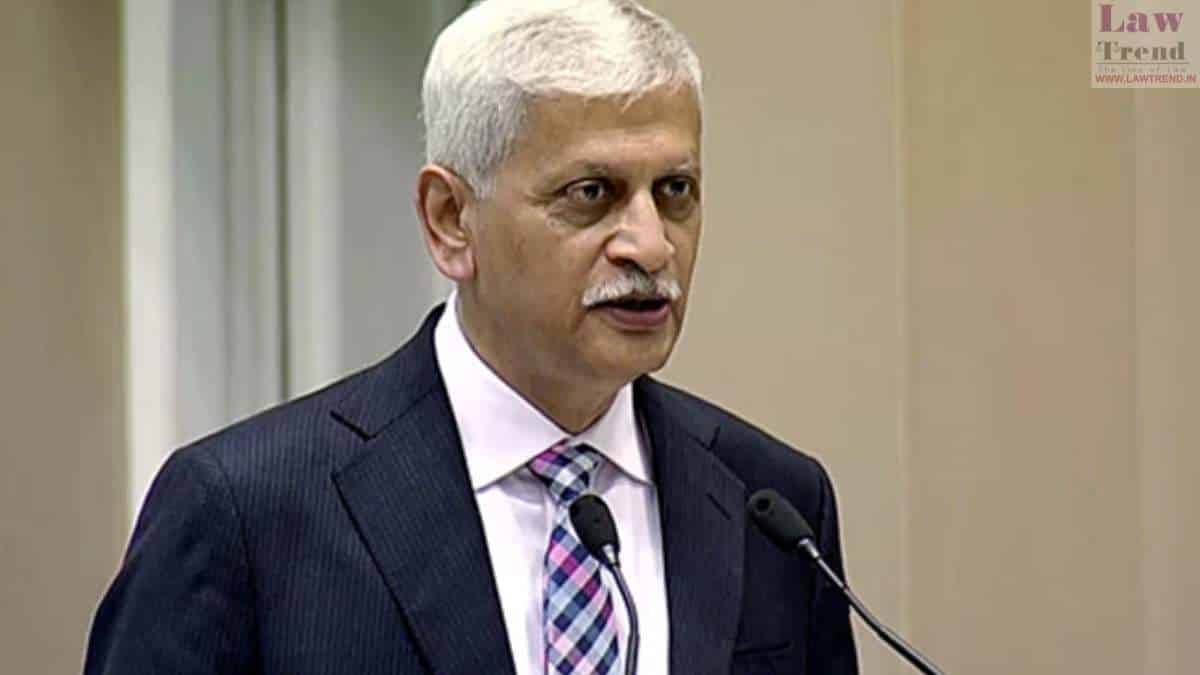
The Supreme Court on Monday appointed former Chief Justice of India U U Lalit as the sole mediator to facilitate an amicable settlement in a high-stakes dispute involving the enforcement of a UAE court decree worth over ₹500 crore against Hyderabad-based industrialist Nimmagadda Prasad. The decree was passed in favour of the Ras Al Khaimah Investment Authority (RAKIA), the sovereign wealth fund of the Emirate of Ras Al Khaimah in the United Arab Emirates.
A bench comprising Chief Justice Surya Kant and Justice Joymalya Bagchi passed the order after both parties expressed willingness to attempt a negotiated resolution through mediation.
During the hearing, senior advocate Gopal Subramanium, appearing for Prasad, informed the court that the industrialist had complied with earlier directions by depositing ₹125 crore as cash security. He also stated that the original title deeds of a 37-acre land parcel in Telangana had been submitted before the court, adding that the property is free from encumbrances.
Subramanium told the bench that his client was prepared to participate in mediation to settle the dispute.
Senior advocates Abhishek Singhvi and Gopal Sankaranarayanan, representing RAKIA, said the foreign investor was also open to time-bound mediation, but sought safeguards. They urged the court to ensure that the status quo regarding Prasad’s assets is maintained and that no third-party interests are created until the mediation process concludes.
Taking note of the consent of both sides, the bench appointed Justice Lalit as the sole mediator and requested him to conduct the mediation exercise for an expeditious resolution.
The court directed that the mediation proceedings be conducted in hybrid mode, allowing representatives of RAKIA to participate via video conferencing. The bench said the arrangement was made keeping in view the security situation in the Gulf region.
The court also clarified its earlier order regarding the businessman’s financial activities. It permitted Prasad to use funds for day-to-day operations of his companies, including payment of salaries, but restrained him from alienating immovable properties without prior permission of the court.
Justice Lalit has also been authorised to hear related parties during the mediation if necessary. The court said the former CJI would determine his professional fees and ancillary expenses in consultation with the litigating parties.
The dispute traces back to the Vanpic Project, a 2008 joint venture aimed at developing ports and an airport in Andhra Pradesh.
RAKIA alleges that Nimmagadda Prasad, in collusion with former RAKIA CEO Khater Massaad, misappropriated USD 120 million that had been earmarked for the project.
Based on these allegations, a UAE civil court passed a decree directing payment of AED 267,941,374, which translates to approximately ₹543 crore as principal and ₹643 crore with interest. RAKIA is now seeking to enforce this foreign decree in India.
Earlier, the Supreme Court had directed Prasad to furnish security worth ₹600 crore as a condition for hearing his challenge to the UAE decree.
In response, the industrialist proposed a combination of assets to meet the security requirement. These included shares and other assets valued at about ₹212 crore, which were already attached by commercial courts under orders dated September 5 and October 6, 2023.
However, the bench declined to accept these assets as part of the security arrangement.
Prasad also offered a 37-acre land parcel in Devarayamjal village in Telangana’s Medchal-Malkajgiri district, which he claimed was worth ₹408 crore, along with additional cash security of ₹125 crore.
The court directed that the original title deeds of the Medchal land be deposited with the Supreme Court registry along with an affidavit affirming that the property is free from encumbrances. The affidavit must also confirm that the required indemnity bond had been furnished in compliance with an earlier release order issued by the appellate tribunal under the Prevention of Money Laundering Act (PMLA).
The court had further ordered that once the ₹125 crore cash security is deposited, the registry should place the amount with UCO Bank at the Supreme Court in a high-interest-bearing fixed deposit initially for six months, with an auto-renewal facility.
The bench clarified that this interim security arrangement is without prejudice to the rights of the parties.
With mediation now underway under Justice Lalit’s supervision, the Supreme Court hopes that the parties may arrive at a negotiated settlement in the long-running dispute arising from the failed infrastructure venture.




