

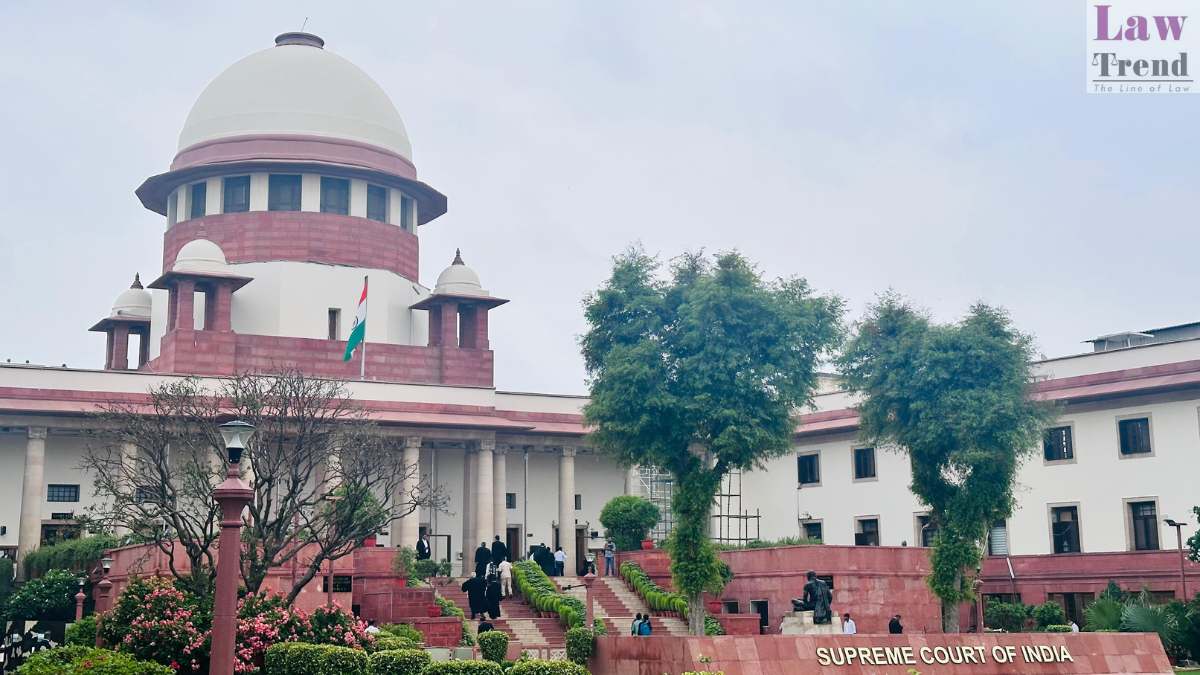
The Supreme Court of India on Thursday sought a response from the Central Government and other stakeholders on a Public Interest Litigation (PIL) seeking the establishment of a specialized “Revenue Judicial Service.” The plea advocates for mandatory legal qualifications and structured training for public servants tasked with adjudicating complex land and property disputes across the country.
A bench comprising Chief Justice Surya Kant and Justice Joymalya Bagchi issued notices to the Union of India, the Law Commission, and other relevant parties. The petition, filed by advocate Ashwini Upadhyay and drafted by advocate Ashwani Dubey, highlights a significant vacuum in the current administrative setup where revenue officers—often lacking formal legal education—are presiding over matters of title, succession, and inheritance.
The petition underscores a staggering statistic: nearly 66 percent of all civil cases in India are related to land disputes. The petitioner argues that the primary “lacuna” in the judicial system is that these cases are handled by executive officers rather than legally trained judicial minds.
According to the plea, the current system subjects citizens to “arbitrary, inconsistent, and erroneous decisions,” which in turn leads to:
- Prolonged uncertainty over property rights.
- Restrictions on the use and transfer of land.
- Increased litigation costs and a backlog in higher courts.
- A denial of effective access to justice, allegedly infringing upon fundamental rights guaranteed under Articles 14 and 21 of the Constitution.
The PIL seeks a formal declaration that the adjudication of title, succession, inheritance, and possession by public servants without formal legal education is “legally impermissible.”
The petitioner has requested the Court to direct the Centre and States to:
- Prescribe Minimum Qualifications: Ensure that any officer adjudicating property rights holds a formal degree in law.
- Establish Training Modules: Create a judicial training framework in consultation with the respective High Courts.
- High Court Supervision: Ensure that the adjudication process for property rights is supervised and monitored by High Courts to maintain legal standards.
The plea noted that while the Allahabad High Court had previously addressed this issue, its directions have reportedly not been implemented “in letter and spirit.” By elevating the matter to the Supreme Court, the petitioner aims to create a uniform national standard for revenue adjudication.
The Court’s decision to issue notice marks the beginning of a legal examination into whether the executive branch’s role in semi-judicial land matters needs a fundamental overhaul to protect the constitutional rights of property owners.




