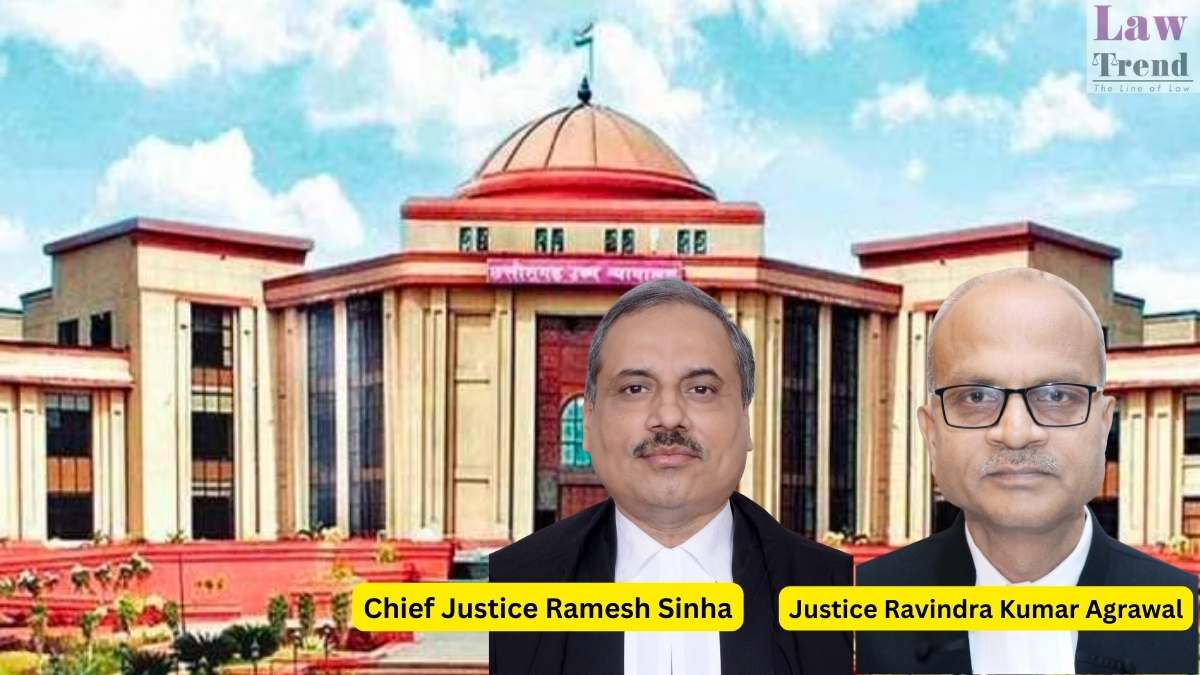
The Chhattisgarh High Court, in a significant judgment delivered on February 28, 2026, has partially allowed a batch of writ petitions, setting aside orders that blacklisted several construction firms for three years. While the Court upheld the State’s decision to terminate the contracts due to doubtful eligibility documents, it ruled that the penalty of blacklisting was disproportionate in the absence of a “clear and conclusive finding of deliberate fraud” by the petitioners.
A Division Bench comprising Chief Justice Ramesh Sinha and Justice Ravindra Kumar Agrawal emphasized that blacklisting amounts to the “civil death” of a business and must satisfy the tests of fairness, proportionality, and reasoned decision-making.
Background of the Case
The dispute arose from tenders issued under the Jal Jeevan Mission for various water supply schemes in Chhattisgarh. The petitioners, including M/s A.K. Construction and Vikram Teleinfra Private Limited, were successful bidders who had secured contracts after forming joint ventures or submitting experience certificates from Respondent No. 6, M/s Vijay V Salunkhe.
After work orders were issued and substantial work (claimed by petitioners to be up to 70%) was allegedly completed, the State authorities alleged that the experience certificates submitted by the contractors were fake. Verification from the Municipal Council, Karad (Maharashtra), suggested that no such certificates were issued. Consequently, the authorities issued show-cause notices, terminated the agreements, and blacklisted the firms for three years.
This was the second round of litigation. In the first round, the High Court had quashed the initial show-cause notices on grounds of pre-determination, granting the State liberty to take a fresh decision after providing a fair hearing.
Arguments by the Parties
Petitioners’ Contentions: Represented by Advocates Mr. B.P. Sharma, Mr. Raza Ali, and Mr. Saurabh Choudhary, the petitioners argued:
- They acted in good faith, relying on certificates provided by their joint venture partner.
- There was “an element of doubt” regarding the certificates, as a criminal court had noted contradictory information from the Municipal Council, Karad.
- They had invested crores of rupees in materials and completed a major portion of the work.
- Blacklisting for three years was an extreme penalty, especially when they were willing to complete the balance work at the original rates.
Respondents’ (State) Contentions: Mr. Praveen Das, Additional Advocate General, argued:
- The petitioners secured public contracts through “fake and fabricated” documents.
- The issuing authority (Municipal Council, Karad) specifically denied issuing the certificates via email.
- Fraud vitiates the entire tender process, rendering the contracts legally unsustainable.
- Adequate opportunity of hearing was provided following the Court’s previous directions, and the petitioners failed to prove the certificates were genuine.
Court’s Analysis and Observations
The Court categorized the issues into two parts: the termination of the contract and the imposition of the blacklisting penalty.
1. On Termination of Contract: The High Court held that the State was justified in canceling the contracts. The Bench observed:
“Once the eligibility of the bidder is found to have been secured on the basis of misrepresentation or false documentation, the employer is justified in cancelling the contract… The sanctity of public procurement cannot be compromised.”
The Court noted that the subsequent criminal proceedings or the grant of anticipatory bail to the partner did not “ipso facto validate the certificate” in the realm of contractual law.
2. On the Proportionality of Blacklisting: The Court took a different view on the three-year debarment. Citing the Supreme Court in Gorkha Security Services v. Government (NCT of Delhi) and UMC Technologies Pvt. Ltd. v. Food Corporation of India, the Bench noted:
“With blacklisting, many civil and/or evil consequences follow. It is described as ‘civil death’ of a person… Such an order is stigmatic in nature and debars such a person from participating in government tenders.”
The Bench found that the State’s Apex Committee failed to record an independent finding that the petitioners themselves “fabricated or knowingly submitted” a forged document. The Court stated:
“In absence of a definitive finding of fraud or conscious misrepresentation by the petitioners, the penalty of blacklisting cannot be sustained… Termination of the contract itself neutralized any advantage derived from the questioned certificate.”
The Decision
The High Court partially allowed the petitions with the following directions:
- Blacklisting Quashed: The direction debarring the petitioners for three years was set aside as being disproportionate.
- Termination Upheld: The Court refused to interfere with the State’s decision to annul the contracts and re-tender the balance work.
- Alternative Remedy: Regarding claims for payments of dues and valuation of work executed, the Court directed the petitioners to invoke the arbitration mechanism or approach a Civil Court, as these involve factual determinations outside the scope of Article 226.
The judgment concludes that while the State must protect the integrity of tenders, administrative actions having stigmatic consequences must be founded on “clear and established culpability.”
Case Title: M/s A.K. Construction & Ors. v. State of Chhattisgarh & Ors. (Lead Case: WPC No. 778 of 2026)