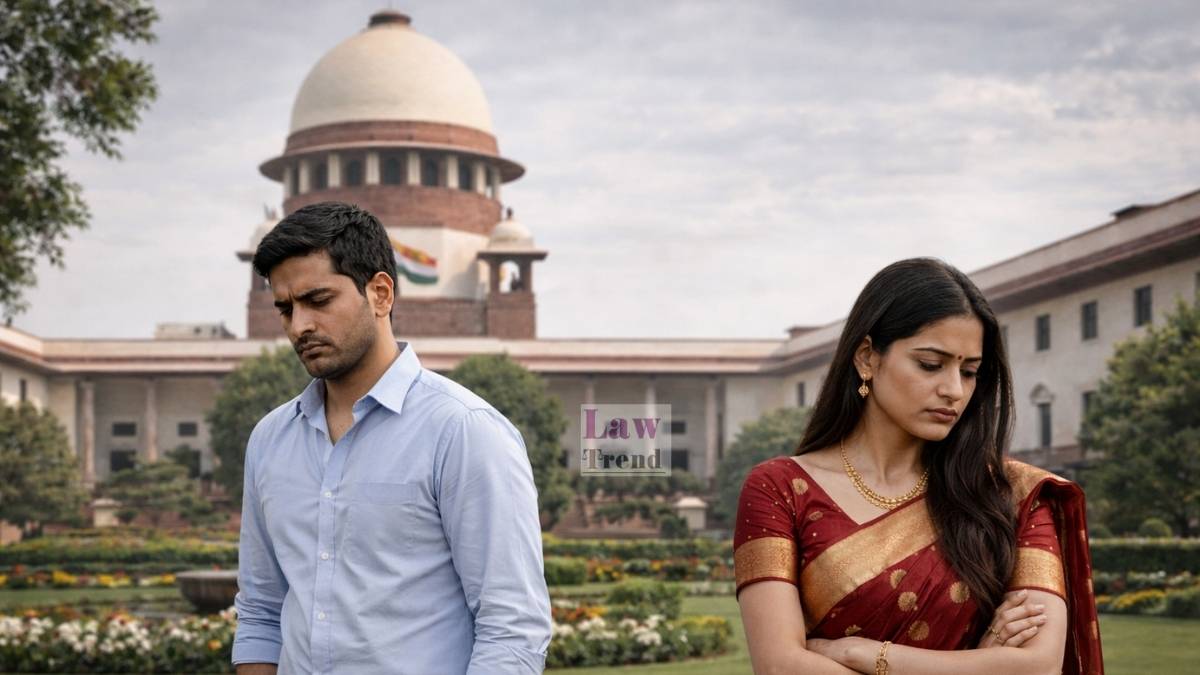
The Supreme Court of India has set aside the findings of “cruelty” and “desertion” recorded against a qualified dentist, characterizing the lower courts’ approach as “archaic,” “regressive,” and “deeply disquieting.” The Court held that a woman’s decision to establish her professional career and prioritize a safe environment for her child’s medical needs cannot be treated as a matrimonial default or a ground for divorce.
The Division Bench, comprising Justice Vikram Nath and Justice Sandeep Mehta, while maintaining the dissolution of marriage on the ground of irretrievable breakdown, slammed the “patriarchal understanding of marital roles” displayed by the Family Court and affirmed by the High Court.
Background of the Case
The appellant, Ann Saurabh Dutt, a qualified dentist, and the respondent, Lieutenant Colonel Saurabh Iqbal Bahadur Dutt, an Army Officer, were married on September 3, 2009. The appellant initially started a dental practice in Pune in 2010. However, when the respondent was posted to Kargil in 2011, she sacrificed her practice to join him.
During her stay in Kargil, the appellant conceived. Finding the medical facilities inadequate for her pregnancy, she moved to Ahmedabad to live with her in-laws and later her parents. Following the birth of their daughter in April 2012, the child developed serious medical complications, including seizure episodes, during a subsequent visit to Kargil. Due to limited specialized medical care in the remote area, the parties returned to Ahmedabad for the child’s treatment.
Severe discord ensued, leading to multiple legal proceedings. In 2022, the Family Court at Ahmedabad granted a decree of divorce to the husband on the grounds of cruelty and desertion, specifically citing the wife’s decision to operate a dental clinic in Ahmedabad instead of residing with her husband at his place of posting.
Lower Court Findings Under Scrutiny
The Family Court had concluded that the appellant was guilty of cruelty and desertion because:
- She gave “precedence to her career” by operating a dental clinic in Ahmedabad.
- She printed and circulated inauguration cards for her clinic without the knowledge of the husband or his family.
- She preferred to stay at her parental home rather than the matrimonial home during visits to Ahmedabad.
- She allegedly prevented her mother-in-law from touching the minor daughter due to “fear of infection.”
- The court observed that it was the “bounden duty” of a wife to reside with her husband wherever he chose to reside.
The Supreme Court’s Analysis and Observations
The Supreme Court rejected these findings, stating that the reasoning was founded upon “deeply entrenched archaic societal assumptions.” Justice Sandeep Mehta, writing for the Bench, observed:
“The endeavour of the appellant to establish her own dental clinic at Ahmedabad, rather than allowing the professional qualification she had earned through years of effort to lie dormant and go waste, has been viewed with disapproval, merely because her stance did not conform to the expectation of the husband and the in-laws that she must abandon her aspirations and reside with her husband at a remote location.”
The Court emphasized that a wife’s professional identity is not subject to an “implied spousal veto” and that marriage does not “eclipse her individuality.” It further noted:
“The expectation that a woman must invariably sacrifice her career and conform to traditional notions of an obedient wife meant for cohabitation, irrespective of her own aspirations or the welfare of the child, reflects a line of reasoning that is archaic, ultra-conservative, and cannot be countenanced in the present day scenario.”
The Bench pointed out a double standard, noting that if the roles were reversed—if the wife were in the Army and the husband a doctor—the husband would never be expected to sacrifice his career, nor would his refusal be branded as cruelty. The Court described the wastage of the appellant’s medical degree as a “sinful wastage of talent and resources.”
On Allegations of Perjury and Religious Conversion
The Court also addressed the husband’s petition seeking his ex-wife’s prosecution for perjury under Section 195 read with Section 340 of the CrPC. The Bench dismissed this petition, stating the allegations were “instigated by personal vendetta and spiteful approach” and “fuelled by anger and pent-up frustration.”
Regarding the husband’s claim that the wife coerced him to convert to Christianity, the Court found no “clear or credible evidence,” noting that the marriage was a love marriage solemnized under both Hindu and Christian rites and registered under the Special Marriage Act.
The Decision
The Supreme Court partly allowed the appeal. While it did not disturb the decree of divorce—given that the marriage had irretrievably broken down and the respondent had reportedly remarried—it explicitly expunged all findings of cruelty and desertion against the appellant.
The Court held that the appellant’s actions were “absolutely justified” manifestations of professional fulfillment and responsible parenthood. The decree of divorce was modified to reflect that it was passed solely on the ground of the irretrievable breakdown of marriage.
Case Details:
- Case Title: Ann Saurabh Dutt v. Lieutenant Colonel Saurabh Iqbal Bahadur Dutt
- Case No.: Civil Appeal @ SLP(Civil) No. 25076 of 2024
- Bench: Justice Vikram Nath and Justice Sandeep Mehta
- Date: May 12, 2026