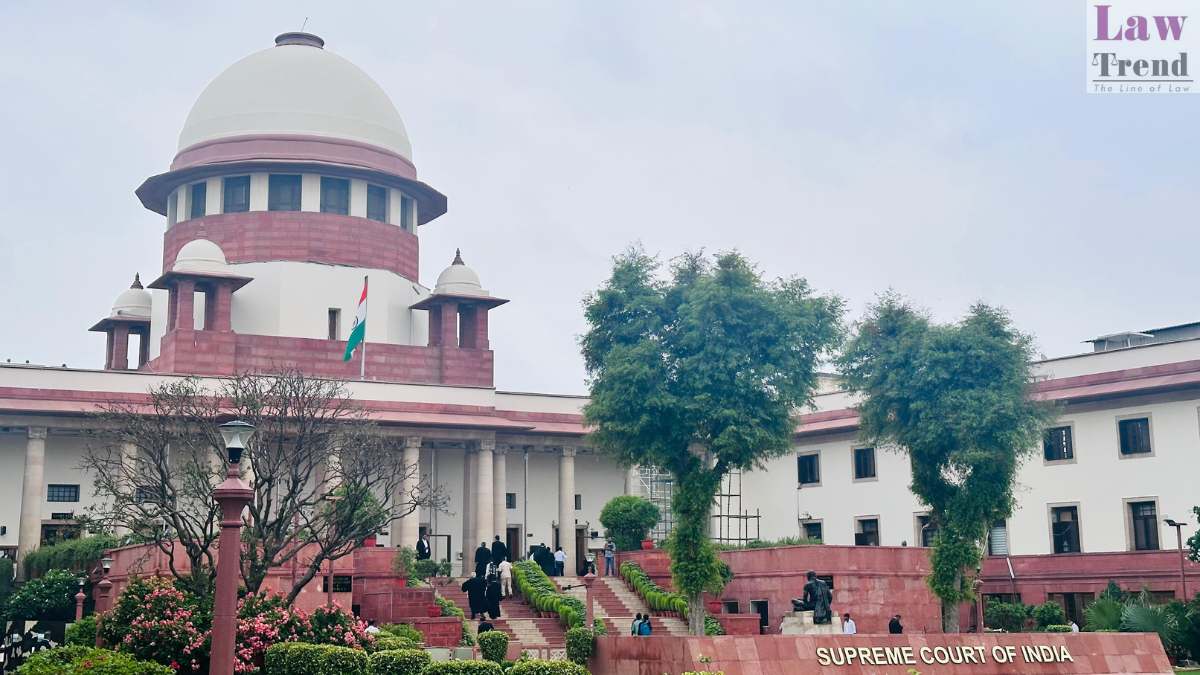
In a significant ruling clarifying the boundaries of corporate insolvency resolution, the Supreme Court of India has held that all pending legal proceedings, including civil suits and arbitrations that have not culminated in quantified and crystallised claims by the date of approval of a Resolution Plan, stand abated, extinguished, or withdrawn. A division bench comprising Justice Manoj Misra and Justice Manmohan allowed the civil appeals filed by M/S Tata Steel Ltd., the Successful Resolution Applicant (SRA) for the corporate debtor Bhushan Steel Limited (BSL). The Court set aside the orders of the Bombay High Court (Nagpur Bench) and a trial court that had permitted a summary recovery suit filed by an operational creditor to proceed despite the sanction of the Resolution Plan.
Background of the Case
Before the initiation of the Corporate Insolvency Resolution Process (CIRP) against BSL, an operational creditor, Varsha (Respondent No. 1), filed a summary civil recovery suit against the company seeking Rupees 38,89,674.14 along with interest at 18 percent per annum. This suit was later registered as Civil Suit No. 153 of 2011. Concurrently, another operational creditor, Masyc Projects Private Limited (Intervenor-Masyc), initiated six separate arbitral references against BSL regarding engineered goods supplied.
During the pendency of these proceedings, the State Bank of India initiated CIRP against BSL. Both Varsha and Intervenor-Masyc submitted to the jurisdiction of the Insolvency and Bankruptcy Code, 2016 (IBC) and lodged their respective claims of Rupees 34,27,895 and Rupees 31,30,67,354 with the Interim Resolution Professional.
On January 17, 2018, the Resolution Professional compiled an Interim List of Creditors, admitting the disputed claims of both Varsha and Intervenor-Masyc at a notional value of Rupee One each. Crucially, Note 3 of this list stated: “Claims are subject to disputes pending before various authorities, and have been admitted/marked as verified with a notional amount of INR 1 (Indian Rupee One only) and the liability is subject to the outcome of the ongoing proceedings.”
Tata Steel subsequently submitted its Resolution Plan on February 3, 2018. Because BSL’s financial debts far exceeded its liquidation value, the operational creditors were legally entitled to “NIL” payment. However, Tata Steel voluntarily provided an Operational Creditors Settlement Amount of Rupees 1,200 crore—earmarking Rupees 1,000 crore for critical operational creditors and Rupees 200 crore for pro-rata distribution among other admitted operational creditors.
On March 20, 2018, the Resolution Professional finalized the list of creditors, admitting the claims of Varsha and Intervenor-Masyc at the notional value of Rupee One each. However, Note 3 was omitted and replaced with Note 2, which stated: “Claims which are subject to disputes pending before various authorities have been verified with a notional amount of INR 1 (Indian Rupee One only).” The Committee of Creditors (CoC) approved the plan the same day, and the National Company Law Tribunal (NCLT) sanctioned it on May 15, 2018.
Subsequent to this approval, Tata Steel moved applications seeking the dismissal of Varsha’s civil suit and the termination of Intervenor-Masyc’s arbitral proceedings. However, both the Trial Court and the Sole Arbitrator rejected these requests. Tata Steel challenged these decisions, but the High Court of Bombay (Nagpur Bench) and the Punjab and Haryana High Court dismissed its writ petitions, prompting the SRA to approach the Supreme Court.
Arguments of the Parties
Appearing for Tata Steel, senior counsel Mr. Ramji Srinivasan argued that the Resolution Professional’s practice of admitting sub-judice claims at a notional value of Rupee One was specifically upheld by the Supreme Court in Committee of Creditors of Essar Steel India Limited v. Satish Kumar Gupta and Others. He contended that under the “clean slate” doctrine articulated in Ghanashyam Mishra & Sons Pvt. Ltd. vs. Edelweiss Asset Reconstruction Co. Ltd., a successful resolution applicant cannot be faced with unforeseen or undecided liabilities post-approval. He asserted that the commercial wisdom of the CoC in approving the plan is final and non-justiciable.
On behalf of Varsha, counsel Mr. Garvesh Kabra argued that the Resolution Plan was vitiated by fraud and manipulation, as Tata Steel had deliberately omitted Note 3 from the Final List of Creditors. He argued that Tata Steel had no statutory authority to selectively alter verified claims and that the surplus of Rupees 149.11 crore from the Rupees 1,200 crore settlement corpus should have been kept in escrow for sub-judice claims pending adjudication.
Representing Intervenor-Masyc, senior counsel Mr. Neeraj Kishan Kaul argued that the Resolution Plan contained an express carve-out. He referred to Clause 8.7.3(i) which protected claims recorded in Annexures 8 and 10 from extinguishment. He contended that the abatement of proceedings was conditional upon the payment of claims from the Rupees 1,200 crore corpus. He suggested a “face value reservation mechanism” where pro-rata shares of pending claims are ring-fenced in a designated account pending the outcome of the litigation to avoid unjust enrichment.
The Court’s Analysis and Reasoning
The Supreme Court observed that the core legal propositions governing the conflict are well-settled. Relying on JSW Steel Ltd. vs. Pratishtha Thakur Haritwal & Ors., the Court reiterated that: “all claims must be submitted to and decided by the resolution professional so that a prospective resolution applicant knows exactly what has to be paid in order that it may then take over and run the business of the corporate debtor.”
The bench rejected Varsha’s allegations of fraud, noting that no application under Rule 11 of the NCLT Rules, 2016 had been filed to recall the resolution plan’s approval.
Addressing the transition from Note 3 to Note 2 in the final list of creditors, the Court found that the omission of Note 3 meant that the claims of Varsha and Intervenor-Masyc were altered from a “notional” Rupee One subject to adjudication into a “quantified” Rupee One claim with finality under the plan.
On the clean slate doctrine, Justice Manmohan observed:
“no Resolution Plan can succeed if uncertain or unquantified claims are permitted to linger and resurface against the Successful Resolution Applicant years after approval. Such a situation would be akin to a hydra-headed recurrence and is antithetical to the ‘clean slate’ principle.”
The Court noted that the Rupees 200 crore pool under Clause 8.2.2 was only available for operational creditor claims that were crystallized and approved by the CoC as of March 20, 2018. Consequently, neither the principle of contra proferentem (interpreting ambiguity against the drafter) nor the Intervenor’s proposed “face value reservation mechanism” was applicable.
Under Clauses 8.7.3 and 8.6.10 of the Approved Resolution Plan, the Court found that all legal proceedings initiated by operational creditors stood immediately, irrevocably, and unconditionally extinguished, waived, or withdrawn.
Observations on MSMEs
Before concluding, the Supreme Court reflected on the adverse impact of the current insolvency framework on small operational creditors. Justice Manmohan observed:
“the present cases underscore the impact of the Code on small operational creditors such as MSMEs.”
The bench further noted:
“the Code does not adequately account for the position of small operational creditors, including MSMEs and statutory local bodies, who stand significantly disenfranchised under the present framework by being placed at the bottom of the repayment waterfall.”
Recognizing that small entities are often ill-equipped to absorb financial setbacks, the Court suggested that the Law Commission and the Legislature examine this issue to ensure a more balanced repayment mechanism.
Decision of the Court
The Supreme Court allowed the civil appeals and set aside the impugned judgments of the Bombay High Court, as well as the trial court’s order dated October 25, 2018. The recovery suit filed by Varsha (Civil Suit No. 153/2011) and the arbitration proceedings initiated by Intervenor-Masyc were dismissed.
Case Title: M/S Tata Steel Ltd. v. Varsha & Anr.
Case No.: Civil Appeal Nos. 9052-9053 of 2026
Bench: Justice Manoj Misra, Justice Manmohan
Date: July 17, 2026