

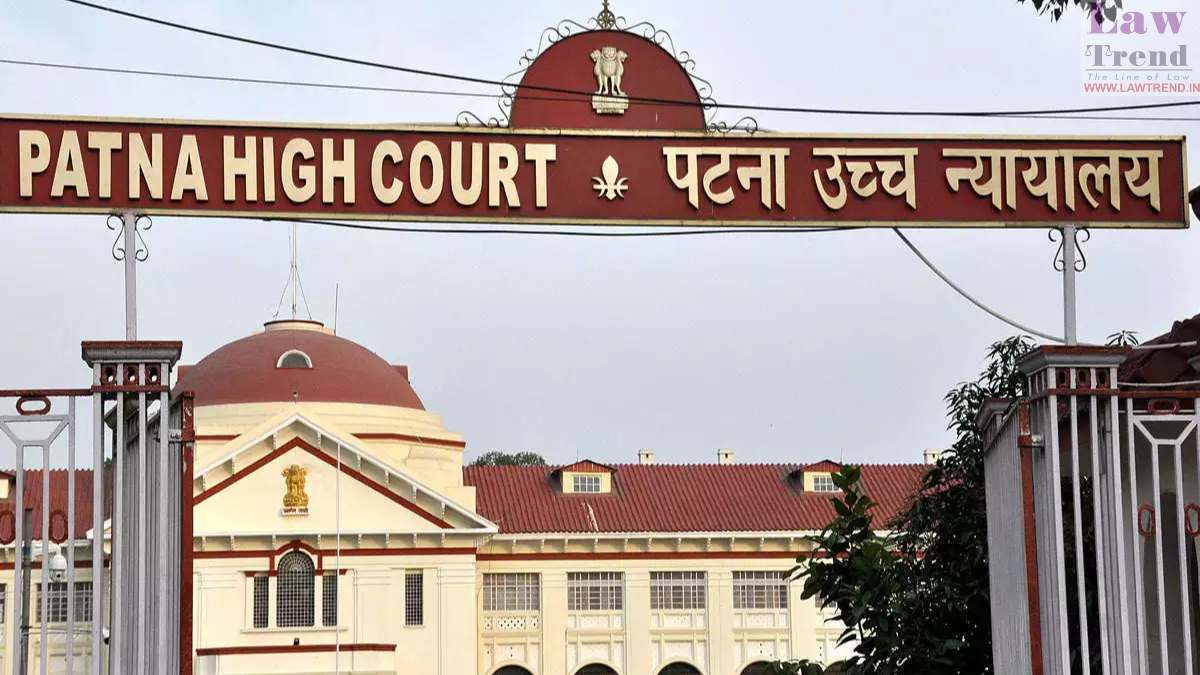
The Patna High Court, presided over by Justice Kumar Manish, has observed that treating a long-serving daily wage employee as a “fresh appointee” at the end of their career runs contrary to the constitutional ethos. Adjudicating a writ petition filed by a superannuated Class-III employee of the Water Resources Department, the Court examined whether continuous daily-wage service spanning decades can be entirely obliterated for pay protection and pensionary benefits when similarly situated junior employees received retrospective benefits. Setting aside the departmental orders rejecting his claims, the High Court directed the competent authority to reconsider the employee’s claims for parity, pay protection, and pensionary benefits, and to pass a reasoned, speaking order within three months.
Background of the Case
The petitioner, Bipin Kumar Verma, was engaged on a daily-wage basis against a sanctioned and vacant Class-III post of typist on June 16, 1980, under the Flood Control Circle, Samastipur. Between 1984 and 1988, several daily-wage workmen were regularized by the establishment committee of the Chief Engineer, Water Resources Department, Samastipur. Verma, however, was not considered, despite assertions that later entrants and individuals without work experience had been regularized.
Aggrieved by this exclusion, Verma submitted multiple representations before approaching the High Court in C.W.J.C. No. 9630 of 1998. By an interim order dated July 15, 1999, the Court directed the State to pay him salary at the minimum of the time-scale of pay for the period worked. The petition was disposed of on December 17, 2003, with a direction to consider his case for regularization within three months. After contempt proceedings in M.J.C. No. 1252 of 2004 were initiated due to non-compliance, the Chief Engineer rejected his claim on August 2, 2004.
Verma subsequently filed a second petition, C.W.J.C. No. 2156 of 2009, which was disposed of on July 7, 2011, directing the authorities to reconsider his case in light of the Supreme Court’s ruling in State of Karnataka v. M.L. Kesari (2010) 9 SCC 247. Continued departmental inaction prompted a fresh contempt petition (M.J.C. No. 4241 of 2012). On December 5, 2012, the Chief Engineer issued an office order regularizing Verma’s service by way of a “fresh appointment” as a Lower Division Clerk. Verma joined the post under protest on December 6, 2012.
As a result of being classified as a fresh appointee, Verma’s basic pay was reduced from Rs. 9,840 to Rs. 7,730, inflicting an immediate basic pay reduction of Rs. 2,110 along with consequential losses in Dearness Allowance. Prior to this absorption, he had been receiving salary in the revised pay scale of Rs. 5,200–20,200 with Grade Pay of Rs. 2,400.
On December 21, 2017, the Superintending Engineer granted Verma pay protection under Rule 78 of the Bihar Service Code. However, the Chief Engineer disapproved and reversed this decision on August 4, 2018, holding that Rule 78 applies only to appointed government servants. Subsequent representations and an application before the departmental Grievance Redressal Committee seeking retrospective regularization from June 16, 1980, were turned down, leading to Verma’s superannuation in November 2019 without pay protection or pension.
Arguments of the Parties
Counsel for the petitioner submitted that Verma rendered uninterrupted service against a sanctioned post for nearly four decades. Citing Paragraph 36 of the writ petition, counsel argued that the petitioner was subjected to hostile discrimination violating Article 14 of the Constitution. Counsel pointed out that one Mahesh Rai, who was junior to Verma as a daily wager, was regularized as early as 1984. Furthermore, a batch of similarly situated employees—Sri Dilip Kumar Rai, Sri Bipin Kumar Singh, Sri Ram Chandra Mahto, Md. Seraj, Sri Laxmi Narayan Singh, Sri Satya Narayan Singh, and Sri Ram Bilash Mehtar—were granted notional regularization with effect from April 1, 1988, for computing retiral and pensionary dues by the same Chief Engineer vide Memo No. 3034 dated October 9, 2010.
To support counting past daily-wage service toward pension, the petitioner relied on the Division Bench judgment in The Registrar General, Patna High Court v. Ram Vyas Dubey (L.P.A. No. 198 of 2016), quoting:
“12. Reading of the above provisions clearly provide that even if a person has worked in a temporary capacity and has not been confirmed, if his service on any post is continuous and is for more than 15 years, then it may be considered as pensionable under Rule 59 of the Bihar Pension Rules, 1950.”
The petitioner further cited Savita Devi v. The State of Bihar (C.W.J.C. No. 12833 of 2017), which relied on Parmeshwar Paswan v. The State of Bihar, holding that the State must take a conscious decision under Rules 58 and 59 of the Bihar Pension Rules regarding counting past service for pension.
The State opposed the petition through a counter-affidavit, contending that Verma was engaged strictly as a daily wager and never obtained temporary status akin to work-charged employees governed by Finance Department resolutions. The State asserted that his absorption was carried out under the Personnel and Administrative Reforms Department circular dated March 16, 2006, wherein Clause 2(5) provides that daily-wage service shall not be recognized as government service for any purpose.
State counsel further argued that under Rules 56, 58, and 61 of the Bihar Pension Rules, 1950, qualifying service requires substantive and permanent employment paid by the government. The State relied on the Full Bench decision in The State of Bihar v. Bhagwan Singh (2014) 4 PLJR 229, the Supreme Court decision in State of Bihar v. S.A. Hassan (2002) 3 SCC 566, and the doctrine of approbate and reprobate cited in Union of India v. N. Murugesan (2022) 2 SCC 25, arguing that having accepted the terms of the December 5, 2012 appointment, the petitioner was estopped from claiming retrospective benefits.
The Court’s Analysis
Justice Kumar Manish noted that judicial discipline and the doctrine of stare decisis require applying consistent judicial frameworks to identical disputes within the same department to uphold Article 14. The Court framed the primary legal question as follows:
“whether the past continuous service rendered by the petitioner as a daily wager since 1980, can be entirely obliterated for the purposes of pay protection and pensionary benefits, particularly when identically situated juniors have been granted such notional benefits”
The Court observed that Verma had discharged perennial Class-III duties continuously since June 16, 1980. Addressing the discrimination outlined in Paragraph 36 of the writ petition, the Court noted that identically placed juniors had received notional regularization from April 1, 1988, for computing pensionary benefits under the same Chief Engineer. Consequently, Verma’s claim of parity required detailed examination regarding the status, engagement dates, and applicable policies of the co-employees cited.
Addressing the State’s reliance on cut-off dates under the 2006 circular and the Division Bench ruling in Ashok Kumar Sharma v. The State of Bihar (LPA No. 1690 of 2013), the Court noted that while that judgment maintained distinctions for daily wagers engaged up to December 11, 1990, its application depends on the specific engagement category and policy, and cannot confer automatic parity without departmental verification.
Emphasizing constitutional restraints on administrative engagement practices, the Court cited the Supreme Court ruling in Dharam Singh v. State of U.P. (Civil Appeal No. 8558 of 2018, decided on August 19, 2025):
“17. Before concluding, we think it necessary to recall that the State (here referring to both the Union and the State Governments) is not a mere market participant but a constitutional employer. It cannot balance budgets on the backs of those who perform the most basic and recurring public functions. Where work recurs day after day and year after year, the establishment must reflect that reality in its sanctioned strength and engagement practices. The long-term extraction of regular labour under temporary labels corrodes confidence in public administration and offends the promise of equal protection.”
The Court also highlighted paragraph 18 of Dharam Singh:
“Sensitivity to the human consequences of prolonged insecurity is not sentimentality. It is a constitutional discipline that should inform every decision affecting those who keep public offices running”
The Court further took note of the Supreme Court ruling in Bhikni Devi, etc. vs. Union of India (Civil Appeal No. 8354-8356 of 2026, decided on June 1, 2026), which held that temporary status casual labourers are entitled to pensionary benefits on superannuation even in the absence of regularization. The Court concluded that Verma’s long period of engagement and subsequent superannuation in November 2019 warranted a fresh, separate determination of his entitlement to pay protection and pension under the applicable rules.
The Decision
The High Court set aside the impugned rejection orders contained in Letter No. 861 dated July 31, 2017, and Letter No. 2149 dated August 4, 2018.
The Court directed the competent authority to reconsider the petitioner’s claims separately with respect to:
- The legal effect of the order dated December 5, 2012;
- The claim of parity with the employees relied upon by the petitioner;
- Pay protection under Rule 78 of the Bihar Service Code; and
- Reckoning of past service for pensionary benefits under the Bihar Pension Rules, 1950.
The competent authority has been directed to complete this exercise and pass a reasoned, speaking order within a period of three months from the date of receipt or production of a copy of the order. The writ petition was allowed to that extent.
Case Details:
Case Title: Bipin Kumar Verma vs The State of Bihar and Others
Case No.: Civil Writ Jurisdiction Case No. 20684 of 2019
ench: Justice Kumar Manish
Date: 29-09-2026




