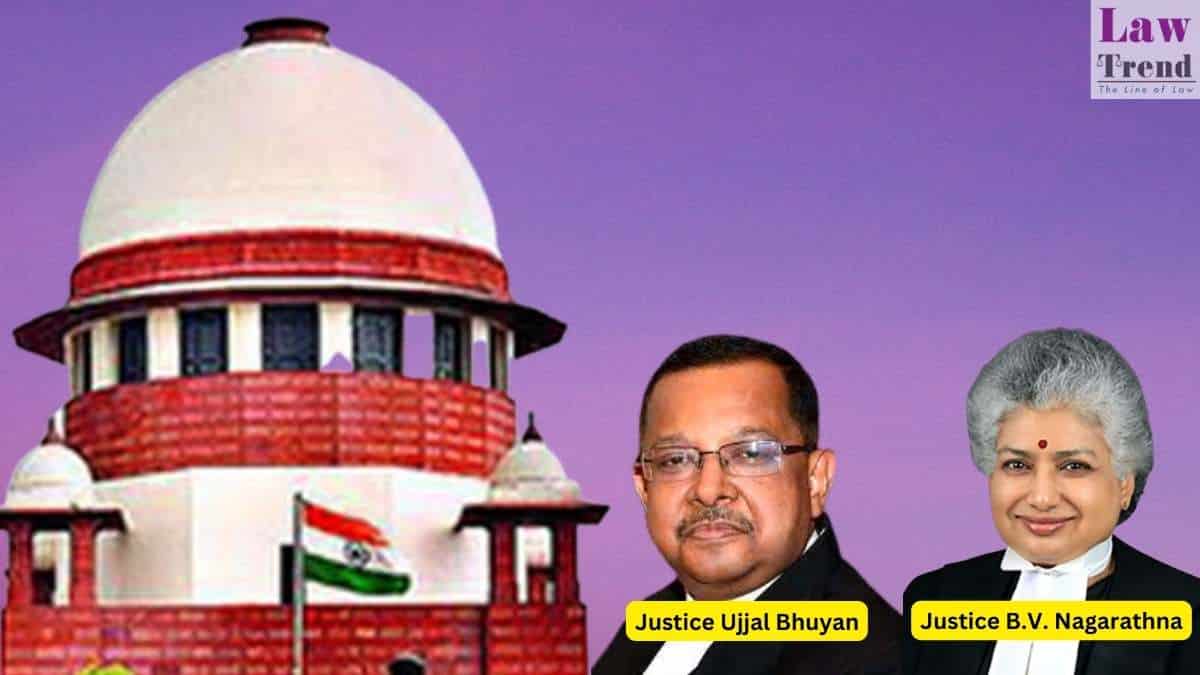
The Supreme Court of India has held that under Section 133 of the Indian Contract Act, 1872, a surety is not absolutely discharged from liability if the contract between the creditor and the principal debtor is varied without the surety’s consent. Instead, the surety is only discharged regarding transactions occurring after such variance, while remaining liable for the original amount guaranteed.
A bench comprising Justice B.V. Nagarathna and Justice Ujjal Bhuyan set aside a Gujarat High Court order which had previously held that a surety must either be held liable for the entire loan amount or none at all. The Supreme Court clarified that the statute mandates a bifurcation of liability in cases of unauthorized contract modification.
Background of the Case
The case originated in 1993 when M/s Darshak Trading Company (Respondent No. 6) obtained a cash-credit facility of ₹4,00,000 from Bhagyalaxmi Co-Operative Bank Ltd. (the Appellant). Respondents Nos. 1 and 2 stood as guarantors for this loan. Subsequently, it was alleged that the borrower, in connivance with bank officers, withdrew amounts far exceeding the sanctioned limit.
Upon default, the Bank filed a Lavad Suit to recover ₹26,95,196.75. The Board of Nominees accepted the claim against the principal borrower but dismissed it against the sureties. On appeal, the Gujarat State Co-Operative Tribunal directed the sureties to pay the original sanctioned amount of ₹4,00,000 with interest.
However, the Gujarat High Court later quashed the Tribunal’s order, holding that under Section 139 of the Indian Contract Act, the sureties stood discharged because the Bank permitted overdrawals without their consent. The High Court reasoned that there could be no bifurcation of liability between the initially sanctioned amount and the overdrawn amounts.
Arguments of the Parties
For the Appellant (Bank): Senior Counsel Sri Raghavendra S. Srivatsa argued that the High Court erred in its interpretation of Section 133. He contended that while a surety is discharged as to transactions subsequent to a variance made without consent, they remain liable for dues outstanding up to the point of variation. Reliance was placed on several precedents including Radha Kanta Pal vs. United Bank of India Ltd. and Bishwanath Agarwala vs. State Bank of India.
For the Respondents (Sureties): The counsel for the sureties relied on Section 139 of the Act, arguing that the Bank’s act of allowing overdrawals was inconsistent with the rights of the sureties and impaired their eventual remedy against the debtor. They contended that because the additional lending happened without their knowledge, they were discharged of all liabilities.
Court’s Analysis and Observations
The Supreme Court examined the distinction between Section 133 and Section 139 of the Indian Contract Act.
On Section 133 (Variance in Contract): The Court noted that Section 133 deals with situations where the surety is “discharged as to transactions subsequent to the variance.” The Court observed:
“Discharge of surety by variance in terms of the contract means that the surety cannot be bound to something for which he has not contracted… In such a situation, a surety is discharged forthwith on the contract made being altered without his consent.”
However, the Court emphasized that this discharge is not absolute:
“The surety is discharged only in respect of transactions that occurred subsequent to the variance of the terms of the contract. Thus, the observation of the High Court… that the sureties must either be liable for the entire loan amount or not at all is erroneous.”
On Section 139 (Impairment of Remedy): Regarding the respondents’ plea under Section 139, the Court clarified that for this section to apply, the creditor’s act must impair the surety’s “eventual remedy” against the debtor. In this case, the Court found:
“…there is no impairment of the eventual remedy of the respondent Nos.1 and 2 sureties against the respondent No.6 principal debtor.”
The Court further cited the cardinal rule from State of Maharashtra vs. Dr. MN Kaul that a guarantor must not be liable beyond the terms of his engagement, but noted that this does not automatically wipe out the liability for the original engagement.
Decision of the Court
The Court concluded that the applicable provision was Section 133, not Section 139. It held that the sureties remained liable for the ₹4,00,000 they originally consented to guarantee, along with applicable interest.
“The High Court was not right in holding that guarantors may be either liable to pay the entire amount… or not at all and that there cannot be a bifurcation of the liability. This is contrary to Section 133 of the Act… they are liable to the extent of their liability till the variance was made.”
The Supreme Court allowed the appeal and set aside the High Court’s judgment dated June 25, 2008.
- Case Title: Bhagyalaxmi Co-Operative Bank Ltd. vs. Babaldas Amtharam Patel (D) through LRs & Others
- Case Number: Civil Appeal No. 3200 of 2016 (2026 INSC 205)