

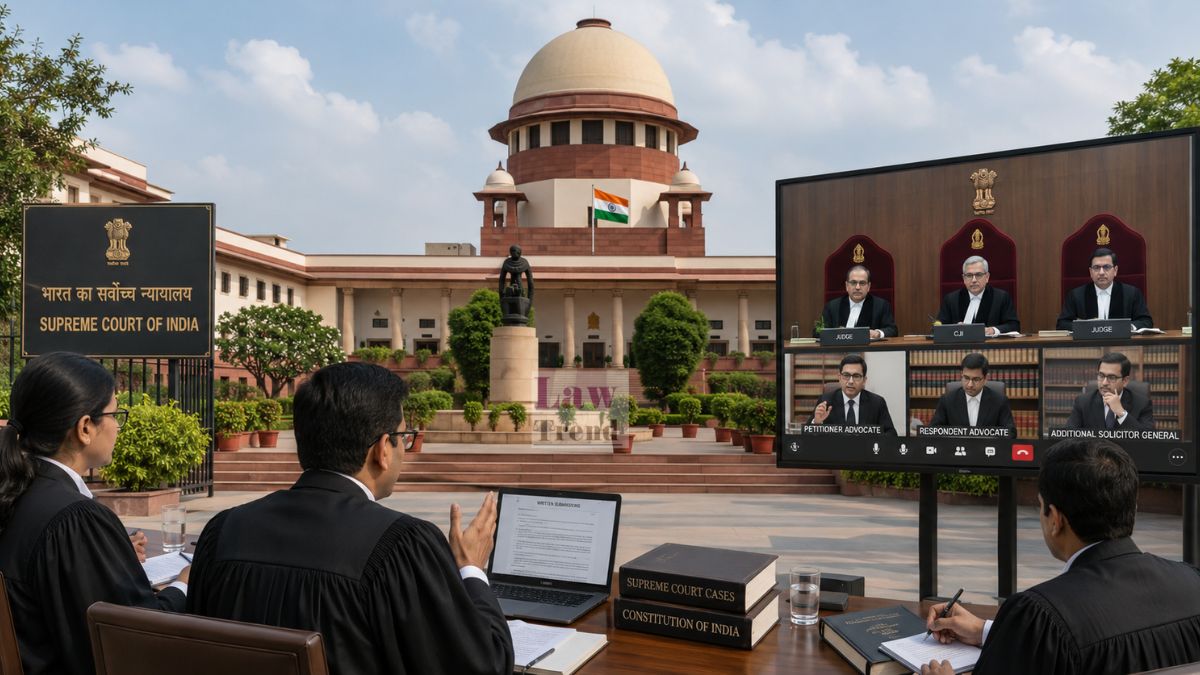
With temperatures in the national capital soaring to a blistering 50 degrees Celsius, the Supreme Court of India on Wednesday issued an appeal to all members of the Bar to attend court proceedings virtually.
While the apex court strongly encouraged the transition to online hearings to protect lawyers from the extreme weather, it declined to issue a mandatory judicial order to that effect, citing potential accessibility hurdles for individual practitioners.
A three-judge bench, comprising Chief Justice of India Surya Kant, Justice Joymalya Bagchi, and Justice Vipul M Pancholi, was hearing a petition that sought directions for all Delhi courts—including district courts—to move online for a period of three months in the “interest of the nation.”
“The temperature in Delhi is touching 50 degrees Celsius and it may not be conducive for senior members to come in public transport. Best is online,” the bench observed.
However, the court exercised caution regarding a blanket mandate. “We appreciate the initiative taken by the petitioner. However, it may not be prudent to issue judicial command for members to appear online without knowing the difficulties faced by them; consequently, we deem it appropriate to not issue any directions,” the bench stated.
A Broader Push for Digital Courts
The Supreme Court’s appeal comes amid an ongoing, nationwide push to digitize court operations. On May 21, Chief Justice Surya Kant shared that he had formally requested all high courts across the country to conduct their hearings online—a directive that the majority of high courts have already successfully implemented.
The issue was brought to the forefront on Wednesday after a lawyer urgently mentioned the petition before the CJI-led bench, highlighting the physical toll the ongoing heatwave is taking on legal professionals traveling to and from district courts.
Aligning with Energy Conservation Measures
This latest recommendation for virtual hearings aligns with the Supreme Court’s recent initiatives to reduce fuel consumption and administrative costs.
Earlier, CJI Kant had requested high court chief justices to transition to online hearings on Mondays and Fridays. This initial measure was introduced to curb avoidable expenditure in light of the ongoing economic pressures from the West Asia crisis.
In a similar move on May 15, the Supreme Court decided to conduct its own cases exclusively via videoconferencing on Mondays and Fridays. During the same period, Supreme Court judges “unanimously resolved” to adopt carpooling arrangements among themselves to maximize fuel efficiency. These conservation strategies followed an appeal by Prime Minister Narendra Modi urging national institutions to cut down on unnecessary expenditures amid the geopolitical tensions in West Asia.




