

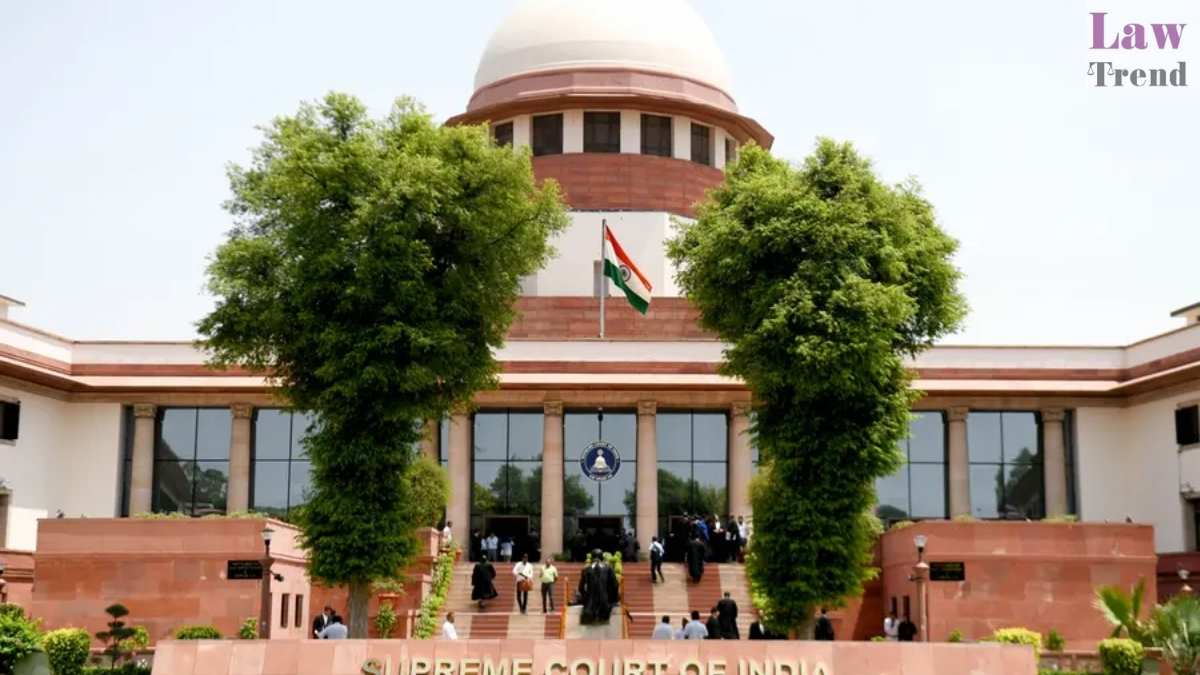
The Supreme Court has held that unauthorised absence and wilful absence are not necessarily the same thing. With this ruling, it set aside the removal from service of a Central Reserve Police Force (CRPF) constable who overstayed his leave by 99 days, calling the penalty grossly disproportionate.
A Bench of Justice Satish Chandra Sharma and Justice Nongmeikapam Kotiswar Singh ordered the reinstatement of Mithilesh Kumar Pathak with 50% back wages. The Bench set aside a Patna High Court Division Bench judgment that had upheld his removal.
Background
Pathak was posted with the 54th Battalion of the CRPF at Anantnag, Jammu and Kashmir. He was granted casual leave from September 21 to October 12, 2000 because his wife was ill. He did not rejoin on October 13, 2000, and did not respond to two registered letters dated October 26 and November 8, 2000 directing him to report for duty. He finally reported on January 19, 2001, 99 days after his leave ended.
In his explanation, Pathak said that he himself had fallen ill on October 9, 2000 at his village in Munger district, Bihar. He said he was treated for infective hepatitis by Dr. S.N. Singh, a Medical Officer attached to Sadar Hospital, Banka. He submitted prescriptions, pathological reports, medicine receipts and a fitness certificate dated January 13, 2001. He also said that his illness, the lack of postal facilities in his village and his wife’s inability to read or write had kept him from responding to the letters.
The Enquiry Officer held both charges, unauthorised absence and disobedience of orders, proved. The medical documents were disbelieved mainly because they carried no indoor or outdoor patient number, the treatment appeared to be private, and the prescriptions and bills seemed to have been written with the same pen. On March 29, 2001, the Commandant removed Pathak from service with effect from March 31, 2001.
His departmental appeal and revision were rejected. In 2007, a Single Judge of the Patna High Court quashed the removal, finding that the rejection of the medical evidence rested on conjectures and surmises. In 2010, a Division Bench reversed this, holding that the Single Judge had exceeded the limits of judicial review, and restored the removal.
Arguments
Counsel for the appellant argued that the medical documents could not be treated as fabricated merely because of the pen or ink used, or the absence of a registration number, without examining the treating doctor or otherwise verifying the papers. Counsel also argued that the penalty was disproportionate.
Counsel for the respondents submitted that Pathak was a member of a disciplined force posted in a sensitive area. They relied on his earlier overstays of 71 days in 1994 and 175 days in 1999, and contended that the medical documents had been procured to justify the absence.
Supreme Court’s Findings
The Court held that the Division Bench had erroneously set aside the Single Judge’s order. It observed, “unauthorised absence and wilful absence are not necessarily synonymous.” The Bench said the circumstances of the absence, the explanation given and the supporting material must be considered before deciding the nature and gravity of the misconduct.
The Court noted that no verification from the treating doctor, the medical establishment or the pharmacy supported the Enquiry Officer’s inference. It held, “Similarity in the writing or ink, without material connecting it to fabrication, could not reasonably sustain the conclusion drawn in the present case.”
The missing patient number and the apparently private treatment “could call for clarification”, the Court said. But these features did not by themselves establish that no treatment was received or that the documents were forged.
On punishment, the Court acknowledged that compliance with orders is essential in a disciplined force. However, it held that the penalty must be proportionate. The Bench concluded that “the penalty of removal from service, in these particular circumstances, is grossly disproportionate in the facts of this case”, even after taking into account the earlier overstays and Pathak’s failure to maintain communication.
Outcome
The Supreme Court allowed the appeal, set aside the High Court’s order dated May 5, 2010, and restored the Single Judge’s order of April 13, 2007. The respondents were directed to reinstate Pathak with immediate effect and pay him 50% of his back wages for the period from his removal until reinstatement. He will also be entitled to all other consequential benefits.
Case Title: Mithilesh Kumar Pathak v. Union of India & Ors.
Case No.: Civil Appeal No. 4411 of 2011
Bench: Justice Satish Chandra Sharma and Justice Nongmeikapam Kotiswar Singh
Date: November 16, 2026


