

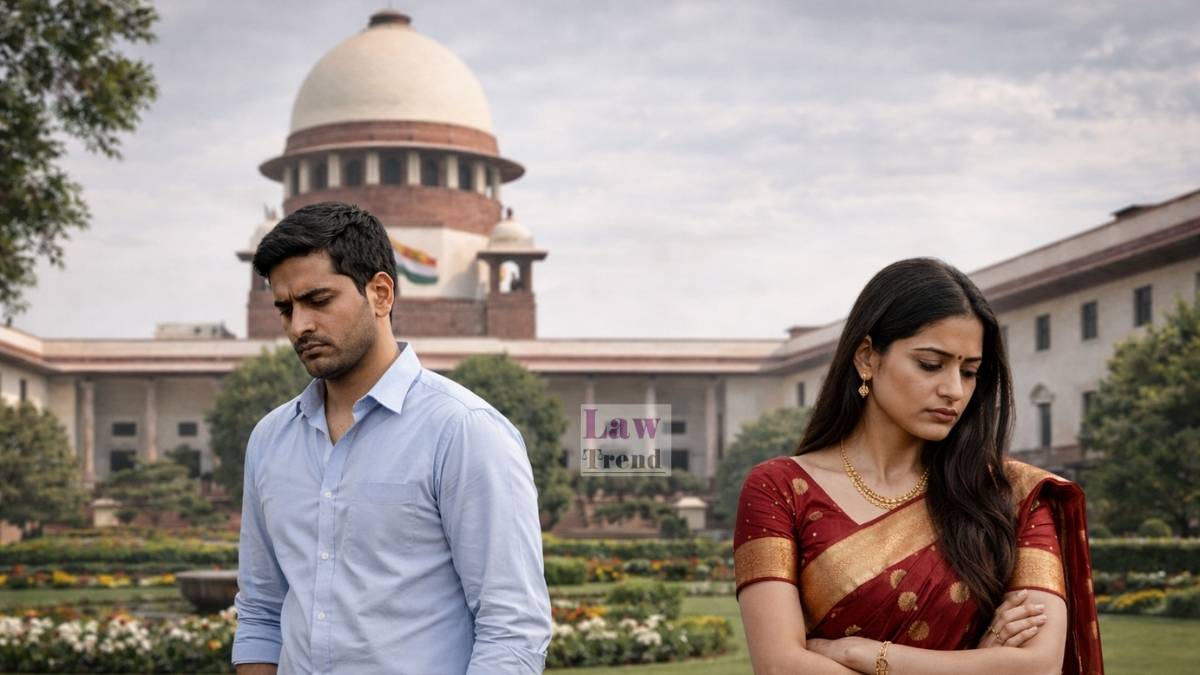
The Supreme Court has used its powers under Article 142 of the Constitution to dissolve the marriage of a Kolkata couple after they settled their disputes. Under the settlement, the husband will pay ₹30 crore to the wife as permanent alimony. A further ₹45 crore will go to their minor son and will be held by the wife in trust for him.
A Bench of Justice Satish Chandra Sharma and Justice Nongmeikapam Kotiswar Singh disposed of the husband’s appeal on the terms of the settlement. It also closed all pending cases between the parties.
Background of the Dispute
The couple married on January 31, 2013, and have a son. In 2020, the wife filed a complaint under Section 12 of the Protection of Women from Domestic Violence Act, 2005, before the Judicial Magistrate, 9th Court, Alipore. With it, she filed an application under Section 23 asking for interim monetary relief and alternative accommodation.
On February 12, 2025, the Trial Court ordered the husband to pay ₹90,000 a month for the child’s upbringing, education and maintenance. It also ordered ₹60,000 a month towards alternative accommodation for the wife and son, making a total of ₹1,50,000 a month with effect from August 4, 2020.
The husband then filed an application under Section 25(2) of the DV Act. He said the wife was in possession of the second and third floors of the matrimonial home at 2B, Hastings Park Road, Kolkata. On July 1, 2025, the Trial Court appointed an Advocate Commissioner to make a local enquiry into who was occupying the premises.
The wife challenged that order. On December 12, 2025, the First Appellate Court set it aside and told the Trial Court to hear the question of appointing a Commissioner afresh. The husband then went to the Calcutta High Court. On April 17, 2026, the High Court set aside the appellate order as infructuous because the wife had filed an affidavit saying she was in possession of the disputed household.
The High Court agreed with the Trial Court that the wife could not claim alternative accommodation while also living in the matrimonial home. It directed that any amount already paid for alternative accommodation be adjusted against the monetary relief awarded for the child. It left the question of alternative accommodation open for future consideration.
Arguments Before the Supreme Court
Counsel for the husband argued that the High Court’s order had disturbed the arrangement set out in the Trial Court’s order of February 12, 2025. Counsel also said the dispute had led to multiple cases before different courts. According to the husband’s counsel, the marriage had broken down irretrievably, and the Court could end the disputes by using its powers under Article 142.
Counsel for the wife opposed these contentions.
Settlement Terms
While the appeal was pending, the Court asked the parties to explore a settlement. They exchanged proposals and reached an agreement. The agreed terms are:
- Permanent alimony: ₹30 crore to the wife, paid by demand draft. The payment is to be made at the same time as she hands over the keys and vacant, peaceful possession of the family home at 2B, Hastings Park Road, Kolkata, within a week of the order.
- Money for the child: ₹45 crore for the minor son, which the wife will hold in trust for him.
- Residence: A home worth up to ₹5 crore will be bought with trust funds and owned by the trust. The wife can live there until she remarries or until the son turns 25, whichever comes first. If she has not remarried when he turns 25, whether she can keep living there will be at the son’s sole discretion.
- Visitation: The husband’s visitation rights will follow the Calcutta High Court’s parenting plan, as specified in paragraph 32 of the husband’s proposal dated September 19, 2026.
- Pending cases: All pending cases between the parties will be closed. These include the domestic violence complaint, the matrimonial suit, criminal cases arising from FIRs registered at Alipore Police Station, civil suits, and proceedings before the Calcutta High Court.
Court’s Directions
The Court said the husband’s parenting plan would stay as it is. If the parents disagree about how the plan is interpreted, carried out or changed, they must first try in good faith to settle it between themselves, “keeping the best interests and welfare of the Child as the paramount consideration.” If that fails, either parent can approach the competent court.
Explaining why it invoked Article 142, the Bench stated that “in order to give complete and effective quietus to the disputes between them, we deem it appropriate to exercise the powers conferred upon this Court under Article 142 of the Constitution of India.”
The Court dissolved the marriage solemnised on January 31, 2013, and ordered a decree to be drawn up accordingly. It directed that the settlement will form part of the order and that the parties must abide by its terms, including the arrangement for the minor child and the parenting plan.
The appeal was disposed of in terms of the settlement.
Case Title: Ankit Saraiya v. Pooja Saraiya
Case No.: Criminal Appeal arising out of SLP (Crl.) No. 12633 of 2026
Bench: Justice Satish Chandra Sharma and Justice Nongmeikapam Kotiswar Singh
Date: November 16, 2026


