

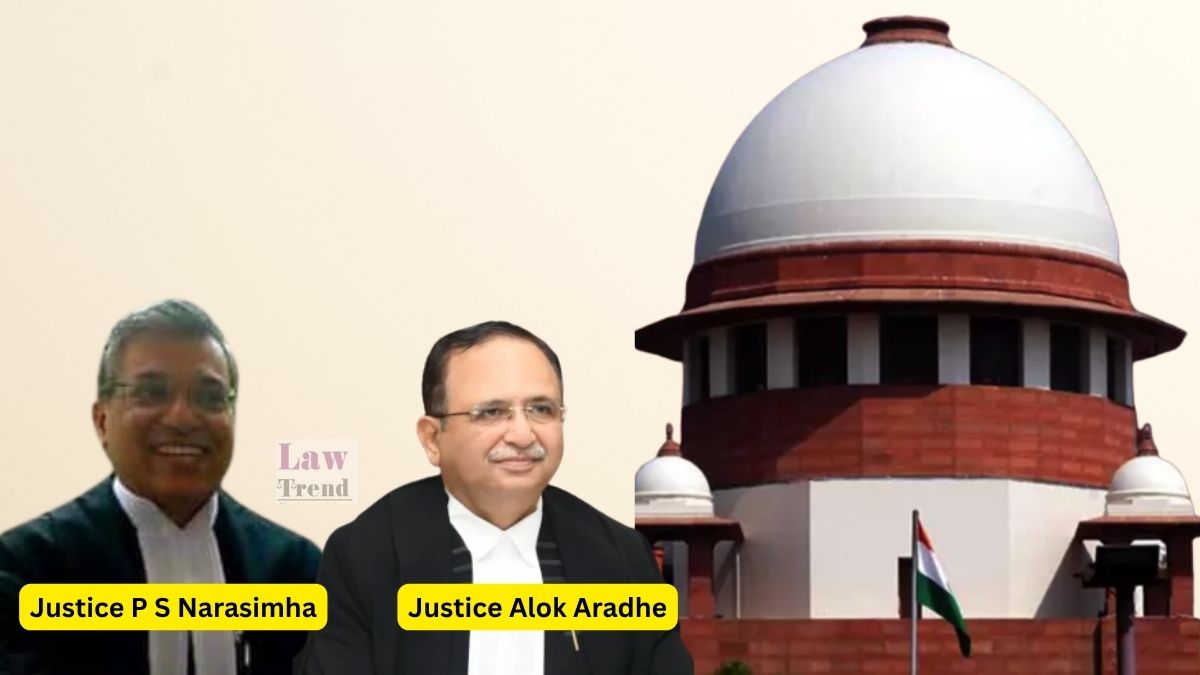
The Supreme Court has said that laws disqualifying people with more than two children from contesting panchayat elections have lost their relevance. It referred its 2003 ruling in Javed v. State of Haryana, which upheld such laws, to a larger Bench for reconsideration.
A Bench of Justice Pamidighantam Sri Narasimha and Justice Alok Aradhe said India’s Total Fertility Rate (TFR) has fallen from 3.0 to 1.9 since Javed. That is below the replacement level of 2.1, and the Court said the foundation of the two-child norm has therefore crumbled.
Background
The appellant’s election as Sarpanch of Kakoda Gram Panchayat was set aside because she had more than two children. That violated Section 14(1)(j-1) of the Maharashtra Village Panchayats Act, 1959. The Court recorded that she gave birth to a third child in 2014 and was elected in the 2022 elections.
Her advocate contended that there was no conclusive proof of the third child because the birth certificate’s place of issue was allegedly not valid. The Court said its enquiry was not about how the High Court had applied the law. It was about whether these laws remain relevant when their very foundation has changed.
Supreme Court on Two-Child Norm: “A Horse That Is Dead”
The Court opened with a strong statement: “We are of the strong opinion that laws that penalise having more than two children have lost their relevance.”
It noted the following demographic changes:
- Fertility below replacement: India’s TFR now stands at 1.9. India is below replacement level fertility even though its total population has not yet begun to decline.
- Ageing population: The share of persons aged 60 and above rose from about 8.3% in 2014 to 9.7% in 2024. Government projections put it at nearly 15% by 2036.
- China’s reversal: Javed had cited China as an example of population control. China later abandoned its one-child policy in 2015 and moved to a three-child policy in 2021, and the anticipated revival in births has largely not followed.
The Court remarked, “It is high time we recall Javed. We cannot ride into the future on a horse that is dead.”
Doctrine of Temporal Reasonableness
The Court relied on Malpe Vishwanath Acharya, Satyawati Sharma and State of Maharashtra v. Super Max International. It held that a law valid when enacted may later become arbitrary when the rationale for its classification no longer exists. It also observed, “Thus, failure to use power to adapt to change is in its own way an abuse of power.”
The Bench noted that Javed was later followed in Rajbala v. State of Haryana. In that case, this Court itself acknowledged that the educational qualifications for panchayat polls would make about 68% of Scheduled Caste women and 41% of Scheduled Caste men ineligible.
Impact on Women and Reproductive Autonomy
The Court said Javed dismissed the impact on women by reasoning that men and women were equally disqualified, and that this did not reflect social realities. It referred to a 2009 study sponsored by the Ministry of Panchayati Raj. The study documented forced abortions, desertion of pregnant wives and denial of paternity, all aimed at evading disqualification.
The Court held that reproductive choice is part of Article 21 and observed: “The imposition of electoral disqualification upon the birth of a third child places a person in the position of choosing between the exercise of their reproductive autonomy and continued participation in democratic governance.”
Outcome
The Court noted that the validity of Javed, Rajbala and the Maharashtra provision was not under challenge before it. Even so, it stated: “Even if the law was legal and valid at the time of its making, it has become invalid as the foundation on which it rested has changed.”
It referred the matter to a larger Bench and directed the Registry to place the judgment before the Chief Justice of India. The interim stay on the High Court’s order will continue until the Civil Appeal is disposed of, so the appellant remains Sarpanch.
The Court recorded the assistance of Amicus Curiae Rukhmini Bobde.
Case Title: Mangala Bhimrao Ingle v. The Additional Commissioner, Amravati Division & Ors.
Case No.: Civil Appeal @ SLP (C) No. 30772 of 2025
Bench: Justice Pamidighantam Sri Narasimha and Justice Alok Aradhe
Date: November 4, 2026


