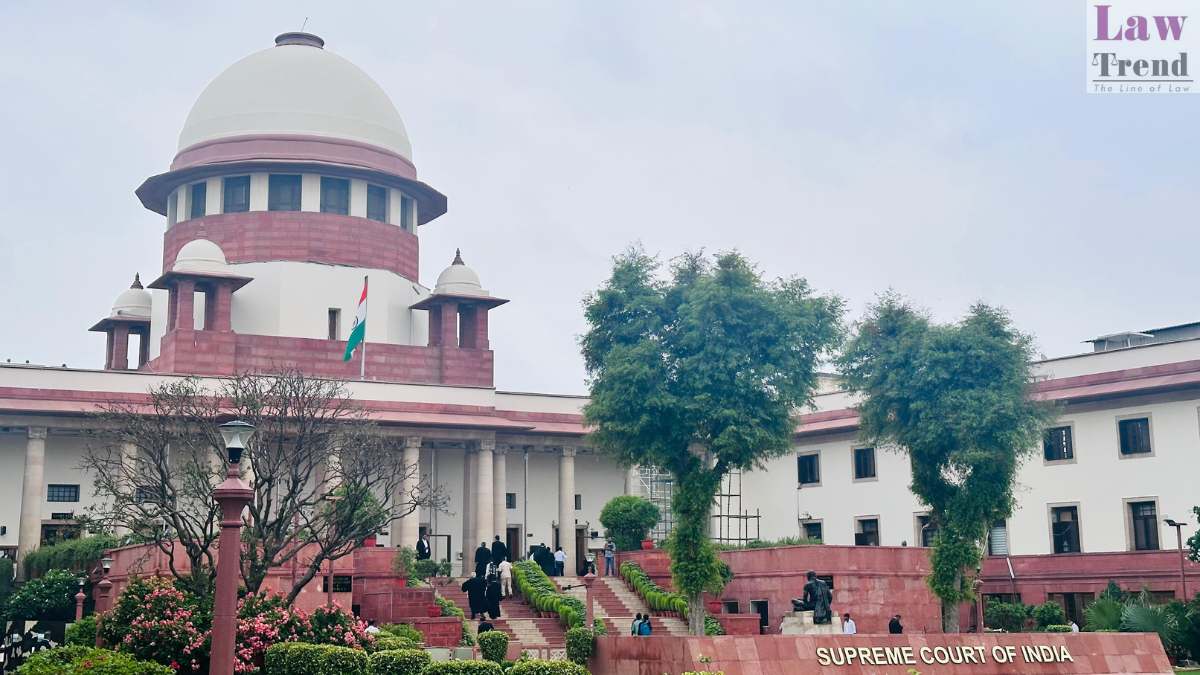
The Supreme Court on Wednesday announced its decision to constitute an expert committee to comprehensively examine mining-related issues in the ecologically sensitive Aravalli range, warning that illegal mining poses a risk of irreversible environmental damage.
A bench comprising Chief Justice Surya Kant, Justice Joymalya Bagchi, and Justice Vipul M Pancholi said the proposed committee would include domain experts and scientists with knowledge of mining, geology, and environmental conservation. It directed Additional Solicitor General Aishwarya Bhati and amicus curiae K Parameshwar to submit a list of names within four weeks, so that the expert body can be finalised.
“The committee will work under the direction and supervision of this court,” the bench clarified.
The top court’s latest order comes in the backdrop of a broader suo motu matter titled In Re: Definition of Aravalli Hills and Ranges and Ancillary Issues, where it is examining the implications of a uniform definition for the Aravalli Hills adopted last year. The case has drawn significant attention due to fears that the new criteria might dilute environmental safeguards and open up protected areas to exploitation.
On November 20, 2023, the court had accepted a uniform definition of the Aravalli Hills and banned the grant of fresh mining leases across Aravalli-covered regions in Delhi, Haryana, Rajasthan, and Gujarat until further expert assessments were completed.
That definition, based on recommendations from a committee of the Ministry of Environment, Forest and Climate Change (MoEFCC), described “Aravalli Hill” as any landform in designated Aravalli districts with an elevation of at least 100 metres above local relief, and “Aravalli Range” as a cluster of at least two such hills within 500 metres of each other.
However, environmentalists and civil society groups raised alarms that applying these cutoffs might strip large swathes of the range from protected status.
Acknowledging these concerns, the Supreme Court on December 29, 2025, had put its earlier directions in abeyance to allow for further deliberation on “critical ambiguities” — particularly whether the 100-metre elevation and 500-metre proximity rules were sufficient to protect the region’s ecological integrity.
On Wednesday, the court extended that stay and moved ahead with plans to create a scientific oversight mechanism.
During the proceedings, it was brought to the court’s attention that illegal mining continues in scattered areas. The court recorded an assurance from Additional Solicitor General K M Nataraj, representing the Rajasthan government, that all such unauthorised mining would be halted immediately.
The Aravalli range, considered one of the oldest fold mountain systems in the world, plays a vital role in controlling desertification, preserving biodiversity, and maintaining groundwater levels across northwestern India. Rampant illegal mining in recent decades has severely degraded large portions of the range, especially in Rajasthan and Haryana.
With the expert committee now in the pipeline, the apex court has signalled a more cautious and evidence-driven approach to balancing environmental protection with development concerns in this sensitive region.