

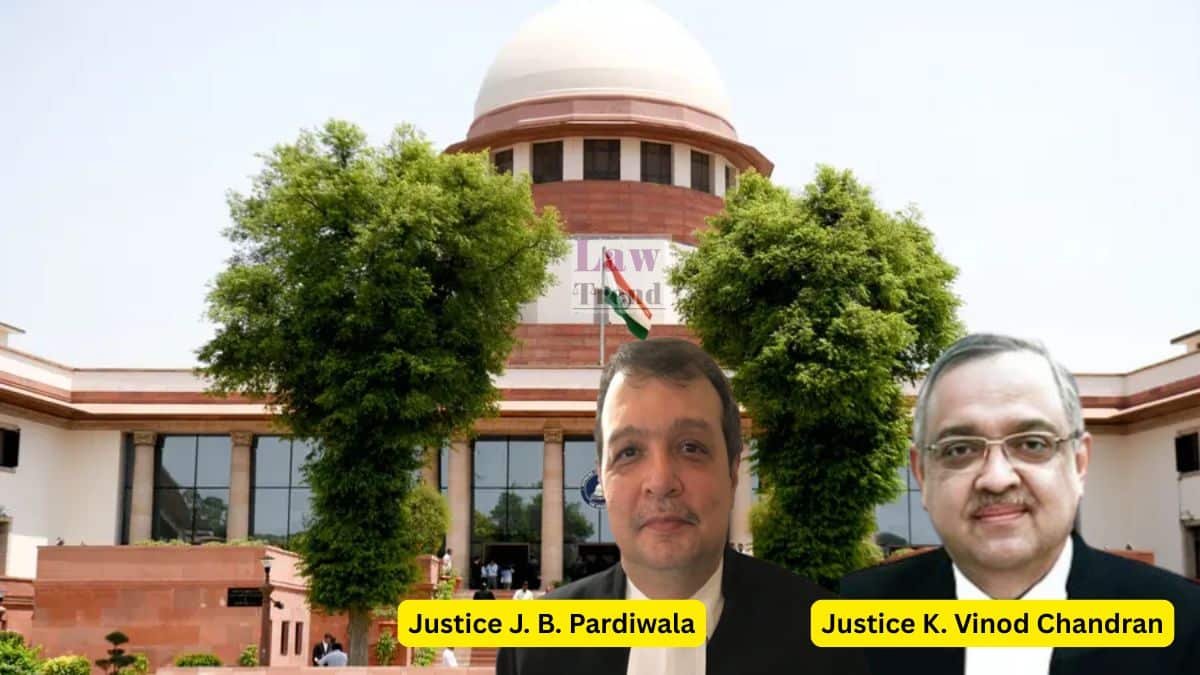
The Supreme Court has struck down the Karnataka Civil Services (Validation of Selection and Appointment of 2011 Batch Gazetted Probationers) Act, 2022 as unconstitutional. It held that the legislature cannot annul the cancellation of a recruitment that had been upheld by the High Court and the Supreme Court.
A Bench of Justice J.B. Pardiwala and Justice K. Vinod Chandran held that appointments made under the tainted 2011 recruitment will come to an end. It directed the State to hold a fresh recruitment with a one-time age relaxation for certain candidates.
The Court opened the judgment with the line: “When the winds of politics change direction, it is the common man, who gets caught in the storm”.
Background
On 03.11.2011, the Karnataka Government notified recruitment to 362 Group ‘A’ and ‘B’ posts. Of the 1,38,307 applicants, 1,090 were called for interview. In 2013, acting on a complaint, the State withheld the final select list and handed the matter to the State CID. The inquiry revealed gross manipulation, rampant corruption and blatant nepotism by Karnataka Public Service Commission officials, and the entire recruitment was cancelled.
The Karnataka Administrative Tribunal quashed the cancellation, but the High Court affirmed it in PILs filed by aggrieved candidates, including the appellants. The Supreme Court upheld this in Avinash C. v. State of Karnataka. A later attempt to resume the process from the written examination stage was rejected by the High Court, and challenges to that order also failed before the Supreme Court.
In 2022, the State enacted the validation law. Of the 362 selected candidates, 46 were found tainted; 191 were appointed under the Act, 14 of them tainted. The High Court dismissed a challenge to the Act on 21.04.2022, and on 23.08.2022 it upheld the Tribunal’s refusal of interim relief in the appellants’ separate challenge. Both orders were taken up before the Supreme Court.
Arguments
Senior Counsel Shyam Divan, for the appellants, argued that the Act effectively nullified the Supreme Court’s decision. He submitted that a legislature cannot sit in appeal over a judgment of a High Court or the Supreme Court.
Senior Counsel Kapil Sibal, appearing for the State, candidly submitted that the legislation could not be supported at all. Senior Counsel C.A. Sundram and Anand Sanjay M. Nuli, for the selected candidates, sought to sustain the law and pressed their case on equity. They argued that no candidate was named in the FIR or chargesheet, and that the State had since changed its stance.
Court’s Findings
The Court noted that the 2011 recruitment was set aside not for a mere defect but for corruption and nepotism vitiating the entire selection. It held:
“There could be no equity, insofar as the selected candidates are concerned, especially the selection being based on a recruitment which is declared as tainted by the Constitutional Courts and the appointment having been effectuated based on a stillborn legislation; the Act of 2022.”
Relying on Medical Council of India v. State of Kerala, along with Janapada Sabha, Chhindwara, In re: Cauvery Water Disputes Tribunal and S.T. Sadiq v. State of Kerala, the Court said a legislature may alter the basis of a decision but cannot directly annul a final judgment. With the cancellation already upheld by the High Court and the Supreme Court, it held that “the power does not lie with the legislature to annul the cancellation, even by a legislation and thus nullify the judgments of the Constitutional Courts.”
The Bench rejected the plea to segregate tainted and untainted candidates, noting that the entire selection was cancelled and the appointments rested only on the unconstitutional Act. It also criticised the High Court’s orders, which it said were dealt with cursorily, observing:
“We cannot but record, a little bit of surprise and a lot more alarm, insofar as the impugned judgments are concerned.”
Outcome
The Court set aside the Act and the impugned High Court orders. It allowed the PIL, transposing the appellants as petitioners. Citing the passage of a decade and a half, it declined to resume the old selection.
Instead, it directed the State to notify recruitment for the vacant Group ‘A’ and ‘B’ posts under the existing rules. A one-time age relaxation will apply to the appointed candidates not found tainted, the six appellants and the petitioners before the Tribunal. If selected, their seniority will run only from the date of fresh appointment, with no back wages or notional appointment. For those currently in service who are selected again, their earlier service will count towards pension and retirement benefits.
The appeals were allowed, and all applications for impleadment and intervention were rejected.
Case Title: Srinivasa T. & Ors. v. The State of Karnataka and Ors.
Case No.: Civil Appeals arising out of SLP (C) Nos. 21195-21196 of 2023
Bench: Justice J.B. Pardiwala and Justice K. Vinod Chandran
Date: 29.10.2026


