

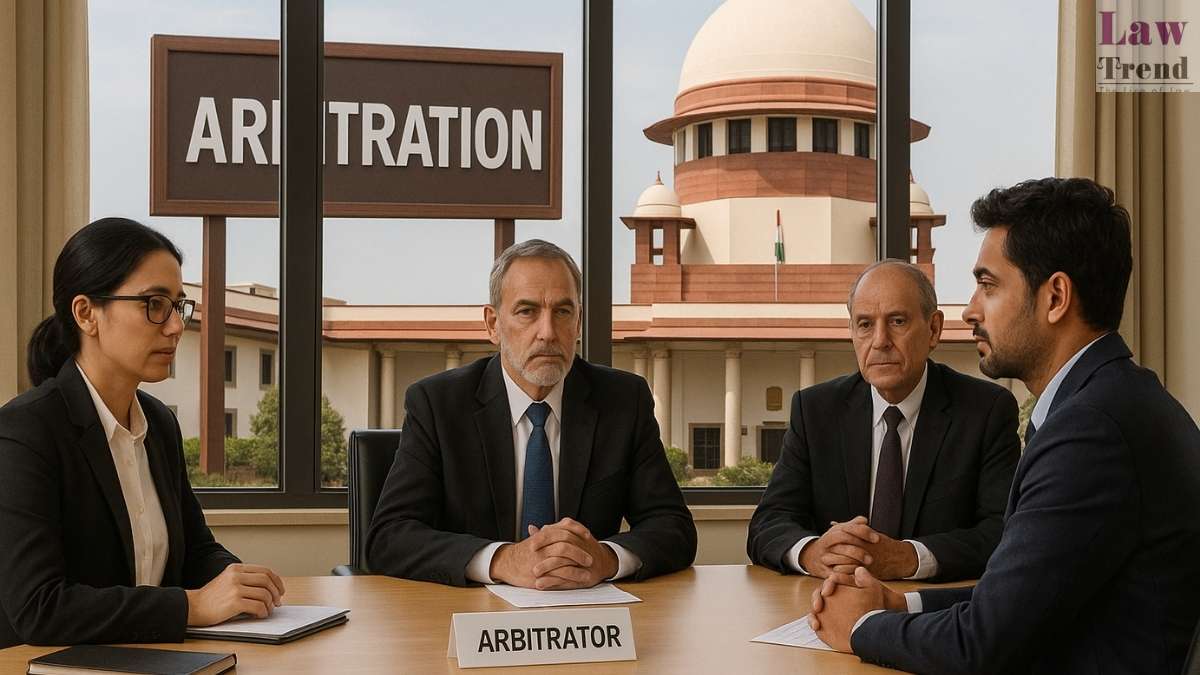
The Supreme Court has held that an arbitral tribunal cannot rewrite the terms of a contract while granting specific performance, as this violates Section 28(3) of the Arbitration and Conciliation Act, 1996. It upheld the Bombay High Court’s decision setting aside an arbitral award in a dispute over land at Village Panchpakhadi, Thane.
A Bench of Justice Sanjay Kumar and Justice Sanjeev Sachdeva found that the majority award had supplanted the agreed terms with its own. However, invoking Article 142 of the Constitution, the Court directed the landowners to refund the amounts received with 9% interest.
Background
On 06.08.2003, Upendra Kantilal Thanawala and four family members executed an “Agreement for Development” with Shreeram Builders and its partners for their undivided 2/9th share in the land. The consideration was fixed at ₹915 per square foot on a projected Floor Space Index of 25,000 square feet, totalling ₹2,28,75,000. The landowners terminated the agreement by notice dated 09.04.2008.
The dispute went to a three-member tribunal. On 10.12.2011, the majority, comprising umpire Justice S.D. Pandit (retired) and P.S. Mudholkar, held the termination illegal and granted specific performance. It raised the rate to six times the agreed price, ₹5,490 per square foot, and directed the builder to deposit ₹10,91,30,164 for a sale deed. It also awarded alternative damages of ₹23,21,19,892 if specific performance was set aside. V.P. Patil dissented.
The Principal District Judge, Thane, upheld the majority award under Section 34 on 25.01.2020. On 05.03.2024, the Bombay High Court set it aside under Section 37, and the builder appealed.
Before the Supreme Court, the appellant said it had paid about 82% of the agreed consideration, deposited the balance in 2017, and was willing to pay the enhanced amount of ₹13,72,75,000 fixed in the award.
Court’s Findings
Relying on Gayatri Balasamy v. ISG Novasoft Technologies, the Court said the High Court’s power under Section 37 is as broad as that under Section 34. It applied the unamended Section 34, since both challenges were filed before 23.10.2015.
On the nature of the agreement, the Bench said that neither its title nor the 1% stamp duty paid was decisive, citing Sasan Power Limited. However, it held that labelling the agreement was not essential, since the contract laid down a binding sequence of obligations. The Court observed:
“The fundamental error writ large in the majority award is that it dealt with the matter as if it was a regular suit for specific performance of an agreement to sell and not as an arbitration arising out of a contract that visited obligations upon the parties thereto with a binding sequence as to how they were to perform their respective parts.”
The Court found that the full consideration due by 01.03.2008 was never paid. It also noted that the price remained open to change because of FSI revisions, additional land and basements. Under the agreement, the conveyance deed was to follow only after all amounts were paid. The Bench held:
“Even if the award, on the analysis undertaken, proceeded on the premise that the subject agreement was an agreement to sell and was not just for development, it was not for the two learned arbitrators to rewrite its terms.”
The Court listed further flaws in the majority award:
- It brought part of the property expressly excluded from the agreement into the conveyance, affecting co-owners who were not before the tribunal.
- It adjusted payments made under an earlier MoU, which had been superseded by the agreement.
- It adopted six times the agreed rate without any computation or reasoning.
On the six-times rate, the Court said the direction was “completely beyond the scope of the agreement and defied logic.”
The Court also held that the agreement provided for no damages, and that granting damages as an alternative to specific performance was opposed to public policy, as the High Court had rightly noted. It concluded that the arbitrators had “completely supplanted them with new terms, as per their own fancies.”
Refund Under Article 142
The Court noted that under Clause 54 of the agreement, the landowners had to return the consideration when they terminated it, since no construction had taken place on their share. Instead, they had kept the money.
To do complete justice and avoid a fresh round of litigation, it directed them to refund all amounts received with simple interest at 9% per annum, from the date of each payment until refund. The appellant’s deposits with the courts are also to be returned with any accrued interest.
Outcome
The appeals were disposed of on these terms, with the parties bearing their own costs.
Case Title: Shreeram Builders v. Upendra Kantilal Thanawala and others
Case No.: Civil Appeal Nos. 9817-9818 of 2024
Bench: Justice Sanjay Kumar and Justice Sanjeev Sachdeva
Date: 29.10.2026


