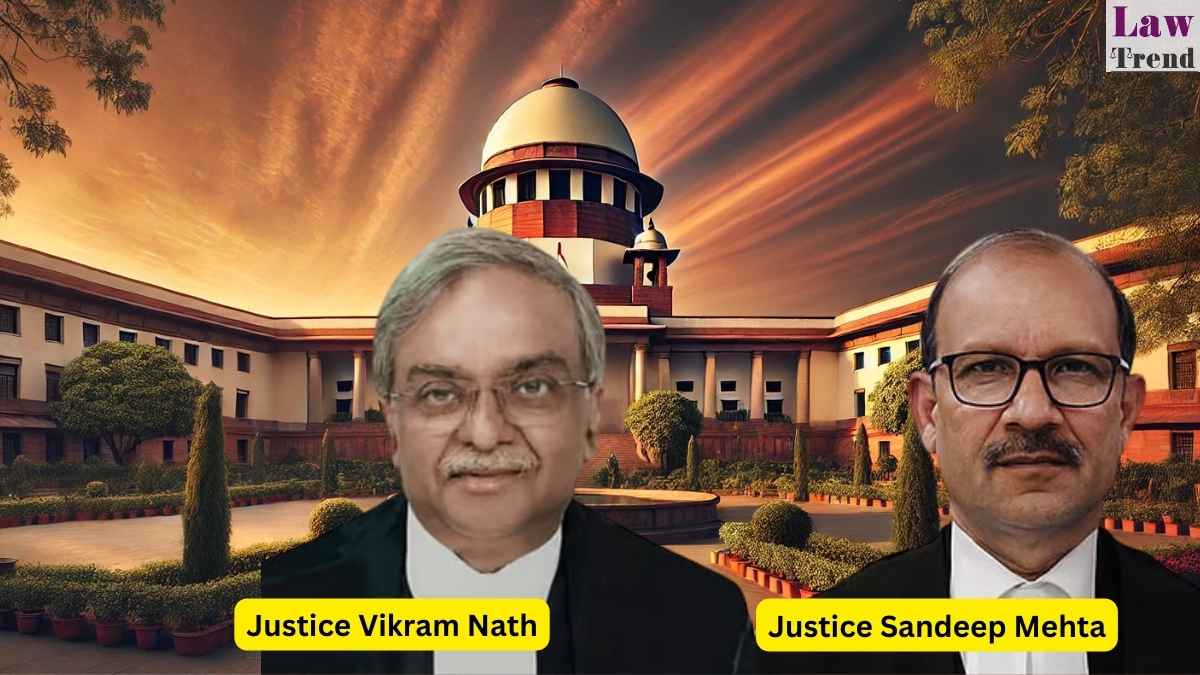
The Supreme Court of India has declared the Srimati Radhika Sinha Institute and Sachchidanand Sinha Library (Requisition & Management) Act, 2015 unconstitutional, striking down the Bihar government’s attempt to compulsorily acquire the century-old institution.
A Bench comprising Justice Vikram Nath and Justice Sandeep Mehta, in a judgment dated March 10, 2026, held that the Act was “manifestly arbitrary” and violative of Article 14 and Article 300A of the Constitution. The Court ordered the immediate restoration of the Trust’s management and rights.
Background of the Case
The Smt. Radhika Sinha Institute and Sachchidanand Sinha Library were established in 1924 by Shri Sachchidanand Sinha, the first President of the Constituent Assembly (interim), in memory of his wife. Funded by the sale of ancestral property, the institution was governed by a formal Deed of Trust executed in 1926. The Deed stipulated that the eldest male member of the family would serve as the Honorary Secretary and Chief Executive Officer.
In 1955, an agreement with the State Government accorded it the status of a “State Central Library,” while maintaining that control remained with the Trustees. After a failed attempt to acquire the library via ordinances in 1983 (which the Supreme Court set aside in 1996), the Bihar Legislature enacted the 2015 Act to take over the institution for “better management.” The appellant, Anurag Krishna Sinha (great-grandson of the settlor), challenged the Act after the Patna High Court upheld its validity in February 2024.
Arguments of the Parties
Appellant: Senior Advocate Sunil Kumar argued that the Act was an exercise of legislative power over a private trust, which is a field occupied by the Indian Trusts Act, 1882. He contended the Act was confiscatory, providing only a “maximum of one rupee” as compensation, thus violating Article 300A. He further stated there were no allegations of mismanagement to justify such a “drastic” takeover.
Respondent (State of Bihar): Senior Advocate Ranjit Kumar argued that the Trust was a “Public Trust” and therefore the Indian Trusts Act did not apply. He contended the takeover was necessary for “better management, development, and preservation” of the library’s heritage, noting that the State had sanctioned over ₹72 crores for its rejuvenation post-enactment.
The Court’s Analysis
The Supreme Court rejected the Patna High Court’s finding that the institution was a “Public Trust,” noting that the legal character depends on the structure of the trust and rights reserved by the Settlor. More importantly, the Bench emphasized that even if it were a public trust, the Act failed the test of Article 14.
On Manifest Arbitrariness: The Court observed that “manifest arbitrariness” is a firm substantive constitutional limitation on legislative power. It cited several precedents including Shayara Bano v. Union of India and Ajay Hasia v. Khalid Mujib Sehravardi.
The Bench noted:
“The cumulative effect of these provisions is not regulatory supervision, but total displacement of a legal and institutional framework that has governed the Institute & Library for nearly a century.”
The Court found a “telling gap” in the records, noting there was not a single communication from the State alleging mismanagement before the Act was passed. Furthermore, since the State Librarian was the ex-officio Chief Librarian, the State could not cite mismanagement as a justification when it failed to act against its own appointee.
On Proportionality and Compensation: The Bench held that the State’s objective of investment and development could have been achieved through “far less drastic means” such as grants-in-aid or audits.
“That the legislature chose the most extreme measure available, when less invasive alternatives were plainly at hand, is itself a manifestation of the arbitrariness that the impugned Act discloses.”
Regarding Section 7, which limited compensation to one rupee, the Court stated:
“A statutory provision that enables acquisition of property while reducing compensation to a token amount lacks the basic attributes of fairness.”
The Decision
The Supreme Court set aside the Patna High Court judgment and struck down the 2015 Act. The Court ruled:
- The Act is declared unconstitutional and struck down.
- The Trust’s rights of management and administration are restored to their pre-2015 position.
- The State is not precluded from providing financial assistance or regulatory oversight in accordance with the law.
- Case Title: Anurag Krishna Sinha v. State of Bihar & Anr.
- Civil Appeal No.: 13581 of 2025