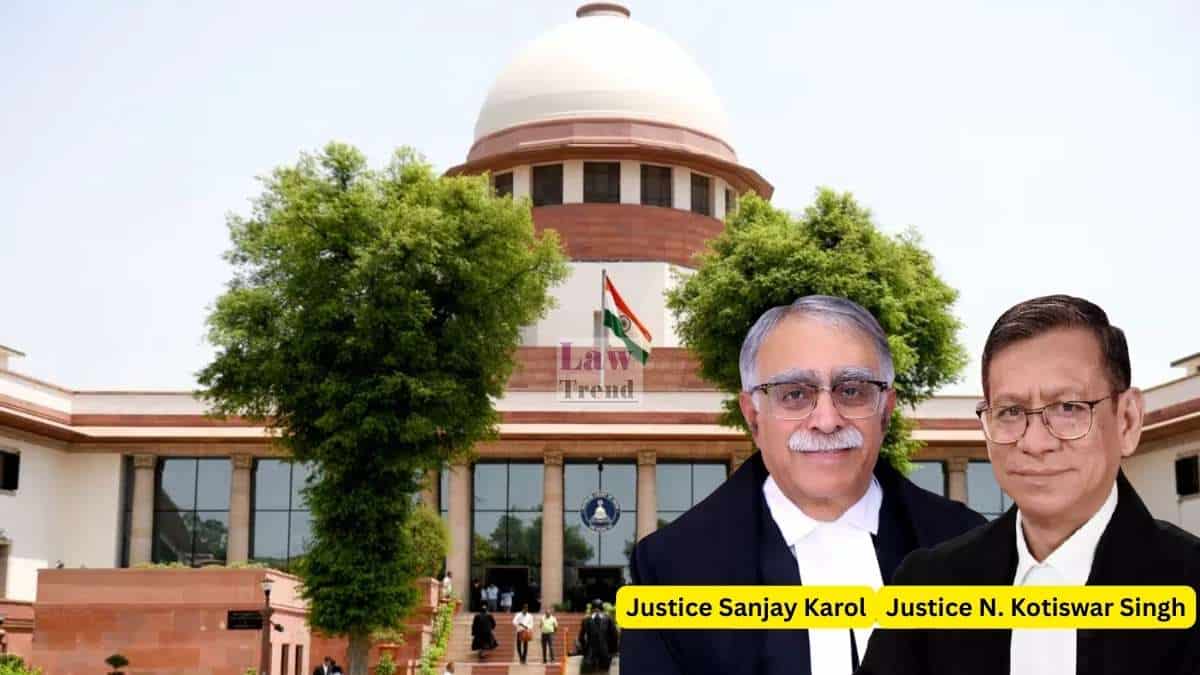
The Supreme Court has set aside the orders of the Allahabad High Court that had directed the completion of an investigation within a fixed timeline and granted protection from arrest to accused persons till the taking of cognizance, despite refusing to quash the First Information Report (FIR) against them.
The Bench, comprising Justice Sanjay Karol and Justice Nongmeikapam Kotiswar Singh, allowed the appeals filed by the State of Uttar Pradesh, observing that the High Court’s directions were contrary to the law laid down in Neeharika Infrastructure Pvt. Ltd. v. State of Maharashtra. The Court held that “timelines are imposed reactively and not prophylactically” and that blanket protection from arrest while declining to quash criminal proceedings is legally unacceptable.
Background of the Case
The case stems from an investigation initiated by the Senior Superintendent of Police, STF Headquarters, Lucknow, following an anonymous petition. A statutory complaint dated July 31, 2024, alleged that several individuals had procured and used arms licenses by submitting forged documents and false affidavits.
Based on an inquiry report dated January 31, 2025, an FIR (Case Crime No. 33 of 2025) was registered on May 24, 2025, at Police Station Nai Ki Mandi, District Agra, under Sections 420, 467, 468, and 471 of the Indian Penal Code (IPC) and Sections 3/25/30 of the Arms Act, 1959.
The allegations against the three respondents were as follows:
- Muhammad Zaid Khan: Allegedly obtained arms licence number 1227/03 using forged documents showing his date of birth as November 25, 1975, whereas his actual date of birth was found to be November 25, 1972.
- Mohd. Arshad Khan: Accused of procuring five arms licences using forged PAN cards, Aadhaar cards, and driving licences. The investigation revealed he altered his date of birth from 1988 to 1985 to project himself as a skilled marksman and enable the import of arms.
- Sanjay @ Sanjay Kapoor: A former Arms Clerk in the office of the Additional District Magistrate, Agra, accused of being involved in acts relating to forgery and concealment of material facts along with the licence holders.
High Court Proceedings
The accused approached the Allahabad High Court under Article 226 of the Constitution seeking the quashing of the FIR. By orders dated July 4, 2025, and June 16, 2025, the High Court disposed of the petitions without quashing the FIR. However, relying on a Division Bench judgment in Shobhit Nehra v. State of U.P., the High Court directed that:
- The investigating officer must complete the investigation within 90 days.
- The accused shall not be arrested till the concerned court takes cognizance of the matter.
The Arguments
The State of Uttar Pradesh appealed to the Supreme Court, arguing that the protection from arrest was contrary to the law laid down in Neeharika Infrastructure Pvt. Ltd. v. State of Maharashtra. The State also contended that the imposition of timelines was unjustified as it risked prejudicing the investigation of a serious offence and that the reliance on Shobhit Nehra was misplaced without reference to the specific facts of the case.
Court’s Analysis
The Supreme Court examined two primary questions: the validity of directing a time-bound investigation and the grant of protection from arrest while refusing to quash the FIR.
On Time-Bound Investigation
The Court observed that while a speedy trial and diligent investigation are integral to Article 21 of the Constitution, directing a time-bound investigation must remain an “exception rather than the norm.”
Justice Sanjay Karol, writing for the Bench, noted that investigation is a process full of “twists, turns and recalibrations.” The Court stated:
“The necessary conclusion to be drawn… is that timelines are not drawn by the Court to be followed by the investigators/the executive right from the beginning, for that would clearly amount to stepping on the toes of the latter. Timelines are therefore imposed at a point where not doing so would have adverse consequences i.e., there is material on record demonstrating undue delays, stagnation, or the like. In sum, timelines are imposed reactively and not prophylactically.”
The Court held that the High Court’s imposition of a timeline in this case needed to be set aside.
On Protection from Arrest
Regarding the protection from arrest till cognizance is taken, the Supreme Court held that the High Court fell into error. The Court criticized the mechanical reliance on the Shobhit Nehra judgment, noting that Shobhit Nehra involved a long-standing family and civil dispute, which was factually distinct from the present case involving allegations of forgery for arms licenses.
The Bench cited the Earl of Halsbury LC in Quinn v. Leathem to emphasize that judgments must be read as applicable to the particular facts proved.
Referring to the three-judge Bench decision in Neeharika Infrastructure Pvt. Ltd. v. State of Maharashtra, the Court reiterated that it is “absolutely inconceivable and unthinkable to pass an order directing the police not to arrest till the investigation is completed while declining to interfere or expressing opinion that it is not appropriate to stay the investigation.”
The Court observed:
“The text of the order in no way provides or attempts to provide, as in Shobhit Nehra (supra), any justification for granting protection from arrest despite the position of law laid down in Neeharika (supra).”
Decision
The Supreme Court allowed the State’s appeals and set aside the conditions imposed by the High Court regarding the time-bound investigation and protection from arrest.
However, the Court directed that the interim protection in favor of the respondents shall continue to operate for the next two weeks, after which “all actions as permissible in law will follow.”
Case Details:
Case Title: State of U.P. & Anr. v. Mohd. Arshad Khan & Anr. (and connected appeals)
Case No.: Criminal Appeal No. 5610 of 2025
Coram: Justice Sanjay Karol and Justice Nongmeikapam Kotiswar Singh
Citation: 2025 INSC 1480